Article
Underwater treasure: some problems of the legal regime of sunken property in Russian, English and US law
Attendee of the Master’s programme “Comparative and Private International Law” (University of Manchester / MSSES), Senior Legal Counsel at KFC (UNIREST LLC)
The article deals with the legal regime of sunken property in law of Russia, England, and the USA, as well as in international unifications. The author examines (1) the relationship between the ownership of wrecked property and the salvors’ and finders’ rights with respect to commercial and warship wrecks, the warships’ sovereign immunity regime, (2) the principle mare liberum and the extension of the rights of coastal states with respect to property sunk within their jurisdictions, (3) the sovereign immunity principle for warships and the international cultural and scientific community interests in research and conservation of the underwater heritage.
Keywords: international maritime law, warship, commercial vessel, ownership, salvage and finding, coastal state, sovereign immunity, liability for damage caused by wrecks, UNCLOS, 2007 Nairobi Convention, 2001 UNESCO Convention.
The legal regulation of wrecks and their cargoes has gained relevance since the middle of the twentieth century. This is due to several circumstances.
Firstly, the invention of scuba diving, which made it possible for people to dive to great depths. This has made sunken treasures from centuries ago, such as the treasures of the Great Armada, as well as less ancient but no less valuable cargoes of gold and silver sunk in the 20th century, including during both World Wars, available for search, research and recovery. This fact has made extremely relevant the problems of relations between ownership of sunken property and the rights of coastal states in whose waters the wrecks’ cargo is located, as well as the scope of rights of companies searching and “salvaging” the sunken treasures, especially taking into account that, according to some estimations, the total value of sunken treasures buried at the sea and oceans bottoms is $600 billion.
Initially, the search for and recovery of sunken treasures was predominantly commercial in nature and was most developed in the USA. Salvage vessels flying their flags and in particular those of Odyssey Marine Exploration1, play the most active role in the search for underwater treasure in international waters.2 It is important to note that both in the Age of Discovery and in the twentieth century cargoes of gold, silver and precious stones were most often transported by warships that belonged to the state or had the status of state warships. It is sufficient to say that throughout the sixteenth and seventeenth centuries in Spain there was a state monopoly on any maritime traffic from the American colonies. Accordingly, any vessel crossing the Atlantic with a cargo of treasure from South America was in the service of the Spanish crown and performed a public function.3 As a result, the interests of private searching companies confronted by those of states claiming ownership of wrecks and their cargoes. The practice that began to emerge showed that ownership, including state ownership, of the ship and cargo was not a sufficiently strong defence against finders and salvors.
As a result, the concept of state sovereignty has been used to protect the interests of the public owner of warships, whereby neither coastal states nor finders/salvors can act on sunken warships without the permission of the flag state.
Secondly, with the development of diesel engines, shipwrecks have become a threat to maritime safety and the environment, making the responsibility of the owner of the wreck for its removal and/or decontamination relevant.
Thirdly, the intense activity of sea treasure hunters, aiming at the commercial search and recovery of artefacts without recording, recording and preserving information of historical, archaeological and cultural importance, has led to the realization of the need for international regulation of issues related to the preservation of underwater cultural heritage. Heritage assets sunk many decades, or even hundreds of years ago, cease to be, in effect, movable objects in their own right and become part of the seabed landscape. It is increasingly thought that the gross destruction of shipwrecks for the purpose of collecting a variety of artefacts leads to the loss of the underwater cultural heritage of mankind.
The above aspects of the international legal regulation of sunken property will be the subject of this article.
The author uses the story of the sinking of the cruiser Edinburgh during World War II and the subsequent salvage of the cargo of gold aboard the Edinburgh 40 years later to illustrate the problematic issues of the legal regime of sunken property.4
Crash
In 1942, the British cruiser Edinburgh left Murmansk with a cargo of gold (465 bars weighing about 5.5 tonnes in total) intended to pay for US supplies under the Lend-Lease Agreement concluded between the USSR, the USA and Great Britain. The cargo of gold transported on “Edinburgh” was insured by USSR Gosstrakh against transport and war risks for the total amount of USD 6,227,000 (at present exchange rate – about USD 114 million) and was 1/3 reinsured by the British Government Bureau of War Risks Insurance.
As the ship moved some 200 nautical miles away from the port of Murmansk, she was torpedoed by a German submarine. After the attack, the crew and escort ships (British destroyers and a Soviet patrol ship) were unable to tow the Edinburgh back to Murmansk, and the damaged cruiser had to be sunk. The crew moved to the British destroyers, the boxes of gold could not be salvaged.
In 1944 Gosstrakh paid the insurance sum (6 227 000) for the lost cargo to the USSR Gosbank, which paid the US, and Gosstrakh in turn received about 2 million US dollars (£500 000) from the British Bureau, with the result that rights to the sunken treasures were transferred to the USSR Gosstrakh and the British Bureau. In 1948, the rights to the bullion were transferred to Ingosstrakh – the Foreign Insurance Office of the USSR, which had spun off from Gosstrakh in 1947.
Death or temporary loss?
At the time of the Edinburgh’s wreck and the payment of the insurance claim, the ship and its cargo lying 260 metres below the bottom of the Barents Sea were considered to be irretrievably lost. However, almost at the same time as the loss of the Edinburgh, a discovery was made that changed attitudes towards the deep-sea wreck and its legal status. In 1942-43, Jacques-Yves Cousteau and Emile Gagnan invented an automatic submersible breathing apparatus, powered by compressed air, that allowed divers to descend to the remains of underwater objects located at depths of up to 300 m.5 This made it possible to dive to great depths, so that treasures sunk decades or even hundreds of years ago were not lost forever, but could be searched for, explored and recovered. This has made questions of ownership of the wreck extremely relevant.
The significance of a shipwreck site
What happens to the property rights of shipowners and cargo owners if they do not take measures to search for and salvage wrecks themselves? Can coastal states raise and claim ownership of shipwrecks and cargo wrecks in their waters on their own? What happens to the rights to property sunk on the high seas?
Until the Second World War, the international law of the sea was dominated by the principle of maximum freedom of use of the oceans and seas by all states, and the sovereign rights of coastal states were limited to 3 nautical miles (the distance of a cannon shot). The emergence of the principle of freedom of use of the sea is associated with the publication of Hugo Grotius’ Mare Liberum in 1609, which was a response to the concept of division of spheres of influence in the world, including on the seas (mare clausum), enshrined in the Treaty of Tordesillas between Spain and Portugal in 1494.6 The principle of free use of the sea meant, above all, freedom of navigation and fishing. The seabed was practically inaccessible to man and therefore there was no need for legal regulation of its use.
However, the rapid development and perfection of equipment for underwater exploration in the mid-twentieth century, not least due to the development of underwater radio technology (sonar, radar) needed to counter German submarines, has greatly expanded human opportunities in seabed exploration, leading to the need to reconsider the established balance of principles mare liberum and mare clausum. The results of this revision are reflected in the 1982 UN Convention on the Law of the Sea (UNCLOS)7, the basis of the international law of the sea, in the form of the establishment of maritime zones.
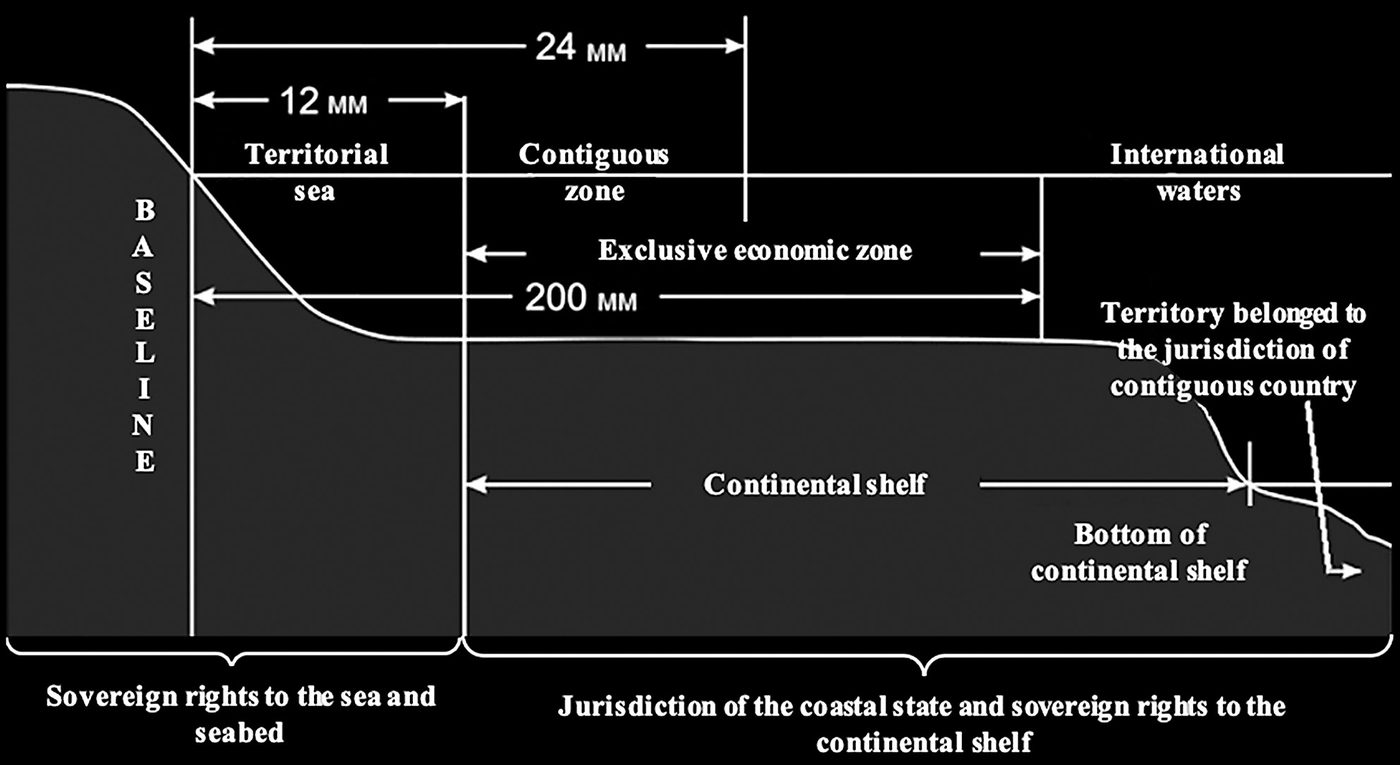
According to UNCLOS, the seabed, subsoil and resources of the oceans and seas outside internal and archipelagic waters, the territorial sea and the continental shelf, referred to as the Area, are beyond national jurisdiction and are the common heritage of mankind (Article 136). No State may claim or exercise sovereignty or sovereign rights over any part of the Area or its resources, nor may any State, person or entity appropriate any part thereof. Accordingly, search and salvage work in the Area does not require any authorization. Under article 417 of the MSC RF, the law of the vessel’s flag applies to vessels wrecked on the high seas and the cargoes onboard.
With respect to the seabed within the territorial sea, the coastal state has sovereign rights. Therefore, in the internal waters, archipelagic waters and the territorial sea, the lifting of a vessel or its cargo requires permission from the coastal state. As will be described in more detail below, after a certain amount of time (usually 100 years), during which the wreck is within sovereign waters, the property passes into the possession of the coastal state. Under Article 417 of the MSC RF, the rights to property sunk in the territorial sea are determined by the law of the state where the property is sunk.
Scheme of maritime zones according to UNCLOS8
In the contiguous zone and on the continental shelf, ship-lifting activities require compliance with sanitary, environmental and other regulations arising from the national law of the coastal state. At the same time, the coastal state cannot claim to lift the wreck on its own and/or acquire ownership over it. For the first time in international maritime unifications, the right to recover wrecks outside the territorial sea, namely in the exclusive economic zone, was provided for in the Nairobi Convention on the Removal of Wrecks of 2007. It may be executed in case the wreck constitutes a danger to navigation or the marine environment and the shipowner refuses to remove the wreck and/or remove the source of danger.
Treasure or danger?
Shipwrecks are not only treasures in a material and cultural sense, but also an immense danger, which can be caused by large quantities of bunker fuel, hazardous cargo (oil and oil products, chemicals) or different kinds of weapons leaking out, which may be catastrophic.
What should be done if the owner of the vessel does not take actions to eliminate the hazard? If the wreck is located within internal or territorial waters, the coastal State may, in accordance with national law, oblige the shipowner to lift or otherwise prevent the damage and/or danger caused by the wreck. If the shipowner evades this obligation, the coastal State may itself remove the hazard and then seek to recover damages and costs from the defective shipowner. However, until relatively recently, the issue of the removal of wrecks that have sunk in the exclusive economic zone and constitute a hazard to shipping and/or the environment remained unresolved. This state of affairs led to the adoption in 2007 of the Nairobi Convention on the Removal of Wrecks9 , which marked a further shift in the balance towards strengthening the mare clausum principle by expanding the rights of the Coastal State in respect of ships sunken in its Exclusive Economic Zone.
The Convention grants the coastal state the right to require the master of a vessel in distress to report, inter alia, the exact location of the wreck and the nature and quantity of the cargo onboard (Art. 5 par. 2). Furthermore, if the coastal state has reason to believe that a shipwreck constitutes a danger, it shall ensure that all practicable measures are taken to ascertain the exact location of the wreck (Art. 7, par. 2).
If the shipowner fails to take action to raise the wreck, the coastal State may remove the wreck by the most practical and expeditious means available, taking into account safety and protection of the marine environment (Art. 9 par. 7), and then recover the costs incurred from the shipowner (Art. 10). In order to ensure the right of the coastal State to recover the costs of the removal of the wreck, the Convention provides for compulsory insurance or other financial security in an amount equal to the limit of the shipowner’s liability in respect of the costs of the wreck removal, subject to the limits laid down in international treaties (Art. 12).
Due to Russia’s ratification of the Nairobi Convention10, Chapter VII of the MSC RF, which regulates relations connected with the sunken property, was amended and its application was extended to the Russian exclusive economic zone.
The new version of the MSC RF stipulates that if the shipowner fails to take measures to remove sunken property, i.e. remove it from the water, carry it in any safe way and destroy it or run aground (Art. 107 par. 3), within the time limits laid down in the MSC RF, the owner shall lose the title to the vessel (Art. 47 par. 1; Art. 113 par. 1). In such case, the vessel shall be removed from the register upon application of the Harbour Master who received the notice of sinking, without requiring the consent of the shipowner (Art. 113 par. 2). After a wreck has been removed from the register, ownership of the wreck is vested in the subject of the Russian Federation whose coastline the wreck is closest to (Art. 113 par. 3). At the same time, a person who is the owner of a sunken property on the date of its sinking shall be liable for obligations associated with the sunken property prior to its sinking, for obligations arising as a result of the sinking of the property, and for the costs of its removal, regardless of the termination of rights to the sunken property, except where such property is owned by Russia (Art. 113, par. 5).
The rules applicable to accidentally raised sunken property have also changed. They have been aligned with Art. 227 par. 2 of the Civil Code (discovery) and stipulate that a person who has accidentally raised sunken property is obliged to report the accidentally raised property to the police or the local authority without delay. Such person shall be entitled to claim compensation from the owner of the wreck in accordance with civil legislation (i.e. up to 20% of the value of the wreck accidentally raised), but not less than the cost of removal of the wreck.11 At the same time, since after the wreck has been removed from the relevant register, the title of the subject of the Russian Federation arises in relation to it, the finder of the wreck will not be subject to the provisions of Art. 228 of the Civil Code, according to which, under certain conditions, he could acquire title to the wreck.12
The sunken property rules described above under the Nairobi Convention do not apply to the removal of sunken war material, unless the State makes a reservation to this effect. Russia has not made such a reservation, and the MSC RF expressly provides that its Chapter VII shall not apply to warships (Art. 107 par. 4).
The record hot and dry summer of 2022 in Europe brought an unexpected reminder of the problem of the legal status of sunken warships. Near the Serbian village of Prahovo, the hulls of 20 German warships, sunk in 1944 during the retreat of the German navy, surfaced as a result of the shallowing of the Danube. The ships are in relatively good condition and are of historic value, but they also represent a great danger. In addition to impeding navigation during the shoaling, the wrecks contain large quantities of munitions that can still be detonated. The question of removing the wrecks remains open for the time being. According to the Decision of the Potsdam Conference on the Distribution of the German Navy dated 31 July 1945, the entire German surface fleet, excluding the sunken ships, was to be divided between the USSR, Great Britain and the USA13 . In this regard, it can be concluded that the sunken ships remained in German public ownership and enjoyed sovereign immunity. This means that any operation to decontaminate the German ships sunk in Prahova is only possible with German permission. As regards the possibility of applying the Nairobi Convention in this case, it should be noted that Germany, which ratified the convention, did not make a reservation extending the Convention to warships (nor did other member states), Serbia is not a party to the Convention.
Inexhaustible property
Emerging international practice recognises that even after sinking and remaining submerged for extended periods, including within the internal or archipelagic waters or territorial sea of another state, public ownership of warships is retained.
For example, the Spanish State, irrespective of the time elapsed since the wreck, does not consider itself to have renounced or otherwise ceded its ownership or other rights over wrecks that were lost while in the service of the Spanish Kingdom and/or that carried property belonging to the Spanish Crown, or over their contents, except through special actions relating to individual ships or property, carried out through royal decrees or acts of parliament.
Under Art. 4 of the Constitution, the U.S. retains title to a wreck unless title has been abandoned or transferred in a manner determined by Congress. The U.S. recognizes the international legal principle that title to a foreign government ship can only be transferred or alienated under the law of the flag state of that ship. Any time elapsed since the loss of a ship does not exhaust or terminate title to the warship.14
Ownership of a warship can only be relinquished through an explicit and unambiguous declaration by the state. England, for example, has sold many sunken warships. In particular, English ships lost at the Battle of Jutland in 1916 were sold for scrap to a Dutch company.
Salvage
The Edinburgh’s story did not end with her sinking. The emergence of the technical capability to lift a cargo of 5.5 tonnes of gold from a depth of 200–300 metres made the Edinburgh the subject of intense scrutiny both for Britain, as the owner of the cruiser and part of the cargo, and for commercial salvors. The USSR at the time did not have the underwater equipment to operate at the depths at which the Edinburgh sank.
In the 1950s, British ships attempted to pinpoint the wreckage and inspect the remains of the Edinburgh, but because the area of the cruiser’s wreckage was included in the system of training grounds for ships of the Soviet Northern Fleet, a full-scale British search operation could not be conducted.
In the 1960s and 70s, several foreign (British, Dutch, Norwegian) diving companies requested permission from the USSR to carry out search and salvage operations but were refused.
By the early 1980s, it had become apparent that unless Britain and the USSR agreed to search for and recover the Edinburgh’s cargo, the gold would somehow be recovered by one of the commercial salvage companies and would quite likely be permanently lost to its owners.
Therefore, negotiations between the British and Soviet governments began in 1981. As a result of which a tripartite agreement was signed on 6 May 1981 between the British Ministry of Commerce, the USSR Ministry of Finance and the British salvage company Jessop Marine Recoveries Ltd.15 headed by Keith Jessop, to carry out the search for the Edinburgh and the recovery of the sunken gold. It should be noted that Jessop collected all kinds of information about the wreck of Edinburgh for more than ten years and together with the Norwegian company Stolt-Nielsen developed a project to search for Edinburgh, in which about 1 million US dollars were invested. In 1979, Stolt-Nielsen had already applied to the Soviet Embassy in Oslo for a survey to search for ships sunk in the Barents Sea during the Second World War, including the cruiser Edinburgh, but was refused a search.
According to the tripartite agreement, the share due to the salvors was 45% of the cargo to be salvaged; the remaining 55% was to be divided between Great Britain and the USSR in the ratio of 1:2, according to their share in the insurance compensation of the sunken cargo. All costs of the operation were to be borne by Jessop Marine Recoveries Ltd. who undertook to work on a “no cure no pay” basis.
The Edinburgh’s gold salvage operation was an incredible success, with 431 of 465 bars recovered from the cruiser between September and October 1981.
Salvors or pirates?
The business of searching for and recovering sunken treasure has, from its inception, been predominantly commercial in nature. Yet it may seem surprising that the remuneration due to Jessop Marine Recoveries Ltd. was nearly half of the cargo recovered. Nevertheless, a study of further practice in shipwreck treasure recovery operations shows that the commercial terms achieved in the salvage of the Edinburgh’s gold can be considered an unqualified success of the representatives of the British and Soviet governments.
For example, in 2010 the British Government contracted Odyssey Marine Exploration to search for and recover the Gairsoppa , a ship carrying a large cargo of silver that was sunk in 1941 by a German submarine some 500 km off the Irish coast. Like the cargo of the Edinburgh, the cargo of the Gairsoppa was insured against war risks by the British Bureau, which took possession of the cargo after the insurance claim was paid. The silver bars were lifted from a depth of almost 4,700 metres. Under the terms of the contract with Odyssey Marine, the salvors were entitled to 80% of the cargo lifted.
The search for and recovery of wrecks in international waters has, until relatively recently, been governed mainly by the international customary law of salvage. The law of salvage applies to both merchant ships and warships. Its peculiarity is that, in addition to salvage by contract, it provides for extra-contractual salvage. Any vessel in the vicinity of the wreck can come to the aid of those in distress and then claim their expenses and salvage compensation. The salvage claim shall prevail over the claims of other creditors of the shipowner and cargo owners and shall be secured by a lien on the ship and its cargo.
The legal problems arising from the application of salvage law to ancient shipwrecks can be illustrated by the activities of Odyssey Marine, already mentioned above. In 2001, it reported the discovery in international waters of the wreck of the British warship HMS Sussex, allegedly carrying a large cargo of gold coins.16 The British government awarded the salvors an international contract to carry out the search operation, with the proceeds from the sale of the treasures and artefacts recovered from the wreck being shared with them. This has provoked negative public reaction, especially from archaeologists. However, from a legal point of view, the British government’s action seems justified, as the existence of a contract makes the search operation manageable and avoids lengthy court procedures to define the limits of the non-contractual salvor’s claims. Moreover, in this case, the British government was not entitled to interfere with the savage operation. First, the wreck was in international waters and therefore outside British sovereignty. Secondly, the personal statute of the salvage company and the lex flagi of the salvage vessel were foreign law and therefore not subject to the English Wreck Protection Act 1973.17 Thirdly, the valuables recovered from the seabed and brought into the U.S. were subject to the jurisdiction of the U.S. federal courts of admiralty18 which, in disputing claims to recovered marine treasures, are governed by salvage law.19 Although the court would most likely have recognised ownership of the ship’s wreck and cargo to Great Britain, there was a high probability that Odyssey Marine as the finder and salvor would have been awarded a substantial part of the treasure.20 In such a situation, entering into an agreement with a salvage company seemed justified both economically and in terms of safeguarding the archaeological value of the ship.
The modus operandi of marine treasure hunters, as well as the materiality of the claims that can be made by a salvage company, can be illustrated by another example involving Odyssey Marine.21 In 2007 Odyssey Marine carried out a search and lift of a cargo of gold and silver coins in an area of international waters in the Atlantic Ocean, which was given the conventional name of Black Swan. The recovered treasure was transported to Florida, USA. The exact location of the find was not disclosed by salvors, but they claimed that the wreck was found 60km off the UK coast. The company argued that the ship carrying the cargo had not been identified, meaning it was not covered by sovereign immunity and flag state permission for search and salvage operations was not required. The Spanish government has expressed doubts about the veracity of the information about the approximate location of the Black Swan, in their view the find was made in the Gibraltar area. Based on speculation that it was a cargo of Peruvian minted gold and silver coins on the Spanish galleon Nuestra Senora de las Mercedes, which sank in 1804 during a battle with a British fleet, the Spanish government claimed exclusive rights to the property located in the Black Swan. In response to this claim, the Federal Court of Admiralty of Florida, on Odyssey Marine’s application, issued an order protecting confidential information on the coordinates of the Black Swan area, as well as the results of archaeological research and prospecting operations in the area. In addition, Odyssey Marine filed an in rem action against the ship in the Florida Federal Court of Admiralty seeking a maritime lien to secure alternative claims (1) for ownership of the wreck and its cargo or (2) for a salvage fee of 90% of the recovered treasure.22 Odyssey Marine’s actions have received extremely negative reviews, with the Spanish Minister of Culture publicly calling the salvage company “pirates of the twenty-first century”.
A little ahead of time, it should be noted that the U.S. courts, all the way up to the Supreme Court, ultimately rejected Odyssey Marine’s claims and ordered them to return the entire cargo of coins they had recovered to the Spanish government. The Nuestra Senora de las Mercedes case, among other things, raised the issue that the application of salvage and finder’s rights to property sunk several centuries ago contains an inherent contradiction. The right of salvage is only applicable when maritime property is in peril, and yet the claim that a shipwreck sunk many years ago can be considered exposed to the dangers of the sea is highly questionable. Furthermore, common sense requires courts to take into account the degree of preservation of the archaeological, historical or cultural value of the ship and its contents during the search and salvage operation when determining the salvor’s reward, whereas, under strict law, this fact is not to be taken into account.23
Although the ruling against Odyssey Marine in the Nuestra Senora de las Mercedes case seems generally fair, it could have a negative effect on the prospects of finding new underwater treasure. Since the court completely ignored the search and salvage company’s claim for compensation for the costs of searching for and recovering the Mercedes cargo, following the judgment Odyssey Marine focused its activities on deep-sea mineral exploration, arguing that the search for shipwrecks was now too risky an activity whose prospects of commercial benefits did not justify the investment in the search campaign.24 In this regard, it cannot be overlooked that the approach to organising salvage operations used in the recovery of the Edinburgh’s gold, namely entering into an agreement with the flag State of the ship and other interested States and/or private parties, seems more promising than unauthorised commercial operations.
Given this problem, national law in many countries, including common law countries, has rejected the application of salvors’ and finders’ rights to historic shipwrecks, including the UK, Canada, Australia, New Zealand and South Africa. For example, the Irish High Court in In re La Lavia concluded that the wrecks of three Spanish galleons sunk in 1588 ceased to be subject to commercial maritime law and had passed into the realm of archaeological law long before they were discovered in 1985. In Canada, salvage law does not apply to ancient vessels, as they are not threatened by the dangers of the sea. On the contrary, the threat is a salvage operation that could result in the loss of the ship’s historical and archaeological value. The Singapore High Court has recognised that the lifting of wrecks of historic ships cannot be done solely for commercial purposes; the reward for such “salvage” should not be.25
The MSC RF provides that the salvage law do not apply to maritime cultural property of prehistoric, archaeological or historical importance if it is located on the seabed (Art. 337 par. 4, subpar. 3), and salvage services rendered contrary to an express and reasonable prohibition by the owner of the ship in danger shall not entitle to reward (Art. 349).
Immunity of war graves
As the Edinburgh contained the remains of 57 sailors, in 1957, the British government declared the wreck a war grave. This move was not least an attempt to protect the ship and her cargo from treasure hunters.
The status of war graves is not regulated by international treaties, the only source of regulation in this respect being international custom and established practice.
The destruction of a warship and her crew shall constitute a military burial ground on the seabed, the care of which shall be taken by the flag State. A naval war grave shall be subject to the law of the flag State and no State, person or entity shall carry out any search and salvage operations without the agreement of the latter, unless the wreck is a source or threat of pollution of the marine environment and the shipowner is deterred from eliminating the danger.26
If the flag state authorises the lifting of wrecks recognised as a war grave, it must ensure that the work is carried out in such a way as not to disturb the remains of fallen seafarers. In the case of the Edinburgh, Jessop responded to protests from Russian Convoy veterans by assuring the British government that the gold would be raised through a torpedo hole in the starboard side, and all other areas of the cruiser would remain untouched, so that the war grave would not be disturbed.
Immunity of wrecked warships
Since, as shown above, the concept of ownership is not sufficiently effective against treasure hunters, the concept of state sovereignty has been used to protect the interests of the public owner of warships, according to which neither coastal states nor finders/salvors can take any action against sunken warships without the permission of the flag state.
The international legal status of warships is regulated by UNCLOS, according to which a warship is a vessel belonging to the armed forces of a state, bearing external marks identifying such vessels of its nationality, commanded by an officer in the service of the government of that state and whose name appears on the relevant service list or equivalent document, and manned by a crew which is under regular armed forced discipline (Art. 29).
The law of the sea applies the principle of immunity for warships and other government ships operated for non-commercial purposes (hereinafter referred to as warships).27 This means that a government ship in non-commercial service cannot be the subject of a property dispute initiated in a foreign court and be subject to judicial enforcement measures arising from this dispute: detention, arrest, confiscation.28
Does the regime of sovereign immunity apply to shipwrecks? Neither the UN Convention on the High Seas29 nor the UNCLOS directly answer this question. Nevertheless, despite the existing doctrinal problems in justifying the principle of sovereign immunity of warships sunk, which will be described below, it can be confidently asserted that it represents an established international custom.30 This fact is confirmed by the statements and actions of most maritime powers, including the UK31, the USA32, France, South Africa33. Russia has also made statements that under international maritime law, sunken warships and government aircraft remain the property of the flag state.34
Further evidence of the existence of the international principle of sovereign immunity for sunken warships is provided by the fact that the 1989 Salvage Convention, as well as the 2007 Nairobi Convention, have excluded them from their application.
The principle of sovereign immunity means, inter alia, that the coastal State in whose waters such a vessel is sunk is not entitled to permit any operations with the ship without the authorisation of the flag State. Sovereign immunity ceases only after the state has abandoned (relinquishes ownership) of the ship or transferred ownership to a private person.
According to a number of authors, international law recognises that warships, including sunken vessels, enjoy sovereign immunity, hence no one other than the opposing belligerent during an ongoing military conflict, whether a state or an individual, has the right to conduct salvage operations or attempt to raise such vessels, wherever they may be, unless the express consent of the sovereign flag state has been obtained. This requirement applies whether the warship is a military burial ground or not.35
Opponents of this approach object that a ship is considered military as long as it is commanded by an officer and has a crew capable of performing a public function. Consequently, once sunk, the ship loses her public function and hence her immunity. An even more radical approach is that a ship, once sunk, ceases to be a seagoing vessel altogether, i.e. perishes as a thing together with all its properties.
Another view is that immunity only lasts for a certain period of time after a shipwreck. While national security considerations justify the extension of State sovereignty and exclusive jurisdiction of the flag State to publicly owned vessels sunk relatively recently, a similar approach is not applicable to vessels falling within the definition of underwater cultural heritage.36
The principle of sovereign immunity is used as a shield against the application of salvage and finders’ rights to shipwrecks and cargoes of cultural and historical value, since the right of ownership in the context of international private maritime law is not always a sufficiently reliable protection tool, as it does not allow the owner, including the public owner, to shield his rights from the arbitrariness of salvage companies. The reference to sovereign immunity for historic shipwrecks is justified by the need to protect underwater cultural heritage in the national interest and for the benefit of humanity as a whole and supports the international custom of respect for war graves, as many shipwrecks are recognised to be.
However, the above brief analysis of doctrinal issues shows that the use of the principle of sovereign immunity in relation to ships wrecked a century or more before they were discovered is not a perfect solution.
Wreckage of a shipwreck
When it comes to commercial search and recovery of maritime treasure, the focus is usually not on the vessel herself, but rather on her cargo. This raises the question of whether the wreck and the cargo should be regarded as a single object (property complex) or as separate items. This question is of fundamental importance in cases where a warship carries private cargo or cargo belonging wholly or partly to another State, as was the case with the Edinburgh when the British cruiser carried cargo, most of which belonged to the USSR. As the lifting of the Edinburgh’s gold was carried out on the basis of a contract, no dispute arose as to the legal regime of the cargo. However, this is not always the case.
In the Nuestra Senora de las Mercedes case already referred to, some of the cargo aboard the Spanish galleon did not belong to the Spanish crown but was privately owned. Spain claimed ownership of the ship as well as jurisdictional immunity with respect to the maritime seizure requested by the salvage company. At the same time, Peru asserted claims against the ship’s cargo of coins as the state of physical, cultural and historical origin of the property. The U.S. court ruled that the Mercedes ship was the property of the Spanish Crown, as Spain had never abandoned the property. Since the owner had the right to refuse the salvage to which it had raised reasonable objections, Odyssey Marine was not entitled to claim a salvage fee. Moreover, applying the U.S. Foreign Jurisdictional Immunities Act37, the courts had held that Spain’s sovereign immunity extended not only to the ship itself but also to its cargo, despite the fact that it was privately owned at the time of the maritime transport. On this basis, with respect to Peru’s claims, the Florida Court of Admiralty indicated that the question of ownership of the cargo was outside its jurisdiction and should be resolved by the court of the State having jurisdiction, i.e. the Spanish court.
The term “wreck” is currently defined in the Nairobi Convention to include a shipwreck or stranded vessel or part of a vessel, including property on board such a vessel, or property that has been or was onboard such a vessel, or property, which is lost from a ship and stranded, sunk or adrift at sea, or a ship which is about to sink or run aground or which is likely to sink or run aground, unless action is taken to render assistance to the stranded ship or the property stranded thereon (Art. 1 par. 2). Due to Russia’s ratification of the Nairobi Convention, the above definition has been implemented in the MSC RF.
Thus, Russian law recognises the cargo as part of the wreck, hence the lex flagi of the ship sunk on the high seas applies to the cargo onboard thereof.
Scale of values
The issues related to the commercial value of wrecks and the dangers that can be posed by shipwrecks have been discussed above, as well as the arguments that justify the special legal status of warships, which excludes them from the general regime of wreck management.
This chapter of the study will focus on another aspect of the legal regime of sunken property, namely its treatment as underwater cultural heritage.
The riddles of “Frau Maria”
National legislation in a number of countries, including Russia, recognises the age of a wreck as a criterion for qualifying it as protected underwater heritage, i.e. 100 years or more.
As stated above, under Article 417 of the MSC RF, the rights to property sunk in the territorial sea are determined by the law of the state in which the property is sunk. Legislation on the protection of cultural property also applies to such property. There is Federal Law “On Objects of Cultural Heritage (Monuments of History and Culture) of the Peoples of the Russian Federation” in Russia, which covers all objects of cultural heritage, regardless of whether they are hidden in the ground or under water. This law defines cultural heritage sites (historical and cultural monuments), archaeological heritage sites, archaeological objects and cultural layers. However, it does not use the term “underwater cultural heritage”.
Shipwrecks may be classified as cultural heritage sites if they meet the criteria established by this law and if at least 40 years have passed since their creation or from the date of historical events with which such sites are associated. Archaeological heritage includes the remains of shipwrecks more than 100 years old (Art. 18 par. 12). Objects of archaeological heritage, as well as all archaeological objects, including those under water, are in public ownership. Any investigations of potential archaeological heritage sites can only be carried out after a specific programme has been developed and an appropriate permit (open list) has been obtained.
As an illustration of how the national rules of a coastal state work in relation to foreign merchant ships, consider the example of the Dutch merchant sailing vessel Frau Maria.38
On her last voyage, the Frau Maria left Amsterdam for St Petersburg in autumn 1771 with a cargo of luxury goods and art intended for the imperial court in St Petersburg, including paintings by famous Dutch artists and large collections of Meissen and Saxon porcelain. During the storm, the sailing ship lost control and crashed onto rocks off the coast of Finland. After the wreck, part of the cargo was salvaged, but the paintings were not found at the time. Despite the fact that the sailing ship and its cargo have been lying at the bottom of the sea for over 200 years, there is good reason to believe that the paintings by Dutch artists were not damaged: paintings were protected by wrapping in moose leather and hiding in lead tubes, the empty space between the canvases and the walls were filled with wax, and the tubes were hermetically sealed and placed in lead boxes.
Because of this, the Frau Maria has become a target for treasure hunters. The search for the sunken sailing ship began in the 1970s. In 1999, her wreck was discovered by an international team of professional divers at a depth of 41 metres in the archipelagic waters of Finland’s Aland Islands.
Claims over the cargo of the Frau Maria were made by Finland, a coastal state in whose archipelagic waters the wreck is located, and by Russia, the successor state to the RSFSR, which in turn inherited rights to the property of the Russian Empire, including the valuables carried on the Frau Maria, which had been purchased for Catherine II at Russian treasury expense.
According to the 1963 Finnish Ancient Monuments Act, the remains of a ship and its cargo found in Finnish archipelagic waters, which have been in Finnish waters for more than 100 years, constitute an archaeological monument and are the property of the Finnish State.
The fact that the remains of the Frau Maria were more than 100 years old was not in dispute. The difficulty in determining the legal status of her cargo was that the sailing ship sank in Swedish waters in the 18th century, this territory came under the jurisdiction of the Russian Empire in 1809 and only after the declaration of Finnish independence in 1917 did Finland’s sovereignty over these waters come into play. The wreck had therefore been under Finnish jurisdiction for less than 100 years when it was discovered, whereas before that the wreck had belonged to the Russian Empire for over a century.
It is fair to say that, despite their mutual claims, the Finnish and Russian parties have been negotiating jointly since 2008 to lift the Frau Maria and/or her cargo or to conserve her remains and establish a museum in situ. While neither Finland nor Russia is a party to the 2001 UNESCO Convention, both parties have expressed their commitment to the principles of the Convention as described below, and their readiness to cooperate in the preservation of the Frau Maria and her cargo as underwater cultural heritage sites. To date, the 100-year period required by the Finnish Antiquities Act has expired. A project to raise or establish an underwater museum of the Frau Maria has not yet been realised.
Underwater cultural heritage and the 2001 UNESCO Convention
Shipwrecks in general and warships in particular are of enormous cultural, historical and archaeological value, as a kind of time portals that allow us to look into the past and restore an authentic picture of events long past. It is a non-renewable resource whose value increases with time.
As described above, the sovereignty of coastal States is limited to inland waters, archipelagic waters and the territorial sea, accordingly national rules governing the protection of sunken property of historic, cultural or archaeological value apply within national borders. The resource regime of the Area, of which the wreck eventually becomes part, is not subject to national regulation. This has created the need for the international harmonisation of regulations for the protection of sunken property of cultural, historical and archaeological value.
The notion of ‘underwater cultural heritage’ is derived from PACE Recommendation 848 ‘On Underwater Cultural Heritage’39 of 1978 containing a provision for the protection of all sites that have been submerged for at least 100 years (with the possibility of both exceptions for sites of lesser significance and extension of protection to sites of historical or cultural interest that have been submerged for a shorter period).40 The determination of the period of time under water as a criterion for the qualification of a wreck as underwater cultural heritage is of fundamental importance, as it provides a useful distinction between the time when salvage and recovery rights on the one hand, and the general rules of disposal of wrecks on the other, cease to apply and a specific regime of protection of underwater cultural heritage comes into force. However, as described below, the temporal criterion of identifying wrecks as underwater cultural heritage sites has been rightfully criticized.
The regulation of underwater cultural heritage is further developed by the UNCLOS, though it does not use the term, referring instead to “archaeological” and “historical” sites found on the seabed and ocean floor, which are not defined by the UNCLOS. However, Articles 149 and 303 of UNCLOS stipulate (1) the obligation of States Parties to protect archaeological and historical objects in various sea areas outside the jurisdiction of coastal States; (2) this obligation is in the interest of humanity as a whole; and (3) States Parties shall cooperate in fulfilling this obligation. In addition, Art. 149 enshrines preferential rights to finds for the State or country of origin or the State of cultural origin or the State of historical and archaeological origin.41
The term “underwater cultural heritage” is defined by the UNESCO Convention, which includes all traces of human existence having a cultural, historical or archaeological character which are partially or totally under water, periodically or continuously, for at least 100 years , including (1) objects, structures, buildings, artefacts and human remains, together with their archaeological and natural surroundings; (2) vessels, aircraft, other vehicles or any part thereof, their cargo or other contents.
The 2001 UNESCO Convention was born in response to the practice of dealing in a strictly commercial manner with recovered treasures since the discovery and recovery of underwater treasures began in earnest. This is evidenced firstly by its emphasis on the in situ protection of underwater cultural heritage, whereby any recovered wreck meeting the criteria of underwater cultural heritage shall be conserved and managed in a manner that ensures its long-term protection, secondly by the principle that underwater cultural heritage shall not be commercially exploited42, and thirdly by the provision that activities directed at underwater cultural heritage shall not be undertaken for commercial purposes.
The 2001 UNESCO Convention aims at the codification and progressive development of rules relating to the protection and preservation of underwater cultural heritage in conformity with international law and practice (Preamble). This objective is pursued through the obligations assumed by the States Parties to cooperate in the protection of cultural heritage under water in internal waters, archipelagic waters, territorial sea, exclusive economic zone, continental shelf and high seas and to take all necessary and feasible measures to that effect (Art. 2 par. 2).
Furthermore, the 2001 UNESCO Convention is intended to ensure that all States Parties with an interest in a discoverable underwater cultural heritage site have the possibility to participate in the decision of its fate. In the first place it concerns (1) the flag State of the wreck, including in situations (i) when no precise information is available on the flag the wreck was flying or (ii) when the flag State has explicitly endangered the wreck; (2) the coastal state in whose territorial waters, exclusive economic zone or continental shelf the wreck is found, and (3) a state with a verifiable link to the wreck, especially of a cultural, historical or archaeological nature (Art. 9 par. 5).
The recognition of a State with a cultural, historical or archaeological link to an underwater heritage site is especially important in cases where the age or condition of a wreck makes it difficult to identify with certainty its ownership.
Up to date, 69 countries have ratified the 2001 UNESCO Convention, including Spain, France, Portugal, Italy, South Africa and many Latin American countries. However, many maritime powers, including Russia, England, Norway, the Netherlands, the USA, have not ratified the Convention.
Among the reasons for not ratifying/acceding to the Convention are (1) extending the Convention to warships and other government ships used for non-commercial purposes; (2) expanding the jurisdiction of coastal states, potentially upsetting the balance between mare liberum and mare clausum principles that emerged from UNCLOS43; (3) defining underwater cultural heritage too broadly.
Military secrecy vs cultural value
Although it was proposed during the discussion of the text of the 2001 UNESCO Convention that sunken warships and other State vessels used for non-commercial purposes should be excluded from its scope, this was not done. This is crucial, as a significant proportion of wrecks falling under the definition of underwater cultural heritage are warships or vessels in the public service.
The inclusion of warships in the scope of regulation of the 2001 UNESCO Convention is one of the main obstacles to its ratification by many maritime states, as they see in the provisions of the Convention a limitation of the widely recognised and applied principle of sovereign immunity of wrecked warships. One of the problematic provisions of the Convention is Art. 7 (3), which recommends that coastal states in whose archipelagic waters or territorial sea state wrecks are located should inform the flag state about their discovery. England, France and Russia have proposed amending this provision to make informing the flag State an obligation of the coastal State, but this has not been adopted.44
Also, opponents to ratification of the Convention refer to Art. 10 (7), which provides that under certain conditions the coastal State in whose exclusive economic zone or on whose continental shelf an underwater cultural heritage object is located may prohibit the flag State from dealing with it if this threatens the sovereignty of the coastal State and may also, before consultation with the flag State and without its consent, take measures to prevent imminent danger threatening the cultural heritage.
Meanwhile, in 2015, the Resolution of the Institute of International Law45 “On the legal regime of sunken warships and other State vessels in international law”46 was published, which confirms the validity of the principle of sovereign immunity in respect of underwater cultural heritage sites. The working documents of the Resolution state that the status of such sites is not in conflict with the ownership of the wrecks and the regime of sovereign immunity, particularly as the UNESCO Convention itself expressly states that its provisions in no way limit the rights of the States Parties under international law and shall be interpreted in a manner that ensures their conformity with UNCLOS (Art. 3). The legal regime of underwater cultural heritage envisaged in the Convention, however, imposes additional obligations on the owner and/or flag state to protect such property and preserve its archaeological and cultural value.47
It should be noted that in some respects the UNESCO Convention provides more protection to the flag State of a shipwreck than the principle of sovereign immunity. For example, the principle does not apply to ships that have been abandoned or sold for scrap by the state. As mentioned above, England sold its ships that perished in the Battle of Jutland in 1916 (and thus passed to underwater cultural heritage status in 2016), which terminated sovereign immunity for them, and with it the UK lost the right to intervene in determining the fate of these ships. However, the UNESCO Convention extends the status of warships and other government ships used for non-commercial purposes and the related flag state rights to ships falling under the definition of underwater cultural heritage, which were owned or operated by a state at the time of sinking, regardless of the subsequent disposition of the flag state (Article 1 (8)). In other words, the status of a State ship under the UNESCO Convention cannot be lost even after the ownership of the State concerned has ceased. Therefore, if Great Britain and the Netherlands were parties to the UNESCO Convention, any action in respect of the wrecks of the Battle of Jutland would require the consent of Britain, notwithstanding their sale to a private Dutch company.48
Limits of protection of underwater heritage
In contrast to Recommendation 848 on Underwater Cultural Heritage, the 2001 UNESCO Convention, in defining the notion of underwater cultural heritage, does not make the reservation that it does not extend to less significant sites. For countries, as for instance England or Russia, where the protection of wrecks is granted upon discovery, assessment of their cultural, historical or archaeological importance and entry in a specialised register, a literal interpretation of the definition of underwater cultural heritage would lead to the hypocritical conclusion that by becoming a Party it would be obliged to grant the same level of protection to all sites in its territorial waters that fall within the definition of underwater cultural heritage. For instance, there are about 10’000 shipwrecks in British territorial waters, for which State protection is neither possible nor necessary.
However, in the English literature on the protection of underwater cultural heritage, there is a view that this understanding of the operation of the UNESCO Convention is erroneous. In reality, the purpose of the Convention is not to discover and establish protection for every site that meets the notion of underwater cultural heritage, but rather to protect those sites that are already being acted upon.49
As has been pointed out above, another controversial criterion for the classification of wrecks as underwater cultural heritage is their time under water. Criticism of this approach is mainly due to the fact that the choice of a period of 100 years has no scientific justification and has been chosen on the basis of administrative convenience. One practical disadvantage of the 100-year period is the current impossibility to classify as underwater heritage ships sunk during the Second World War (ships sunk during the First World War have already acquired the status of underwater cultural heritage).50
The starting and ending points of the 100-year period are relevant to the temporal criterion. As mentioned above, the criterion for the qualification of a sunken property as archaeological heritage under public ownership in Finland is the time spent in sovereign waters, and thus, in the case of the Frau Maria, the starting point of 100 years was the proclamation and recognition of the independent Republic of Finland. In Russia, wrecks are considered archaeological sites from the date of their origin or from the date of their creation, i.e., the time of construction of the vessel or the creation of the objects on it is decisive. UNESCO Convention considers as underwater cultural heritage sites that have been partially or totally under water, periodically or continuously, for at least 100 years. In this case, the time counts from the time of the wreck.
For the UNESCO Convention, the important question is at what point a period of 100 years must elapse before a wreck falls under the regime of underwater cultural heritage. Does the discovery of a wreck terminate this period? It has been suggested in the literature that the period of submergence should not be determined at the time of discovery, but at the time the wreck is supposed to be surveyed and recovered. This approach best contributes to the principle of protection of underwater cultural heritage enshrined in the Convention51 .
Conclusion
Flag State ownership of wrecks, including those falling under the definition of underwater cultural heritage, cannot always protect the owner of the wreck from the claims of the coastal State in whose waters the wreck occurred, nor from the claims of salvage companies demanding reward for the recovery of the wreck in the high seas.
It is for this reason that the concept of sovereign immunity, on which the flag state relies to protect its rights in relation to a shipwreck against claims by coastal states and salvors, has become widespread. However, this concept is theoretically flawed, and its application can lead to unfair dispute resolution. In addition, it only applies to warships and other publicly owned vessels used for non-commercial purposes. Accordingly, based on the principle of sovereign immunity, the flag state is not entitled to any claim against ships in respect of which it has expressly relinquished or ceded ownership.
Shipwrecks falling within the definition of underwater cultural heritage are not only of commercial value. They are the heritage of humanity as a source of historical, cultural and archaeological knowledge.
Therefore, an adequate legal regulation of underwater cultural heritage requires the resolution of a multitude of issues pertaining to private and public international law. The main problem in elaborating and internationally unifying such a regulation is the need to reconcile the interests of all parties involved, which include the flag State, the coastal State in whose waters the vessel is situated, States with a verifiable link to the vessel and/ or its cargo, the private owners of the vessel and cargo, search and salvage companies professionally engaged in shipwreck recovery and the scientific archaeological community.
The UNESCO 2001 Convention is an attempt to deal with these issues, based on a reconciliation of already established international custom, notably salvage and finders’ rights and the principle of sovereign immunity of wrecks, and recent doctrinal developments concerning the status of underwater cultural heritage, aiming to protect historical and cultural property and reconcile the interests of all parties involved. The UNESCO Convention guides States Parties with an interest in an underwater cultural heritage site to mutually coordinate their actions and to cooperate, also by concluding international treaties concerning a specific wreck.
However, it cannot be overlooked that the concept of sovereign immunity retains its position. The ambiguity between this concept and the legal regime of underwater cultural heritage proposed by the UNESCO Convention is one of the main reasons why many maritime powers, including Russia, Norway, the UK and the USA, have not ratified the UNESCO Convention. However, in both the UK and the US, the UNESCO Convention has been the subject of intense debate in the legal community since its conclusion. Both of these countries, unlike Russia, were represented in the Institute of International Law Commission, which worked on the Resolution on the Legal Regime of Sunken Warships and Other State Ships in International Law.
Unfortunately, the legal status of sunken property in general and underwater cultural heritage in particular has not yet been adequately addressed in the national legal literature, and the prospects for ratification of the UNESCO Convention are very dim.