Article
Members of the Russian Maritime Law Society: From Composer to Winemaker
Jurist, Bankruptcy practice
The lives of these individuals are closely intertwined with the history of maritime law. Among them were prominent jurists, maritime practitioners, and public officials whose decisions shaped the development of the industry. While we have managed to gather substantial information on some of them, others remain largely enigmatic. For instance, the professional background and key accomplishments of eleven members are known only in fragments, and for eight members of the Society, almost no records have survived.
This publication is not only a story of what has been uncovered, but also an invitation to continue the search. Perhaps among our readers are those who can shed light on the forgotten names and help enrich the history of the Russian Maritime Law Society.
The Russian Maritime Law Society brought together professionals dedicated to the development and study of domestic maritime law. Its membership included esteemed legal scholars and practicing lawyers, government officials, and entrepreneurs whose work was closely tied to the maritime industry. But who were these people?
At the time of its founding on 18 May 1905, the Russian Maritime Law Society counted 54 members.1
The earliest documentary evidence of their affiliation with the Society is preserved in the records of the Comité Maritime International. Bulletin No. 30, which reports on the outcomes of the Venice Conference (25–28 September 1907),2 mentions three members of the Society who formed part of the Russian delegation: chairman Sergei Vasilyevich Rukhlov, his deputy Iosif Ivanovich Karnitsky, and Secretary Valerian Eduardovich Grevs. These names became the starting point of our research.
Special mention should be made of the Russian honorary members of the Comité Maritime International, Fyodor Fyodorovich Martens, Mikhail Alexandrovich von Taube, and Ivan Alexandrovich Ovchinnikov. They represented the Russian Empire at the Comité’s conferences even before the Maritime Law Society was established. Although they were not formally members of the Society, they contributed alongside its members to the development of maritime law both nationally and internationally.
By 1913, the Society comprised 53 individuals, including full members, honorary members, and associate members. According to its charter, they were elected to key positions such as chairperson, deputy, editorial board member, secretary, and treasurer. However, the composition of the Society was not static: the chairperson and deputy were re-elected every two years, while the treasurer and part of the council were renewed annually. Moreover, the charter allowed for the admission of new members as well as the removal of those who failed to fulfil the obligations associated with their membership category.
The regular rotation of members undoubtedly complicates efforts to reconstruct a complete list of the Society’s members and their respective roles. Today, we can only assume as to how long some of them were involved in its work, whether they were permanent participants or took part only occasionally.
The gaps in biographical information can be attributed to several factors: varying levels of involvement among the members themselves, the revolutionary upheavals of the early 20th century, political repression, mass emigration, and the fragmentary nature of surviving archival records. The professional diversity of the Society also played a role: alongside lawyers, its ranks included naval officers, entrepreneurs, financiers, journalists, agronomists, physicians, and even artists. This diversity, while enriching the Society’s discussions, also complicates research, as traces of their activities are scattered across a wide–and at times unexpected–range of sources.
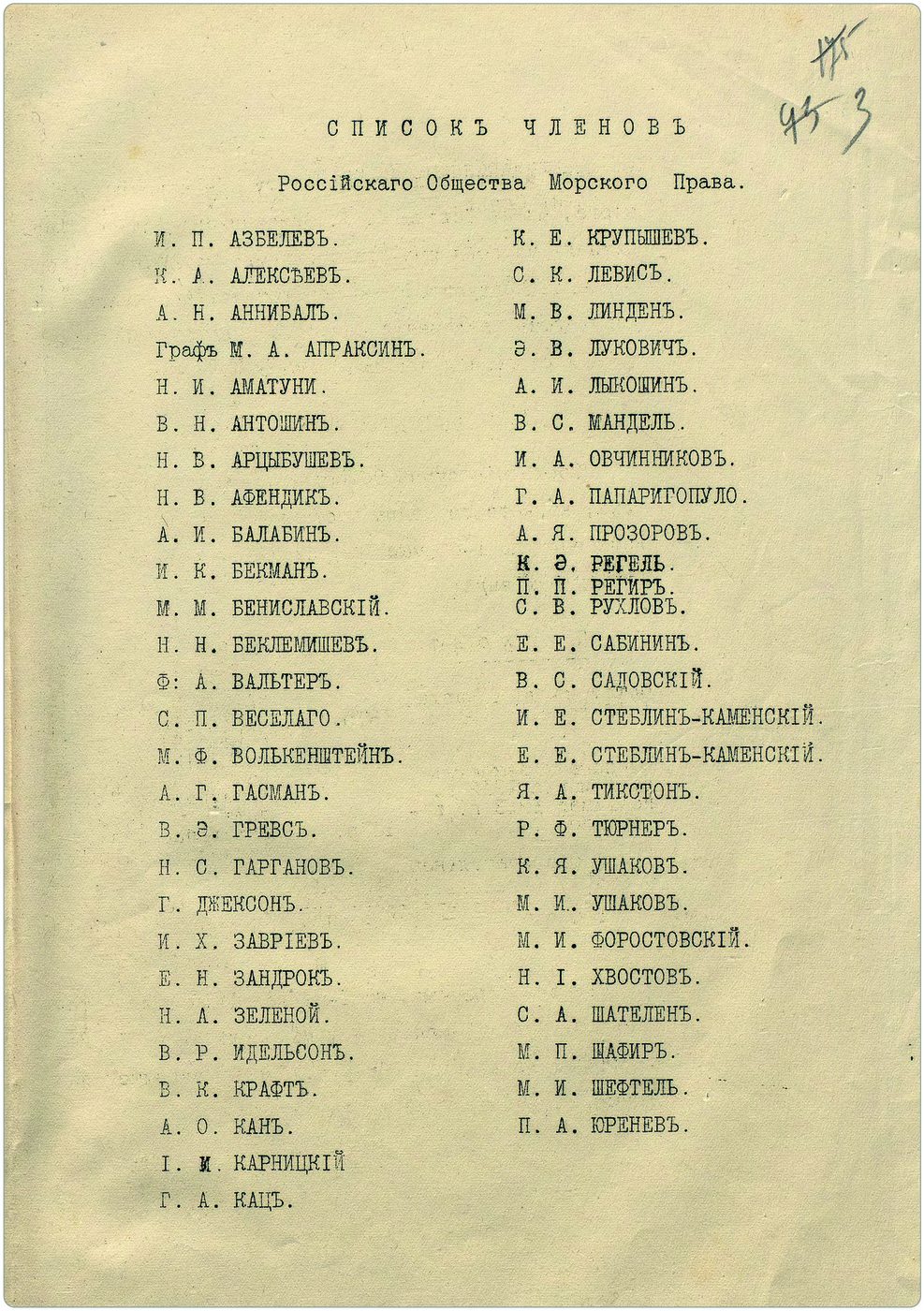
The complete membership list dated 21 May 19133 is especially valuable, it is the earliest known document listing all 53 members of the Society. Admittedly, it does not include any details about their positions or professional affiliations, leaving ample room for further research.
In this article, we attempt to fill some of these gaps by focusing primarily on the biographies of the Russian honorary members of the Comité Maritime International. Their work not only influenced the activities of the CMI, but also laid the foundation for the development of maritime law in the first half of the 20th century.
LIST OF MEMBERS
Russian Maritime Law Society
I.P. AZBELEV
K. A. ALEKSEEV
A. N. ANNIBAL
COUNT M. A. APRAKSIN
N. I. AMATUNI
V. N. ANTOSHIN
N. V. ARTSYBUSHEV
N. V. AFENDIK
A. I. BALABIN
I. K. BEKMAN
M. M. BENISLAVSKY
N. N. BEKLEMISHEV
F. A. WALTER
S. P. VESELAGO
M. F. VOLKENSTEIN
A. G. GASMAN
V. E. GREVS
N. S. GARGANOV
G. JACKSON
Y. KH. ZAVRIEV
E. N. ZANDROK
N. A. ZELENOY
V. R. IDELSON
V. K. KRAFT
A. O. KAN
I. I. KARNITSKY
G. A. KATZ
K. E. KRUPYSHEV
S. K. LEVIS
M. V. LINDEN
E. V. LUKOVICH
A. I. LYKOSHIN
V. S. MANDEL
I. A. OVCHINNIKOV
G. A. PAPARIGOPULO
A. Y. PROZOROV
K. E. REGEL
P. P. REGIR
S. V. RUKHLOV
E. E. SABININ
V. S. SADOVSKY
I. E. STEBLIN-KAMENSKY
Е. Е. STEBLIN-KAMENSKY
Y. A. TIKSTON
R. F. TURNER
K. Y. USHAKOV
M. I. USHAKOV
M. I. FOROSTOVSKY
N. I. KHVOROSTOV
S. A. SHATELEIN
M. P. SHAFIR
M. I. SHEFTEL
P. A. YURENEV
RSHA: Record Group 111, Series 1, File Unit 76, P. 3
RUSSIAN HONORARY MEMBERS OF THE CMI
Fyodor Fyodorovich (Friedrich Fromhold) Martens (1845–1909)
A diplomat and international legal scholar of Estonian origin, member of the Council of the Ministry of Foreign Affairs, vice president of the Institute of International Law, and a member of the Permanent Court of Arbitration in The Hague.
He was born on 15 August 1845 in the city of Pernov, Governorate of Livonia (now Pärnu, Estonia).
Owing to his academic excellence, Martens was transferred from an orphanage school to the St. Peter’s German School, from which he graduated in 1863 before entering the Faculty of Law at the Imperial St. Petersburg University.
From 1867, Fyodor Fyodorovich remained at the university to contribute to the development of the emerging discipline of international law. Two years later, after his thesis “On the Right of Private Property in Time of War” was approved and he successfully completed his master’s examination, he was awarded the degree of Master of International Law. The young scholar was then sent abroad to further his studies and gain experience in the field.
In 1871, Martens was invited by the university administration to return to St. Petersburg and take up the chair of International Law. That same year, he was appointed by the curator of the St. Petersburg Educational District as an associate professor.
Two years later, he defended his doctoral thesis, “On Consuls and Consular Jurisdiction in the East,” in which he argued that international law is closely interconnected with domestic legal systems and the degree of individual liberty, considering the latter a key criterion for a state’s participation in international affairs.
During this period, Martens actively collaborated with the Ministry of Foreign Affairs. In 1873, he worked with the Ministry’s archives to compile a comprehensive collection of all international treaties ever concluded by Russia with other countries. The first volume was published a year later, and the fifteenth, the final one appeared in 1909.4 Around the same time, Martens took part in the Brussels Conference, which focused on the codification of the laws and customs of war.
In 1876, Fyodor Fyodorovich was appointed full professor at St. Petersburg University, where he remained until 1905.
In 1879, Fyodor Fyodorovich was appointed special official under State Chancellor Alexander Mikhailovich Gorchakov. Two years later, he became a permanent member of the Council of the Ministry of Foreign Affairs.
He was soon awarded an honorary Doctor of Laws degree by the University of Edinburgh (1884), followed by the same distinction from the University of Cambridge (1895).
Beginning in 1886, Fyodor Fyodorovich taught international law at the Imperial Alexander Lyceum. That same year, he became a member of the Russian Red Cross Society.
Martens was one of the founding members of the CMI (1897) and its honorary member. Beginning in the 1880s, he represented Russia at nearly all major international conferences, including the 1889 Brussels Conference on Commercial and Maritime Law, the Brussels Anti-Slavery Conference (1889–1890), the conferences of the Permanent Court of Arbitration in The Hague, and various international Red Cross conferences.
Martens also served as a government delegate to the Hague Conference on Private International Law in 1893, 1894, 1900, and 1904, and was among the organisers of the Hague Peace Conferences of 1899 and 1907. At the First Hague Conference, he worked on developing principles for the peaceful settlement of international disputes. It was during this conference that the famous “Martens Clause” was incorporated into the Convention Respecting the Laws and Customs of War on Land, a landmark step in the humanisation of the laws of war. Its core idea remains enshrined in modern international humanitarian law: even in situations not specifically regulated by law, both combatants and civilians are protected by the principles of international law derived from established customs, the laws of humanity, and the dictates of public conscience.
At the Second Hague Conference in 1907, Martens chaired the commission on maritime law. Its work resulted in the adoption of eight conventions that laid the foundation for this branch of international law.5
In 1900, Martens was made a foreign member of the French Academy of Moral and Political Sciences, and in 1908, he was elected a Corresponding Member of the St. Petersburg Academy of Sciences.
Martens was also actively involved in international arbitration, serving as an arbitrator in disputes between states, many of which had serious political implications. He was repeatedly appointed as an arbitrator from the lists of the Permanent Court of Arbitration in The Hague, a clear recognition of his unquestioned authority in this field.
In recognition of his contributions to the development of humanitarian law and his efforts in the peaceful settlement of international disputes, Martens was repeatedly nominated for the Nobel Peace Prize. According to the prize’s online archive, Fyodor Fyodorovich holds the record for the most nominations–24 in total. This surpasses the combined number of nominations received by all other nominees from both the Russian Empire and the Soviet Union.6
Martens died on 6 June 1909 (according to some sources, 7 June) at the Valk railway station in the Governorate of Livonia, en route to St. Petersburg, from sudden cardiac arrest. He was buried in the Lutheran section of the Volkovo Cemetery.7
Mikhail Alexandrovich von Taube (1869–1961)
Russian and French international lawyer, diplomat, historian, councillor, professor, and public official.
Mikhail Alexandrovich von Taube was born on 3 May 1869 in Pavlovsk, in the Saint Petersburg Governorate.
After graduating from the Sixth St. Petersburg Gymnasium in 1887, he entered the Faculty of Law at St. Petersburg University. Upon receiving a first-class diploma for his thesis “The Reception of Roman Law in the West,” he remained at the university to prepare for a professorship in international law (1891), at the recommendation of Professor Fyodor Fyodorovich Martens, under whom he had studied.
In 1896, he earned a master’s degree,8 and three years later, a doctorate in international law.9 He taught at Kharkov University (from 1897), later returned to St. Petersburg University (1903–1911), and also lectured at the Imperial School of Jurisprudence (1909–1917).
Taube later served as full dean of the Faculty of Law (1904). Shortly thereafter, he was appointed full professor of international law and promoted to the rank of actual state councillor (1906). In 1907–1908, Mikhail Alexandrovich lectured on international law at the Higher Women’s Law Courses established by E.I. Peskovskaya, which operated from 1905 to 1911.10
Alongside his academic and teaching activities, Mikhail Alexandrovich also pursued a legal career. In 1892, he was assigned to the Ministry of Foreign Affairs, where he began working as a file clerk in the Second Division of the Minister’s Chancellery. Over time, Taube advanced within the Ministry, rising from a junior official to a member of its Council.
Mikhail Alexandrovich was an honorary member of the CMI representing Russia. In addition, some sources refer to him as a founding member of the Russian Maritime Law Society.11
In 1904–1905, Taube represented Russia before the Paris International Commission of Inquiry on the Dogger Bank Incident; from 1908 to 1909, at the London Naval Conference; and from November 1909, at the Permanent Court of Arbitration in The Hague.
In 1910, at the Paris session of the Institute of International Law, Taube became an associate member of the Institute; in 1914, he was appointed a member of the Academy of International Law in The Hague and joined its Administrative Council; and in 1915, he became a corresponding member of the American Institute of International Law.
Continuing his public service, from 1911 Mikhail Alexandrovich served as deputy minister of Public Education, actively participated in the work of the State Duma, and contributed to drafting legislation on the introduction of universal primary education.
Some sources attribute a key role to Taube in the decision to repatriate Russian gold from German banks on the eve of World War I in 1914, a move that provided crucial support to the state treasury during the challenging years of the war.12
In 1915, Mikhail Alexandrovich was appointed senator with the rank of privy councillor. Two years later, he became a member of the State Council by imperial appointment.
Taube was also an active participant in the country’s socio-political life. In 1906, he became one of the founding members of the St. Petersburg Philosophical Society and was granted full membership. Two years later, he joined the ranks of the Supreme Prize Court on behalf of the Ministry of Foreign Affairs and also served as the Ministry’s representative in the Russian Society for the Protection of Women.
As a supporter of the anti-war movement, Mikhail Alexandrovich von Taube became one of the founding members of the St. Petersburg Peace Society in 1909.13
In 1912, Taube became a full member of the Imperial Historical Society, and from 1914, a member of the Imperial Society for the Promotion of Historical Enlightenment. He was also affiliated with the Moscow Archaeological Institute and several provincial scholarly archival commissions. In 1913, Mikhail Alexandrovich was made an honorary member of the Society of Classical Philology and Pedagogy in St. Petersburg.
From 1917, Taube lived in exile. He lived, worked, and lectured on history in Finland, Sweden, France, Germany, and Belgium. He was a member of the Special Committee for Russian Affairs in Finland (1918), the Academy of International Law in The Hague, the Russian Historical and Genealogical Society in America, and served on the academic council of the Russian Scientific Institute in Berlin.
A long-standing passion of Mikhail Alexandrovich, a descendant of the old Swedish-German von Taube family dating back to the 13th century, was genealogy. He researched the origins and histories of the von Taube and von Uexküll families. Before his emigration, he was one of the founding members of the Russian Genealogical Society and a member of the Historical and Genealogical Society.
In exile, Taube continued his passion for genealogy. In 1950, he became Vice President of the Russian Historical and Genealogical Society in France. He was also a member of the Russian Historical and Genealogical Society in America and of the Central Genealogical Commission under the Union of the Nobility of Europe. This Commission was established to prevent imposture, to serve as a noble arbitration tribunal, to maintain a unified register of noble families, and to publish a compendium of titled and untitled Russian nobility. Its mission was to consolidate all matters relating to the Russian nobility within a single institution and to provide official information to interested parties in accordance with the laws of the Russian Empire.14
Mikhail Alexandrovich von Taube died on 29 November 1961 in Paris. He was buried alongside his children at the Russian cemetery of Sainte-Geneviève-des-Bois (grave No. 5416).
Ivan Alexandrovich Ovchinnikov (1865–1917)
Military legal officer, international maritime law expert, lieutenant general of the Navy, and professor at the Alexander Military Law Academy and the Nikolaev Naval Academy.
After graduating from the Naval Cadet Corps in 1886, Ovchinnikov was commissioned as a midshipman. Upon completing his studies at the Military Law Academy in 1892, he attended lectures at the Faculty of Law of the University of Lausanne in 1894–1895.
In 1896, he was appointed lecturer in maritime international law at the Nikolaev Naval Academy and also taught full-time at the Naval Cadet Corps.15 A year later, Ivan Alexandrovich began teaching international law at the Military Law Academy, where he later defended his dissertation titled “Prize Law.”
In April 1899, Ovchinnikov was appointed as a representative of the Naval Ministry at the First and Second Hague Peace Conferences (1899, 1907), as well as at conferences in Brussels (1905, 1910), Geneva (1906), and London (1908–1909).16
Ivan Alexandrovich was an honorary Russian member of the CMI.
In March 1902, he joined the Special Council tasked with drafting the Code of Merchant Shipping, and in April 1909, he became a member of the Commission for the revision of existing regulations concerning prize awards.17
In 1903, Ovchinnikov was promoted to the rank of lieutenant colonel, and a year later was appointed field officer for special assignments to the Chief of the Admiralty Naval Staff. In 1907, he was promoted to colonel; in 1911, to major general; and in 1915, to lieutenant general of the Navy.
As a lieutenant general from 1915, Ovchinnikov represented the Ministry of the Navy at international conferences on matters of international maritime law.18
Alongside his role representing Russia on the international stage, Ivan Alexandrovich was also deeply involved in teaching. From 1907 to 1917, he served as a professor at the Alexander Military Law Academy, and at the Nikolaev Naval Academy he held the position of full professor and head of the Department of International Law (from 1910). At both institutions, he had been teaching international law as a full-time lecturer since 1900. Between 1911 and 1914, he also held the same position at the Naval Cadet Corps.
In December 1914, Mikhail Alexandrovich was appointed full head of the Central Reference Bureau for Prisoners of War under the General Directorate of the Russian Red Cross Society.
In 1916, he was awarded the title of Professor Emeritus at the Nikolaev Naval Academy.19
Ovchinnikov held the position of chief legal adviser to the Ministry of the Navy and the Naval General Staff on matters of international maritime law and the law of naval warfare.20
Ivan Alexandrovich was also the author of numerous works on international and prize law, including “International Maritime Law in the 19th Century,” “Notes on International Maritime Law,” “The English Declaration of Neutrality,” and “A Compendium of Maritime Law,” among others. A significant number of his writings were published in Morskoy Sbornik (The Naval Digest). However, this publication is now a bibliographic rarity, and as a result, Ovchinnikov’s scholarly legacy remains largely unknown, even within academic circles.21
Ovchinnikov and his family were killed in Sochi in late 1917 during a bandit attack.
MEMBERS OF THE RUSSIAN MARITIME LAW SOCIETY
Ivan Pavlovich Azbelev (1862–1931)
Sailor, ethnographic scholar, insurance official, publicist, and author of books on maritime travel.
He was born in Yekaterinburg in 1862.
After successfully graduating from the Naval School in St. Petersburg, Azbelev was commissioned as a midshipman on 27 September 1882 and, in the same year, set out on a circumnavigation aboard the corvette Skobelev, under the command of Captain Lieutenant Blagodarev.
During the expedition, newly discovered geographical features were named after the ship’s officers; in Azbelev’s case, an island (New Guinea Sea, 5°06’ S, 145°49’ E) and a shoal22 (New Guinea Sea, 5°06.2’ S, 145°49.9’ E) bore his name.23 Following the expedition, Azbelev published a scientific article on the hydrography of a section of the west coast of Africa. Ivan Pavlovich continued to write books and popular science articles about his maritime journeys.
Azbelev later transferred to the Military Department in 1887. Ten years later, following his resignation, he devoted himself to the insurance industry. Beginning as an inspector, Ivan Pavlovich eventually held senior positions in several major St. Petersburg insurance companies, including Yakor, Salamandra, and the St. Petersburg Insurance Society.
Starting in 1905, Azbelev became one of the board directors of the Northern Steamship Company and joined the board of the Russian-Spitsbergen Company.
He retired from service in 1926 “due to age,” following the closure of the companies in which he had served.
On 15 February 1930, he was arrested on charges of undermining the economic power of the USSR and participating in an Émigré Trade Organization (under Article 58.11 of the RSFSR Criminal Code). Azbelev spent over a year in custody, during which he was subjected to repeated interrogations that ultimately led him to disclose information granting access to his foreign assets.
On 28 March 1931, the Collegium of the Joint State Political Directorate (OGPU) sentenced Ivan Pavlovich to death by shooting.24 He was executed on 6 April 1931 and buried in a mass grave alongside other victims. The location of his burial remains unknown.
Later, in 1935, Azbelev’s son, Nikolai Ivanovich, was convicted as a public enemy and exiled to the Aktyubinsk Region for a term of five years. Among the charges against him was the dissemination of “provocative rumours” that his father had been subjected to torture, information he had received from his mother, who had been permitted to visit her husband.25
Kir Alekseevich Alekseev (1860–1923)
Financier, financial adviser to the Korean Emperor, correspondent of the Russian Ministry of Finance in Japan, and actual state councillor.
He was born on 14 December 1860 in the Voronezh Governorate.26 From 1871 to 1878, he was a cadet at the Mikhailovsky Voronezh Cadet Corps and was later transferred to the Nikolaev Cavalry School, where he completed his studies in 1880. Until 1886, Alekseev held the rank of second lieutenant in the Life Guards Cuirassier Regiment.27
Kir Alekseevich later served in the Ministry of Finance, where he headed the Chancellery of the Customs Duties Department from 1886 to 1909.
In archival correspondence dated August 1904, concerning the proposed establishment of a national association of the Comité Maritime International in the Russian Empire, and from October 1905, which included a notice about the Second General Assembly of the founding members of the Russian Maritime Law Society, Alekseev is listed as Head of the Merchant Shipping Department under the General Directorate of Merchant Shipping and Ports.
In 1899, Alekseev was granted the rank of actual state councillor.
On the recommendation of Finance Minister Sergei Yulievich Witte, Alekseev was appointed as the Russian Financial Adviser to the Korean Emperor. He held this position from May 1897 to March 1898.28 According to some accounts cited by Iosif Iosifovich Kolyshko (a writer, special official at the Ministry of Finance, and Witte’s confidant), Alekseev “wasted no time establishing himself in Korea under the guise of a financial agent overseeing the Korean Emperor.”29
From 1897 to 1917, Alekseev served as the correspondent of the Russian Ministry of Finance in Japan. This period is mentioned in the diaries of Saint Nicholas of Japan (born Ivan Dmitrievich Kasatkin), a missionary and Archbishop of Tokyo and All Japan, who kept a diary from 1870 to 1911.
A diary entry dated 15 March 1898 notes that a telegram from St. Petersburg instructed Nicholas of Japan to detain Father Ambrose in Nagasaki, in connection with the resignation of financial adviser Alekseev from his post in Korea.
An entry dated 19 April recounts a meeting with Alekseev, who had been transferred from Korea to Japan, and his secretary, Stepan Alexandrovich Garfield. According to Kasatkin, the guests shared “many interesting things about Korea,” such as the claim that “in Korea, the chief swindler stealing from the state is the King himself; he delights when an official cleverly steals from the treasury.” Alekseev also said that during his tenure managing state finances, ministers “could no longer steal, some even complained to the King about it, and he personally advised them on how to extract money from Alekseev.”30
“He is truly a phenomenon: he can recite the entire annual financial statement by heart, dictate to three scribes simultaneously while conversing with someone else, and play chess on two boards from memory without mixing up the moves. At the same time, he is a very likable person, captivating in conversation, speaks like a book, and is open-hearted,” this is how Alekseev was described by Saint Nicholas of Japan on 25 April 1898. The final diary entry mentioning Kir Alekseevich was dated 11 October 1898, noting his farewell visit before departing for Russia three days later.
It is also worth noting that the Alekseev family belonged to the nobility. This is evidenced, in particular, by seal matrices found in the archive of the Russian Academy of Sciences, in the collection of Academician Vladimir Ivanovich Vernadsky. One of these seals, a noble heraldic signet, belonged to the Alekseev family, and specifically to Kir Alekseevich.31
The reason Alekseev’s seal was found in Vernadsky’s archive lies in his marriage to Olga Ivanovna Alekseeva (née Vernadskaya), the sister of Academician Vladimir Ivanovich Vernadsky. Upon marriage, she adopted her husband’s surname. Their marriage lasted from 1882 to 1913.
After 1917, Alekseev emigrated to Germany, where he died on 16 January 1923. He was buried in the Orthodox Cemetery in Tegel, in the second row of the fourth section.
Arkady Nestorovich Annibal (Hannibal) (... –1966)
Teacher, linguist, art historian, and orientalist specializing in Iranian studies.
The date and place of birth of Arkady Nestorovich Annibal are unknown.
He graduated from the Imperial School of Jurisprudence on 15 May 1912. After that, he likely began working as a private tutor for the large family of Nikolai Mikhailovich Bukhteyev, head of the Kama-Votkinsk Mining District, from 1913 until January 1916.32
In a letter to architect Lidiya Sergeevna Sakharova, who was restoring the Tchaikovsky House Museum in Votkinsk based on the Bukhteyevs’ photographs and recollections, Raisa Nikolaevna Bukhteyeva, daughter of Nikolai Mikhailovich Bukhteyev and a former student of Annibal, described him as “a remarkably talented figure, who possessed fluency in eight foreign languages, was an exceptional sculptor and painter, and an outstanding musician, able to recall and perform the works of Liszt, Borodin, and others entirely by heart.”33
The letter also mentions that after graduating from the School of Jurisprudence, Annibal seriously considered joining a monastery. At his mother’s suggestion, he tried teaching workers at the Votkinsk factory and eventually abandoned his plans for monastic life, focusing on teaching instead.
It is known that Arkady Nestorovich served in the Shirvan Regiment in northern Persia, which allowed him to further improve his Persian, a language he had begun studying during his student years.34 Some sources not only confirm his fluency in “about a dozen” foreign languages, but also claim that, in addition to the School of Jurisprudence, Annibal graduated from the Institute of Oriental Languages.35
During World War I, Arkady Nestorovich served as an aide-de-camp to General Nikolai Nikolaevich Baratov and took part in the Mesopotamian campaign.
After the revolution, Annibal settled in Iran and actively studied local historical monuments. In cooperation with the Ministry of Education and Arts, he established an ethnographic museum in Tehran and another museum in the ancient city of Qazvin.
In January 1926, Annibal visited Moscow to deliver a series of lectures in his capacity as an orientalist specializing in Iranian studies and former officer of General Baratov’s Expeditionary Corps. During his visit, he spoke about the state of school education in Iran.36
In his final years, Annibal served as the director of a museum and library in the Iranian city of Abadan, where he passed away on 3 March 1966.37
Count Matvey Alexandrovich Apraksin (1863–1926)
Master of Ceremonies of the Imperial Court, commandant of the Hospitals of the Ministry of Transport, and actual privy councillor.
He was born on 27 June 1863 in St. Petersburg. In 1882, Apraksin graduated from the Naval Academy38 with the rank of naval cadet, and was subsequently promoted to midshipman and assigned to the 3rd Fleet Crew that same year. He served on foreign voyages until 1884 and again from 1886 to 1888.
From 1884, Matvey Alexandrovich served in the Guards Naval Crew and was promoted to lieutenant in 1890.
From 1898 to 1903, Apraksin was in retirement, having been discharged from service with the rank of captain 2nd rank due to “domestic reasons.”
Over the course of his service, Matvey Alexandrovich was awarded several Russian orders–including the Orders of St. Vladimir (3rd and 4th Class), St. Anna (2nd Class), and St. Stanislaus (2nd and 3rd Class), as well as foreign orders from Denmark, Greece, and Japan, reflecting both his diplomatic missions and international recognition.39
In 1903, Apraksin was granted the title of Master of Ceremonies of the Imperial Court.
After retiring from active service, Matvey Alexandrovich worked at the Ministry of Transport (his personnel file dates from 1905 to 191740). In 1905, he was appointed special official of the 6th Class at the Ministry, while retaining his court title. In 1907, by order of the Minister of Transport and “for the benefit of the service,” he was seconded to the Office of Inland Waterways and Highways.
For his distinguished service, Matvey Alexandrovich was promoted to the rank of actual state councillor in 1910. Two years later, in 1912, he was appointed to the Personal Chancellery of His Imperial Majesty, under the institutions of Empress Maria Feodorovna, who oversaw charitable and educational establishments.41
Matvey Alexandrovich also served as Vice chairman of the Board of The Russian East Asia Steamship Company. During World War I, he held the position of commandant of the hospitals under the Ministry of Transport, and in 1918, he oversaw a military hospital in Crimea.42 Apraksin died in exile in France on 27 August 1926.
Nikodim Isaevich Amatuni (1865–1946)
Public figure, expeditionist, collector, actual state councillor.
He was born on 3 May 1865 in the village of Oshakan, in the Erivan Governorate,43 into a princely family.44
Upon graduating from the Faculty of Law at St. Petersburg University in 1889, Nikodim Isaevich received the degree of Candidate of Law. The following year, Amatuni entered public service in the Criminal Cassation Department of the Senate, where he served as a judicial candidate with the rank of Collegiate Secretary.
From 1893 to 1903, he served as an inspector and file clerk to judicial investigators in the district courts of Ekaterinoslav, Vitebsk, Saratov, and Kamenets-Podolsky.
In 1903, Amatuni submitted a petition to Grand Duke Alexander Mikhailovich, the chief administrator of Merchant Shipping and Ports, requesting an appointment within the department under his authority. That same year, Nikodim Isaevich was appointed a special official of the 6th class under the Chief Administrator.
A year later, Amatuni was promoted to collegiate councillor with seniority and appointed head of an expedition organised by the General Directorate of Merchant Shipping and Ports to the ports of the Persian Gulf and the surrounding provinces. The expedition lasted from February to October 1904.
Back from the expedition, Amatuni was posted to other cities (Novorossiysk, Sukhum) to organise meetings and develop practical recommendations for institutions engaged in trade with southern Persia (Iran), as well as to arrange commercial and artisanal exhibitions.45
In 1908, Amatuni was sent to foreign ports visited by express steamers of the Russian Steamship and Trading Company to assess their commercial significance.
Following 1917, Amatuni fought in the Civil War for the White Guards. Following their defeat, he emigrated to Paris.
Whilst residing overseas, Nikodim Isaevich remained active in various white émigré societies and gave public recollections, for instance, at the Society in Memory of Empress Alexandra Fyodorovna (1927), the Union of Russian Jurists, and the Alumni Society of Former Students of St. Petersburg University (1935).
Amatuni passed away on 4 March 1946 and was laid to rest in the in Sainte-Geneviève-des-Bois.46
Nikolai Vasilievich Afendik (1864–...)
Special official of the Ministry of Finance, the General Directorate of Merchant Shipping and Ports, the Ministry of Trade and Industry, publicist, actual state councillor.
Nikolai Vasilievich was born on 19 April 1864 in Saint Petersburg. In 1886 he entered the Law Faculty of St. Petersburg University, and two years later transferred to the Law Faculty of the Imperial University of St. Vladimir in Kiev. He graduated in 1890 with a second-class diploma.
Afendik then worked as a sworn advocate in the city of Libava, Courland Governorate47 (1896), and in 1898 he was appointed to the Department of Trade and Manufactures of the Ministry of Finance as head of the Department on Merchant Shipping Affairs.
When the General Directorate of Merchant Shipping and Ports was established, Nikolai Vasilievich was appointed head of the Collegiate Secretary Service in the Department of Merchant Shipping and Ports.48
From 1908 and at least until 1912, he served as a special official of the 6th class under the Minister of Trade and Industry.
Afendik was a member of the Special Council for drafting the Code of Merchant Shipping and was in charge of its record keeping.
Nikolai Vasilievich also served on the boards of the Commercial Bank in Białystok and the Russian French Bank. In 1915, he was promoted to the rank of actual state councillor.
He took a great interest in the development of ports and foreign trade, writing articles on these subjects. Indeed, in 1912, his 77-page study, “On the Issue of Attracting Private Capital for Port Equipment and the Establishment of a Network of Grain Elevators,”49 was published. Afendik was also a contributor to “Notes on the Maintenance and Development of Northern Fisheries and on Urgent Measures to Address the Shortage of Fish Products”50 (1917).
In 1918, Afendik was appointed a member of the Foreign Department of the Commissariat of Internal Affairs of the Union of Communes of the Northern Region, which operated from April 1918 to May 1919.
The date and circumstances of his death are unknown.
Iogan (Ivan) Karlovich Bekman (1848–1921)
Advocate, collegiate assessor, winery owner.
He was born in the Italian city of Cremona on 26 September 1848. From 1865 to 1871, he studied at the Faculty of Law of St. Petersburg University.
Thereafter, Bekman held the post of controller at the General Ecclesiastical Consistory and also practiced as a sworn advocate.
In 1894, Bekman acquired an old ceramics factory in the town of Luga, which was subsequently converted into a glassworks.
As of 1912, Beckmann served as assistant to the head, and later as chairman of the church council at the Katharinen Kirche.51 Later, Ivan Karlovich practiced as an advocate and attained the civil service rank of collegiate assessor.52
Bekman passed away on 21 December 1921 in Dorpat.53
Mikhail Mikhailovich Benislavsky (1860 (according to other sources, 185754)–1933)
Polish landowner, deputy of the Second State Duma from the Vitebsk Governorate.55 deputy chairman of the Russian Maritime Law Society.
He was born on 5 November 1860, in the estate of Uzulmuyzha, Rezhitsa Uyezd,56 Vitebsk Governorate.
After graduating from the Riga Polytechnic Institute, Mikhail Mikhailovich served as Consul General of Denmark in St. Petersburg.
In February 1907, Benislavsky was elected to the Second State Duma by the general assembly of electors of the Vitebsk Governorate Electoral Commission.57 He served as chairman of the Duma’s Fourth Department and was a member of the parliamentary commission on the regulation of rest periods for employees in commercial and artisanal establishments.
Until 21 May 1913, Benislavsky served as deputy chairman of the Russian Maritime Law Society. During this period, he was also known for his role as business manager of the Russian East Asian Steamship Company.
Mikhail Mikhailovich passed away on 1 February 1933 in Warsaw.58 He was laid to rest at the Stare Powązki Cemetery (Section 107, Row 6, Grave 16).
Nikolai Nikolaevich Beklemishev (1857–1934)
Naval officer, publicist, hydrographer, publisher and editor of the journal More (The Sea), major general in the admiralty
He was born on 18 March 1857 in the village of Bozheninovo, Aleksin Uyezd, Tula Governorate (according to other sources,59 in Serpukhov).
In 1876, Beklemishev graduated from the Navigational Division of the Technical School of the Maritime Department and was commissioned as a warrant officer in the in the Corps of Naval Navigators. Over the next 28 years, he pursued a military career, undertaking long-distance voyages and participating in hydrographic surveys.
In 1886, Nikolai Nikolaevich also graduated from the Shipbuilding Department of the Nikolaev Naval Academy. He went on to teach there, as well as at the Nikolaev Engineering Academy, the Naval Cadet Corps, and the Officer Mine Class.
After retiring from service, Beklemishev continued to engage with military and naval affairs. He pursued literary work and authored a number of publications on naval history, shipbuilding, mine warfare, merchant shipping, as well as on political, economic, and industrial issues in Russia.60
In 1901, Beklemishev founded the journal More i ego zhizn (The Sea and Its Life) in Saint Petersburg, which was renamed More in 1905. He remained its publisher and editor until the journal ceased publication in 1917. The journal focused on naval and technical matters.
From 1901, Beklemishev was assigned to the staff of Grand Duke Alexander Mikhailovich, who in 1902 was appointed head of the General Directorate of Merchant Shipping and Ports. At that time, Beklemishev became Senior inspector of Merchant Shipping, and later Head of the Department of Commercial Ports.
In 1902, Nikolai Nikolaevich took part in drafting the Code of Merchant Shipping. From 1903, he headed the Department of Military and Naval Engineering at the Imperial Russian Technical Society.
In 1904, he retired from service with the rank of major general in the admiralty.
In retirement, Beklemishev was actively involved in public affairs. He founded and chaired the League for the Renewal of the Fleet, served as secretary of the Society for Naval Research, and was a member of the Special Committee for the Strengthening of the Navy through Voluntary Contributions.
The exact date of Beklemishev’s death is unknown.61
Filipp Antonovich Walter (1865–1936)
Legal scholar, civil and commercial law expert, legal adviser to the Ministry of Justice, senator, privy councillor. Member of the Editorial Committee of the Russian Maritime Law Society.
Walter was born on 28 September 1865 in Saint Petersburg
In 1887, Walter graduated from the Faculty of Law of St. Petersburg University with the degree of Candidate of Law, after which he remained at the university in the Department of Civil Law.
In 1892, after passing the examination for the degree of Master of Law, Filipp Antonovich began lecturing as privatdocent (private associate professor) in the Department of Civil Law and Legal Proceedings. He also taught in the Department of Commercial Law and Legal Proceedings,62 delivering a course on Law of Bills, and, in 1893–1894, a course on Russian family and inheritance law.
In 1887, Walter worked in the Chancellery of the Civil Cassation Department of the Senate, and two years later joined the Commission specially established by Imperial decree to draft a Civil Code. Filipp Antonovich also served as a member of the Special Council for the drafting of the Code of Merchant Shipping, where he was listed in official records as legal adviser to the Ministry of Justice,63 a position he is known to have held since at least 1898.64
In 1910, Walter taught civil law at the Bestuzhev Courses. In 1912–1913, he served on the Editorial Committee of the Russian Maritime Law Society and worked on translating the society’s documents into foreign languages.
In 1909, Filipp Antonovich held the position of special official of the 5th class under the Minister of Justice. In 1914, he was promoted to the rank of privy councillor, and in the following year, Walter was appointed senator of the Civil Cassation Department of the Senate.
After the October Revolution, Filipp Antonovich served as associate professor in the Department of Civil Procedure (1918–1921), and he then became a professor at Leningrad University, a position he held until 1930.
In retirement from academia, he worked as a legal adviser for various institutions, including Spichsnabsbyt and Souzskladtar.
Walter died on 1 January 1936. The location of his burial is unknown.
Sergei Petrovich Veselago (1865–1941)
Head of the Department of Commercial Ports at the Ministry of Trade and Industry, deputy minister of Trade and Industry, actual state councillor. Deputy chairman of the Russian Maritime Law Society.
Veselago was born in 1865 in Saint Petersburg. He graduated from the Naval Corps in 1884 and from the Military Law Academy in 1891. According to Sergei Petrovich’s heirs,65 his career as a naval officer began before the Revolution, when he completed two circumnavigations and worked on naval armament systems. Veselago was a member of the Special Council for the Drafting of the Code of Merchant Shipping, taking part in its work as a representative of the Ministry of Trade and Industry, serving as Head of the Merchant Shipping Department, and holding the court rank of chamberlain of the Imperial Household.
On 21 May 1913, Veselago was elected deputy chairman of the Russian Maritime Law Society.
During this period, he headed the Department of Commercial Ports within the Ministry of Trade and Industry, was a member of the Council of the Volunteer Fleet, and served as chairman of the Committee for Maritime Education,66 and, in 1915, he was appointed deputy minister of Trade and Industry with the rank of privy councillor. Within the Ministry, Sergei Petrovich oversaw the construction and operation of commercial seaports.
Following the Revolution, Veselago remained in the USSR and served as head of the Merchant Shipping Department.
Sergei Petrovich died of starvation in 1941 during the Siege of Leningrad.67
Mikhail Filippovich Volkenstein (Moisei Fishelevich) (1861 (or 1859)–1934)
Advocate, sworn advocate, editor, publisher, and public figure.
He was born on 22 March 1861 in Rostov-on-Don (according to other sources,68 in Berdichev, Zhytomyr Oblast).
After graduating from the Faculty of Law of St. Petersburg University, Mikhail Filippovich was admitted to the Bar in 1884. He took part in many high-profile criminal and civil cases, and also defended individuals deemed politically unreliable in trials involving political charges.
In the spring of 1896, Volkenstein gave bail for Vladimir Ilyich Ulyanov (Lenin), who was accused of committing a socially dangerous act, namely the founding, in 1895, of the League of Struggle for the Emancipation of the Working Class. The advocate petitioned for Ulyanov’s release pending trial, citing his declining health.69 A few years earlier, in 1893, Volkenstein had employed Ulyanov as an assistant to a sworn advocate and subsequently recommended him to the St. Petersburg Bar Association.70
Mikhail Filippovich was active not only as a lawyer but also served on the Literacy Committee of the Imperial Free Economic Society, and after the Committee was dissolved, he developed an interest in publishing. Volkenstein worked as a legal adviser to the journal Russkoye Bogatstvo (Russian Wealth), and in 1895 became the owner and editor of the St. Petersburg political journal Novoye Slovo (The New Word), which was published from 1895 to 1897.
In 1896, Mikhail Filippovich became director of the board of the Izdatel publishing company, and also oversaw the editorial offices of the newspaper Son Otechestva (Son of the Homeland) and the magazine Zhivopisnoye Obozrenie (Pictorial Overview).71 After Izdatel was shut down, Volkenstein held the position of legal adviser to several major joint-stock companies, including the Northern Steamship Company. He was also known as director of the Society for Access and Railway Tracks in Russia.
In 1922 (according to other sources, in 191772 or 192173) Volkenstein emigrated to Tallinn, where he became a member of the Council of Elders of the Revel Russian Club.
Towards the end of his life, Volkenstein lost his sight, and unable to cope with his helplessness any longer, he took his own life on 14 March 1934. He was buried in Saint Petersburg.
Anatoly (Natan) Grigoryevich Gasman (1844–1919)
Civil lawyer, member of the State Council, Senator, deputy minister of Justice, and actual privy councillor.
Gasman was born on 23 September 1844 in Vilna (Lithuania). In 1867, Anatoly Grigoryevich graduated from the Faculty of Law of St. Petersburg University with the degree of Candidate of Law.
Gasman was then assigned to the Department of the Ministry of Justice. From 1868 to 1882, he served in the provinces, successively holding the positions of assessor in the Kursk and Tambov Chambers of Criminal and Civil Courts, deputy prosecutor, member, and deputy chairman of the Saratov District Court. From 1882 onwards, Gasman participated in an audit of the Livonian and Courland governorates, the results of which laid the groundwork for the administrative reform of the Baltic provinces.
In 1886, Anatoly Grigoryevich was appointed senior legal adviser at the Legal Consultation Office of the Ministry of Justice. In this role, he played a key part in extending the 1864 Judicial Statutes to the Baltic region and reforming local peasant courts. In addition, he personally drafted the main sections of the project and participated in the meetings of the State Council where it was reviewed.74
In 1895, Gasman was appointed Senator75 and promoted to the rank of privy councillor. He served in the Civil Cassation Department and in the First General Assembly of the Senate; initially as a member, and from 1906 as chairman of the Commission for the Revision of Notarial Regulations.
During his service in the Senate, Gasman took part in consultations on the revision of existing legislation and published legal articles in such periodicals as Sudebnaya Gazeta (Judicial Gazette), Sudebny Zhurnal (Judicial Journal), Zhurnal Grazhdanskogo i Ugolovnogo Prava (Journal of Civil and Criminal Law), Vestnik Prava (Herald of Law), Zhurnal Ministerstva Yustitsii (Journal of the Ministry of Justice), Pravo (Law), and Notarius (The Notary).
Since 1904, Gasman had been cooperating with the General Directorate of Merchant Shipping and Ports, and as its representative, he participated in the work of the Special Council for drafting the Code of Merchant Shipping and chaired meetings on the development of regulations concerning loans for the purchase of newly built merchant vessels, including the procedures for issuing and securing such loans.
Between 1906 and 1913, Gasman served as deputy to the Minister of Justice, Ivan Grigoryevich Shcheglovitov.
Anatoly Grigoryevich died in Petrograd on 13 December 1919 and was buried in the cemetery of the Alexander Nevsky Lavra.
Valerian Eduardovich Grevs (1876–1939)
Notary, titular councillor, collegiate assessor. Secretary of the Russian Maritime Law Society.
He was born on 19 September 1876 in St. Petersburg. Valerian Eduardovich received higher education at the Imperial School of Jurisprudence in St. Petersburg (1897), and then entered the service of the Ministry of Justice.
In 1897, Grevs was attached to the St. Petersburg Judicial Chamber as a junior candidate for judicial office, and was later appointed secretary to the prosecutor of the Irkutsk Judicial Chamber. Later, he became a junior clerk at the Main Prison Administration (1899).
After that, Valerian Eduardovich entered legal practice and headed a notarial office, becoming a prominent figure in the field of notarial law by 1914.76 He handled all legal affairs of Prince Alexander Petrovich of Oldenburg and served as his legal adviser.
Grevs was also Secretary of the Russian Maritime Law Society (at least in 1907 and 1913), and a member of the Special Council for the Drafting of the Code of Merchant Shipping, during which he prepared a draft of the rules on the registration and mortgaging of seagoing vessels.77
In 1917, Valerian Eduardovich became a member of the Petrograd municipal government and chairman of the Food Committee.
By the end of 1917 he emigrated to Japan, where he lived until 1919. In 1919–1920, he resided in Siam (present-day Thailand), and later moved to the United States, where he joined a major law firm.78 While in exile, Grevs became a member of the Association of Former Sworn Advocates, served on the leadership board of the Society for Aid to the Russian Church in America, and acted as secretary of the Board of Trustees of the North American Archdiocese.79
Grevs died on 3 June 1939 in New York (according to other sources, in Watertown, Connecticut).
Yakov (Akop) Khristoforovich Zavriev (Zavarian, Zavriyan, Zavriyan) (1866 (or 1864)–1920)
Physician, author of medical articles, member of the All-Russian Constituent Assembly, activist of the Dashnaktsutyun Party, and court councillor.
Yakov Khristoforovich was born 1866 in Tiflis (Tbilisi). In 1892, he graduated from the St. Petersburg Military Medical Academy, and in 1900, he defended his dissertation to earn the degree of Doctor of Medicine.
Two years later, Zavriev became chief physician of the Balakhani District Hospital in Baku, and in his spare time, wrote articles on medical topics. Shortly afterwards, he founded a hospital in the Turkish city of Mush, where he dedicated himself to improving access to medical care for the local population.
From 1891, Zavriev was associated with members of the Narodnaya Volya movement and promoted ideas of national liberation. From 1914 to 1915, he took part in the Armenian volunteer movement.
At the end of 1917, Yakov Khristoforovich was elected to the All-Russian Constituent Assembly from the Transcaucasian Electoral District on List No. 4, representing the Armenian nationalist party Dashnaktsutyun (“Union”80). Within the party, he was responsible for foreign affairs. He left for Tiflis amid the events of the October Revolution.81
In July 1918, Zavriev was arrested. Despite this, he was later appointed physician at the Moscow Hospital for Acute Infectious Diseases, where he contracted typhus and died on 20 February 1920.
Evgeny Nikolaevich Zandrok (1875–...)
Economist, insurance expert, and organiser of apiculture.
He was born in 1875 in Saint Petersburg. After graduating from the Faculty of Natural Sciences at St. Petersburg University and completing advanced courses in intensive agriculture, Zandrok moved to Barnaul. There, he founded a museum of apiculture, worked as an agronomist, gave lectures, and published articles.82
“Not being content with government service and wishing to pursue farming on an experimental and exemplary basis, though lacking the means to do so, I accepted, with the permission of my superiors, an agency position with the Salamandra Insurance Company in 1898, in order to supplement my income. Within six months, I was appointed chief agent for the Altai District, and another six months later as an inspector for Western Siberia. I left agronomic service altogether and devoted myself entirely to the insurance business,” wrote Evgeny Nikolaevich in his autobiography on 20 December 1924.83
A year later, he was appointed trustee of the board for all of Siberia, and he opened the All-Siberian branch of Salamandra in Tomsk and headed it until 1905. Zandrok was later transferred to Saint Petersburg, where he headed the local branch and subsequently became assistant manager of the company’s operations. In 1917, Evgeny Nikolaevich was appointed general manager, a post he held until 1919, “bringing the company to the point of handing it over to the authorities then in power.”84
Later, Zandrok took part in the establishment of an unnamed mining partnership in the Urals and a gold-mining joint-stock company in the Altai region. He was elected to the boards of both enterprises, and in 1916 became a member of the Council of the Gold Industry Bank in Petrograd.
After Salamandra ceased operations, Zandrok declined an invitation to join the board of the Re Salamandra partnership in Copenhagen, and lived and worked in Ukraine until the late 1920s. There, he managed his own estate while simultaneously holding financially responsible positions in various institutions.
Shortly afterwards, Evgeny Nikolaevich was arrested by the Dnepropetrovsk GPU on charges of “counter-revolutionary agitation” and was administratively exiled to Barnaul in April 1932. There, Zandrok worked as a consultant to the municipal planning commission. In January 1933, he was arrested again and sentenced to five years in a labour camp.
Zandrok’s subsequent fate remains uncertain. According to some sources, he never returned from imprisonment, as he had suffered from serious illness while in the camps. Other accounts,85 however, indicate that he did return and was still alive as of 18 May 1951.
Nikolai Alexandrovich Zelenoy (1844–...)
Vice-admiral, participant in the Russo-Turkish War and the Central Asian campaign, chairman of the Volunteer Fleet Committee.
Zelenoy was born on 8 July 1844 into the family of Alexander Ilyich Zelenoy, a hereditary naval officer, admiral, and member of the Main Naval Court. In August 1857, Nikolai Alexandrovich was enrolled in the Naval Cadet Corps and was promoted to the rank of petty officer the following year.
In 1861, Zelenoy completed his training and was commissioned as a midshipman. The following year, he embarked on a round-the-world voyage, which lasted until 1864. Between 1865 and 1875, and again from 1882 to 1884, Nikolai Alexandrovich served on voyages in the Baltic, Black, and Mediterranean Seas, the Gulf of Finland, and on foreign deployments.
In 1876, he became the tutor to Grand Duke Sergei Mikhailovich. Two years later, Zelenoy was assigned to the Commander-in-Chief of the Caucasian Army and enrolled in the staff of the Caucasian Military District.
From 1885 to 1895, Nikolai Alexandrovich commanded the ships Boyarin, Zabiyaka, Admiral Spiridov, and Dmitry Donskoy. Between 1889 and 1891, he also served as a naval agent in England.86
Zelenoy is known to have even served as a judge at the 1900 Olympic Games in Paris, where he was a member of the jury for the sailing regatta events. At the Paris Exposition, Nikolai Alexandrovich oversaw the naval section and commanded the 11th Fleet Crew, which comprised several vessels stationed in Kronstadt.87
In addition, Zelenoy was a member of the Special Council tasked with drafting the Code of Merchant Shipping. In 1904, Nikolai Alexandrovich was promoted to vice admiral and appointed chairman of the Volunteer Fleet Committee. He retired from service on 20 October 1908. The details of Zelenoy’s later life and the circumstances of his death remain unknown.
Vladimir Robertovich Idelson (1881–1955)
Advocate, legal scholar, financier, insurance expert, lecturer, and publicist.
Vladimir Robertovich was born in 1881 in Taganrog into the family of a pharmacist. After graduating from the Taganrog Gymnasium, he entered the Faculty of Law at Kharkov University in 1899. That same year, Idelson’s first scholarly work, “The Insurance Contract under Russian Law,” was published. It was awarded a gold medal in civil law and appeared in the “Notes of the Imperial Kharkov University.”
After completing his studies in 1903, Idelson enrolled at the Faculty of Philosophy of the University of Berlin, where he focused primarily on political economy, statistics, and finance. In 1904, his article “The Insurance Contract in Recent Legislative Drafts” was published in the journal Vestnik Prava (Herald of Law). It offered a detailed analysis of efforts to codify private insurance law in Germany, Switzerland, and the Russian Empire.
In 1905, Vladimir Robertovich was awarded a doctorate in philosophy and published two articles in a Berlin-based professional insurance journal, addressing the codification of British insurance law and issues in Russian insurance legislation.
In 1906, Idelson passed his master’s examination in political economy at Kharkov University, received the title of privatdocent, and became a lecturer at the Polytechnic Institute in St. Petersburg. At that time, the institute had only just begun training specialists in banking, credit, and financial operations more broadly.88
At the Institute, Idelson lectured on monetary circulation, credit, and insurance. Between 1908 and 1913, he published a series of articles on insurance in Izvestiya Politekhnicheskogo Instituta (Proceedings of the Polytechnic Institute). The journal also featured his book reviews and surveys, including a 1908 overview of nine Western European works on insurance.
Vladimir Robertovich’s professional interests lay at the intersection of economics and law, which led to his admission to the bar in 1911. “Judging by Mr. Idelson’s commitment to the Department of Economics, his enrolment in the bar will in no way affect the quality of his teaching,” stated a reference issued to Idelson by the director of the Polytechnic Institute, Professor Alexander Alexandrovich Radtsig.89
Prior to 1914, Vladimir Robertovich made several international trips for scientific research. By 1916, he had become a member of the board of the Russian English Bank and was elected deputy chairman of the Committee of Representatives of Joint-Stock Commercial Banks.
In March 1918, Idelson resumed his position as an associate professor at the Polytechnic Institute, and in June, he was temporarily assigned to Moscow and Taganrog for the summer, after which he emigrated to England. There, he continued his legal career.
A renowned authority on Russian law, Vladimir Robertovich served as an expert witness in court cases concerning the nationalisation of Russian companies and banks. After becoming a naturalised British citizen in 1930, he was appointed King’s Counsel.
Within a few years, Idelson was elected to the Honourable Society of Lincoln’s Inn, the executive council of the Grotius Society, the legal advisory Committee of the British Council, and the Society of Comparative Legislation and International Law. In the final year of his life, he served as vice-president of the Grotius Society.90
Vladimir Robertovich passed away in London in 1955.
Iosif Ivanovich (Martin-Joseph-Ivan) Karnitsky (1840–1914)
Polish and Russian lawyer, senator, and actual privy councillor. Deputy chairman of the Russian Maritime Law Association.
Karnitsky was born on 19 August 1840 at the Lyandskorona estate, Lyutsinsky Uyezd, Vitebsk Governorate.91
Karnitsky graduated from the Faculty of Law at the Sorbonne in 1861. After receiving the degree of Licentiate (Master) of Laws, he began his career at the Warsaw Civil Tribunal, where he served until 1864.
Within three years, he worked in the Chancellery of the state council of the Kingdom of Poland, and from 1867 to 1869, he served as assistant prosecutor at the Kingdom’s Court of Appeal. He later held posts of the assessor (1869–1870), judge of the Warsaw Civil Tribunal (1870–1872), chief executive of the Chancellery of the Government Commission of Justice (1872–1873), and member of the Emeritus Commission of the Kingdom of Poland (1873–1876).
From 1877 to 1882 (according to some sources, until 1883), he served as deputy chief prosecutor of the Civil Cassation Department of the Senate. In 1895, he was appointed senator. Karnitsky continued working in the Civil Cassation Department until 1898, after which he joined the First General Assembly.
Iosif Ivanovich joined the Editorial Commission responsible for drafting the Civil Code at its inception in 1882 and remained a member until the work was completed. From 1900 to 1904, he served as deputy chairman. Following the death of the commission’s chairman, A. A. Knirim, Karnitsky succeeded him and led the commission until 1906.
In 1905, he was appointed deputy chairman of the Russian Maritime Law Society, a position he continued to hold at least until September 1907.
Karnitsky also played a prominent role in the civil division of the Law Society at St. Petersburg University. He was a full member from 1877 to 1907, and from 1907 onward, he held honorary membership. He served as secretary from 1882 to 1890, as a member of the Editorial Committee from 1882 to 1891, as deputy chairman from 1892 to 1899, and ultimately as chairman from 1900 to 1905.
Karnitsky passed away on 23 April 1914 while undergoing medical treatment in the Bavarian resort town of Bad Wörishofen.
Viktor Karlovich Kraft (1857 (or 186392)–1927)
Admiral, chairman of the Russian Commercial Volunteer Fleet Association.
Viktor Karlovich Kraft, a native of Kherson Governorate,93 came from a family of naval officers. He was admitted to the junior preparatory class of the Naval Academy in St. Petersburg on 15 September 1876 and graduated as a midshipman on 27 September 1882.
From 1879 to 1891, Viktor Karlovich undertook voyages in the Baltic and Black Seas, the Gulf of Finland, and abroad, and took part in naval expeditions in the Pacific Ocean. He was discharged from service at his own request (due to family circumstances) on 9 August 1899.94
According to St. Petersburg address and reference directories,95 by 1902 Kraft was employed by the Russian Commercial Volunteer Fleet Association. In 1905, he headed its commercial department, which issued certificates for the transportation of passengers and cargo. Records of his activity disappear after 1908, but it is known that between 1914 and 1917 Viktor Karlovich retained this position. He is also credited with playing a key role in securing the return of ships that had been seized following the Revolution.96 The last records of him date from 1924 to 1925, which suggest that he was working as a lawyer at that time.
Wilhelm Mikhailovich Linden (1843–1937)
Lieutenant general of the Navy, inspector of the Volunteer Fleet, maritime author, collegiate councillor. Treasurer of the Russian Maritime Law Society. Honorary citizen of the city of Alushta.
Linden was born on 5 March 1843 in Irkutsk. He graduated from the Naval Cadet Corps as a midshipman in 1862 and completed the Hydrographic Department of the Naval Academy in either 1868 or 1869.
From 1864 to 1865, Linden, together with fellow graduates, served aboard the clipper Almaz as part of Rear Admiral Stepan Stepanovich Lesovsky’s squadron on a mission to the coast of North America. From 1869 to 1872, he took part in a round-the-world voyage on the corvette Boyarin.97
Wilhelm Mikhailovich also served as a naval agent in England and later, in Russia, as first officer in a steamship company. He wrote the sea story In the Pacific Ocean (From the Round-the-World Voyage of the Boyarin). The work, which describes the global circumnavigation undertaken by Russian sailors, was published in the seventh issue of Vestnik Evropy (Herald of Europe) in 1871.98
From 1881, Linden served as inspector of the Russian Commercial Volunteer Fleet Association.
Wilhelm Mikhailovich retired in 1906 and subsequently lived in Alushta.
Linden’s name later appeared in the records of the Special Council for Drafting the Code of Merchant Shipping. He was listed in official documents as a file clerk, collegiate councillor, assistant head of the Department of Merchant Shipping and Ports. He likely assumed leadership of the department in 1911, as he was mentioned in this capacity by the International Maritime Committee in the bulletin of the conference held in Paris from 9 to 13 October of that year.99
From at least October 1911 until 21 May 1913, Linden served as Treasurer of the Russian Maritime Law Society. In 1920, Linden emigrated from Yalta to Constantinople, then in 1922 to Mainz, and later settled in Paris. In 1932, Wilhelm Mikhailovich left the Paris Mess in Paris and joined the Maritime Assembly. While in exile, he published articles in the Maritime Journal, and in the spring of 1937, six months before his death, his book Squall was published in Prague. Linden died in Paris on 30 October 1937.
Alexander Ivanovich Lykoshin (1861–1918)
Statesman, senator, member of the State Council, landowner, philanthropist, and privy councillor.
Alexander Ivanovich was born on 29 September 1861. After graduating from the Imperial School of Jurisprudence in 1882, he entered the service of the Ministry of Justice.
He later held a number of positions, including senior head of the desk (1888–1891), editor of the First Department of the Senate (1891–1893), special official (1893–1895), and officer of the Chief Prosecutor’s Office within the 4th Department of the Senate (1895–1899), which dealt with military and naval affairs. From 1899 to 1901, he served in the Department of Heraldry.
Between 1897 and 1898, Lykoshin focused on legislative work and joined the editorial commission responsible for drafting the Civil Code. During this time, he wrote on various aspects of civil law, expressed a particular interest in peasant customary law and state legislation concerning rural communities, and actively contributed to the preparation of a draft Votchinnoye Ustav (landholding statute) and new copyright regulations.
Alexander Ivanovich Lykoshin was also involved in shaping maritime law. He served on the Special Council for the drafting of the Merchant Shipping Code, authored a dissenting opinion on behalf of the Ministry of Justice concerning the proposed rules the mortgaging of seaworthy vessels,100 and wrote an article titled “Contested Issues in Merchant Shipping.” Among the problems Lykoshin identified were the structure and valuation of the merchant fleet; inadequate vessel registration procedures; weak standards of seaworthiness; the urgent need to introduce maritime mortgages; the absence of a registration system for river vessels; the lack of legal protections for the inland fleet; and the unavailability of credit for river shipping.101
In 1901, Alexander Ivanovich was appointed deputy chief prosecutor of the Civil Cassation Department of the Senate, and three years later, he became a member of the Consultative Council at the Ministry of Justice. He also contributed to the Journal of the Ministry of Justice.
From 1905 onwards, he was a member of two conservative political organisations: the Russian Assembly and the Patriotic Union.
From 1907 to 1913, while continuing to serve on the Consultative Council of the Ministry of Justice, Lykoshin devoted his attention to the of Internal Affairs. During these years, he held a seat on the Minister’s Council and was subsequently appointed deputy minister of Internal Affairs.
In 1908, Lykoshin was promoted to the rank of privy councillor.
That same year, he became one of Stolypin’s closest collaborators in the planning and execution of agrarian reforms, taking part in the work of various commissions and interdepartmental councils.
Between 1908 and 1911, he presented reformist legislation before both the State Duma and the State Council. He was later appointed a full member of the State Council in 1914, and in 1915 joined the Special Session on Matters Concerning the Compulsory Expropriation of Immovable Property.
During the Civil War, Lykoshin left for Ukraine, where he died in Kyiv on 11 November 1918.
Veniamin Semyonovich Mandel (1863–1931)
Advocate, member of the Union of Russian Sworn Advocates, chairman of the Society for Assistance to Russian Citizens in Berlin, and a prominent figure in the Jewish community movement.
Mandel was born in 1863 in the town of Šiauliai (Lithuania). He graduated from the Faculty of Law at St. Petersburg University in 1884 and, in 1887, was admitted to practice as a sworn advocate within the Petrograd Judicial District. Veniamin Semyonovich specialised in insurance law and served as legal adviser to the Salamandra Insurance Company as well as to the Russian Insurance Company.102
Legal practice did not define the full range of Mandel’s interests. He was also one of the founders and an active member of the Jewish People’s Party, and served as chairman of the Petersburg Society for the Regulation of Jewish Emigration.103 As noted in his obituary (presumably written by Boris Lvovich Gershun), “what most deeply engaged his attention and commitment was the question of Jewish emigration. He served as chairman of the Petersburg Society for the Regulation of Jewish Emigration and dedicated himself entirely to its work, took an active role in convening the World Jewish Emigration Congress and, in 1911, travelled to Berlin and Vienna with a delegation from the society he led. Disturbed by the often shockingly unjust obstacles placed before Jewish emigrants from Russia at border checkpoint, Mandel undertook trips in 1914 to Hamburg and Bremen, where, thanks to his determined efforts in negotiations with shipping companies, meaningful improvements were secured for emigrants.”104
Veniamin Semyonovich was also involved in the publication of Evreisky Mir (Jewish World), a Russian-language journal issued in St. Petersburg between 1909 and 1911. He served as chairman of the Society for Jewish Music and sat on the board of the Jewish Literary and Artistic Society.
In the autumn of 1919, Mandel emigrated to Finland, relocating a year later to Berlin. In exile, he held leadership positions in several organisations. He headed the Society for the Assistance of Russian Citizens in Berlin and chaired the Abstracts Commission of the Union of Russian Sworn Advocates. This commission organised lectures and discussions on current legal and social issues facing the russian émigré community in Europe. Topics included the legal status of emigrants (with papers presented by V.S. Mandel and M.A. von Taube in 1920), historical aspects (such as B. L. Gershun’s report on the St. Petersburg Bar), and questions of professional ethics, among them, participation in Soviet court proceedings and the advertising of legal services in the German press. Other areas of focus included the proposed Russian constitution, developments in Soviet law, and Issues concerning the legal status of the Soviet population.
At the same time, Mandel continued his legal practice and served as legal adviser to the Salamandra Insurance Company. Shortly before his death, he opened a boarding house, financed with borrowed funds.
He died in Berlin on 14 March 1931.
Alexei Yakovlevich Prozorov (1842–1914)
Entrepreneur, financier, member of the Third State Duma representing St. Petersburg, philanthropist, and privy councillor. Honorary citizen of the city of Vyatka (Kirov).
Alexei Yakovlevich Prozorov was born on 12 August 1842 in Arkhangelsk, into a merchant family.
Prozorov joined the family business shortly after completing his studies at the Moscow Commercial School in 1862. His father, Yakov Alexseevich, specialised in the wholesale trade of grain and linen goods, which were exported via the ports of Arkhangelsk and St. Petersburg. It was Yakov Alexseevich who succeeded in freeing local merchants without ships of their own from their dependence on foreign trading companies. He shipped goods abroad independently, bypassing intermediaries, and negotiated directly with international trading houses.105
In 1879, the Prozorov family relocated from the city of Vyatka (now Kirov) to St. Petersburg. That same year, Yakov Alexseevich and his only son, Alexei Yakovlevich, became full partners in the trading house Yakov Prozorov and Son. Initially, Alexei Yakovlevich worked under his father’s guidance. However, following Yakov Alekseevich’s death in 1881, he became the sole proprietor of the firm.
Over the course of his extensive career, Prozorov held various positions, including being one of the founders of the Northern Telegraph Agency (1882), serving as chairman of the St. Petersburg Stock Exchange Committee (1897–1914), and being a full partner in the Russian Seal-Hunting Association. He also chaired the boards of the Kamchatka Trading and Industrial Company, the Rossiya Insurance Company, and the I.Riting Glass Manufacturing Company; and he was chairman at the Baltic Paper Spinning and Weaving Manufactory in Reval, a member of the board of the Volga-Kama Commercial Bank, as well as chairman of the Council of Congresses of Representatives of Exchange Trade and Agriculture (1906).
Prozorov was also known as a member of the board of the St. Petersburg Commercial School, an honorary justice of the peace in the Luga District, and a shareholder or investor in several commercial enterprises.
Prozorov took part in the work of various advisory bodies attached to the Ministries of Trade and Finance. He served as a special official under the Minister of Trade and Industry and was a member of the Council of Trade and Manufactures. Among other roles, Alexei Yakovlevich was a member of the Special Council responsible for drafting the Code of Merchant Shipping.
Like his father, Prozorov was actively engaged in public affairs and charitable work. In 1891, he was awarded the title of Honorary Citizen of Vyatka “as one of the finest of its former citizens, who always responded warmly and generously to any worthy cause for the benefit of his native city.”106
During the First Russian Revolution, Prozorov became a member of the St. Petersburg Club of Public Figures (the first political club in the country) and joined the Union of 17 October party.
In September 1911, Alexei Yakovlevich was elected to the Third State Duma from St. Petersburg by the First Congress of Municipal Voters. He sat with the Octobrist faction and served on both the Financial Commission and the Commission on Trade and Industry.
Alexei Yakovlevich died of blood poisoning on 22 January 1914 and was buried in the Isidorovskaya Church at the Alexander Nevsky Lavra.
Petr Petrovich Regir (1851–1919)
Entrepreneur, shipowner, merchant of the first guild, and founder of a major shipping company.
Regir was born in 1851 in Mariupol, into a family of German colonists.
After earning his initial capital through grain trading, he started building a fleet in the 1880s, his first acquisition was the paddle steam tug Uspekh, built in England in 1872. This was soon followed by the purchase, also in England, of his first cargo steamer, Natford, as well as the lease of the Engineer Avdakov in 1889. These vessels were primarily used to transport coal from Mariupol to various ports along the Black Sea and to Constantinople (Istanbul)
The P. P. Regir Steamship Company was soon registered in St. Petersburg, and by 1891, Petr Petrovich had attained the status of a 1st guild merchant.
From that point forward, the Mariupol shipping enterprise experienced substantial growth: between 1893 and 1912, large new vessels were actively acquired and constructed.
In order to expand the business, the charter of the Russian Commercial Shipping Society, which was founded specifically to develop the steamship enterprise, was approved on 30 December 1911. Petr Petrovich, who served as chairman of the board, held a controlling interest in the company. The organisation’s head office was located in Odessa, while its board operated from Saint Petersburg.
Over the span of just twenty-three years without any government support Regir succeeded in establishing the largest shipping company in Russia, which by tonnage ranked fifth among all domestic steamship enterprises.107
Little is known about the later life of Petr Petrovich. In 1910, he gave a presentation at the Second Regular Congress of Shipowners of the Black Sea–Azov Region, held from 27 September to 4 October, addressing the issue of representing maritime enterprises within the Department of Merchant Shipping.108 He also served as a member of the Port Authority and as director of the District Branch of the Provincial Prison Committee.
Petr Petrovich remained in Russia throughout the time of the Revolution. The exact date and circumstances of his death are unknown.
Sergei Vasilievich Rukhlov (1852–1918)
Public official, lawyer, minister of railways, member of the State Council, state secretary to the Emperor, and actual privy councillor. First Сhairman of the Russian Maritime Law Society. Honorary citizen of the city of Vologda.
Rukhlov was born on 24 June 1852 in the village of Novoye, in Vologda Uyezd, Vologda Governorate. After graduating from the Vologda Gymnasium in 1870, Rukhlov enrolled at the Faculty of Law of St. Petersburg University. He completed his studies in 1873, earning the degree of Candidate of Law. That same year, Rukhlov entered the Ministry of Internal Affairs.
There, Sergei Vasilievich worked for six years before transferring to the Main Prison Department, where he served as chief file clerk. In 1882, he was appointed inspector of the 6th class. In this role, he conducted numerous inspection visits to civil correctional institutions, issuing directives for the reorganisation of prisons and the Moscow transit hospital. Through his efforts, prison sanitary conditions were improved, compulsory inmate labour was introduced, and provincial prison inspectorates were established in several regions. For his successful reforms in the management of St. Petersburg’s correctional institutions, Sergei Vasilievich was granted the Sovereign’s Favour in 1886.
In 1890, he was appointed inspector of the 5th rank. For his work on the publication of the Statute on Exiles, Rukhlov was once again granted the Sovereign’s Favour.
In 1892, Sergei VasilIevich was appointed assistant state secretary of the State Council, serving in the Department of State Economy, and five years later was promoted to state secretary.
From 1903 to 1905, he served as deputy to Rear Admiral Grand Duke Alexander Mikhailovich, the chief administrator of Merchant Shipping and Ports. After the department was dissolved, Rukhlov was appointed to the State Council, where he served until 1917. For his service, he was awarded numerous honours, including the Order of St. Alexander Nevsky in 1910.
From 1905 to 1910, Sergei Vasilievich was the first chair of the Russian Maritime Law Society.
Between 1909 and 1915, Rukhlov held the post of minister of railways. In 1912, he was appointed state secretary to the Emperor, and the following year was granted the rank of actual privy councillor. In 1914, he joined the Finance Committee but retired the following year due to health reasons.
Sergei Vasilievich was also actively involved in public life. On his initiative, the Society for Assistance to Students from Vologda in St. Petersburg was established in 1901 (renamed in 1904 as the Society for Assistance to Natives of Vologda in St. Petersburg), and in 1906, he became one of the co-founders of the Northern Circle of Fine Arts Enthusiasts and provided it with financial support.109
By resolution of the Vologda City Duma dated 17 May 1901, Sergei Vasilievich was awarded the title of Honorary Citizen of the City of Vologda “for his tireless charitable work in support of the city’s student youth.”110
Rukhlov was arrested during the February Revolution. After his release, he left for the North Caucasus.
On August 29, 1918, he was arrested again in Essentuki by the North Caucasus Cheka. He was imprisoned in Pyatigorsk as a part of a group held hostage and accused in the case known as “The Plot to Assassinate the Leaders of the Proletariat.” He was executed with the others, cut down by sabres on Mount Mashuk.111 The exact date of Rukhlov’s death remains unknown; various sources cite October 21, 27, or 31, 1918.
Vladimir Stepanovich Sadovsky (1841–1919)
Lawyer, international commercial and civil law expert, deputy minister of trade and industry, privy councillor.
In 1868, Sadovsky was elected privatdocent at Novorossiysk University following the successful defence of his dissertation, “On the Development of Workers’ Associations as a Measure of State Reform.”
Once he had attained the rank of state councillor, Vladimir Stepanovich moved to Saint Petersburg in 1885. By 1892, having been promoted to privy councillor, Sadovsky joined the Fourth Department of the Senate and became a member of the Editorial Committee responsible for drafting the Civil Code. In this capacity, he prepared and published draft articles on general and limited partnerships.
Sadovsky joined the Special Council responsible for drafting the Code of Merchant Shipping in 1900, playing an active role in shaping its key provisions.
In 1903, Vladimir Stepanovich published his work “Draft Articles on the Right to Sail under the Russian Flag with Commentary.”112 The publication aimed to protect Russian capital in international trade and to advance both its interests and those of the Russian treasury. In 1907, another annotated draft by Sadovsky appeared under the title “On Rescue and Assistance at Sea.”113
A year later, Vladimir Stepanovich was appointed deputy chief prosecutor of the Second Department of the Senate, which dealt with peasant administrative affairs. He also served as legal adviser to the General Directorate of Merchant Shipping and Ports. From 1907 to 1916, Sadovsky was a member of the Council of the Minister of Trade and Industry, attaining the rank of privy councillor in 1909.114
In 1915, Sadovsky published an article titled “The International Brussels Conference on Maritime Law” in the Journal of the Ministry of Justice. The article was accompanied by a preliminary draft of an international convention on the unification of certain rules concerning maritime mortgages and liens.115 Vladimir Stepanovich retired from public service in 1916. He died in Petrograd in 1919.
Egor (Georgy) Georgievich Steblin–Kamensky (08.04.1855 (according to other sources – 1853)– not earlier than 1935)
Privy councillor, chief executive of the Chancellery of the Ministry of the Navy, and senator of the Governing Senate serving in both the Department of Heraldry and the Judicial Department. First chairman of the Russian Maritime Law Society.
He was born on 8 April 1855 in Kiev.116 After graduating from the First Vilna Gymnasium, Steblin-Kamensky applied to the Faculty of Law at the Imperial St. Petersburg University and was successfully admitted.
In 1876, he completed his studies with a degree of Candidate of Legal Sciences and entered military service as a private in the cavalry of the Russian Imperial Army, joining the 13th Narva Hussars Regiment of His Imperial Highness Grand Duke Konstantin Nikolaevich. After being promoted to non-commissioned officer, he was transferred to the reserve.
From late December 1876 until 11 February 1877, Georgy Georgievich was formally retired from service.117
Starting in 1877, he served in the Ministry of Justice as a senior candidate for judicial appointments to the Warsaw Court of Appeal. The following year, he was promoted to assistant secretary of the same court. At the same time, in 1878, Egor Egorovich was on duty in the provinces of the Kingdom of Poland.118
A year later, he was confirmed in the rank of collegiate secretary, subsequently promoted to titular councillor for length of service, and dispatched to serve as acting court investigator for the Wieluń Governorate of the Kalisz District Court.
In 1881, Steblin-Kamensky was advanced to the rank of collegiate assessor, again for years of service.
The following year, he was appointed secretary of the Warsaw Court Chamber, and in 1883, became a member of the Kalisz District Court. That same year, Egor Egorovich transferred to the Ministry of the Navy, taking up the post of assistant legal adviser.
He was soon promoted to the rank of court councillor (1885) and appointed assistant of the 6th class. In 1888, he attained the rank of collegiate councillor, and in 1891, was elevated to the rank of state councillor.
Subsequently, Steblin-Kamensky worked as chief file clerk of the 5th class in the Chancellery (in 1893 or 1894, according to different sources) and as head of the Maritime Ministry’s codification works (in 1896, the year in which Egor Egorovich was promoted to actual state councillor). By 1901, he had become head of the Chancellery of the Ministry of the Navy.
Steblin-Kamensky contributed to discussions on draft laws and existing regulations in both his personal capacity and as a representative of the Ministry of the Navy:
– In 1885, he participated in a commission under the General Directorate of Shipbuilding and Supply for the review of a project concerning hired craftsmen and labourers at the Port of Saint Petersburg.
– In 1896, as a representative of the Ministry of the Navy, he took part in discussions on the reorganisation of the zemstvo system in non-zemstvo provinces and on the draft regulations concerning the collection of a lodging tax from hotel guests.
– In 1901, he was appointed as a representative of the Ministry to the Special Council for the drafting of the Code of Merchant Shipping, as well as to the Special Council for the Discussion of the Reorganisation of the Zemstvo System.
– In1904, he served as chairman of the commission tasked with the preliminary development of regulations on the valuation and sale of prizes; also acted as a member of the commission for revising the regulations of the Admiralty Council and the commission charged with defining the rights and responsibilities of the commander-in-chief of the Fleet and Ports and the chief of Baltic Sea Defence.
– In 1905, as a representative of the Ministry of the Navy, he participated in discussions concerning the reform of the existing Governing Senate. As a member of the relevant commissions, he contributed to the drafting of legislation on local administrative courts, the revision of regulations on maritime service qualifications (morskoy tsenz), and the development of a bill governing the service of naval officers.
– In 1906, he served on the Special Council tasked with drafting service instructions and provisional staffing tables for the Office of the Naval General Staff.
– In 1907, he took part, in his capacity as a member of the Council, in reviewing a draft regulation on the administration of naval commands.
– In 1909, he was engaged in discussions on the revision of the regulations concerning prize money, as well as legal questions relating to the laws of war and neutrality.
– In 1910, he served on a commission responsible for drafting new regulations governing naval prizes.
For his diligent service as a member of the commission for the revision of the Code of Maritime Regulations (1888), and of the commission tasked with reviewing the status of civilian craftsmen and workers employed by the Naval Department (1892), Egor Egorovich was granted the Sovereign’s Favour.119
From 1904 until at least 1911, he also served as prosecutor at the Higher Prize Court.120 In 1905, he was promoted to the rank of privy councillor. In 1910, Egor Egorovich was elected chairman of the Russian Maritime Law Society.
In October 1911, he was appointed a senator serving in the Department of Heraldry of the Governing Senate, and in 1915 he was transferred to the Judicial Department. In 1917, Egor Egorovich once again worked in the Senate, this time in the Fourth Department.
After the October Revolution, Steblin-Kamensky appears to have remained in the USSR. Indirect evidence of his continued presence comes from the 1923 All Petrograd yearly directory, where he is listed under the abbreviated surname Steblin121 as a lawyer.
Egor Egorovich had been dependent on his daughters, Elizaveta and Olga, since 1925, and his name was last recorded in the house books during the first half of 1929. According to some sources, he was deported from Leningrad to Samara with his sister, Natalia, and his daughters in March 1935.122
His exact date of death remains unknown, although available sources suggest that he was still alive as late as 1935.
Ivan Egorovich (Georgievich) Steblin-Kamensky (Steblin-Kaminsky), Holy Martyr Father John (1887–1930)
Naval officer, archpriest of the Russian Orthodox Church.
Ivan Egorovich was born on 26 October 1887 in Saint Petersburg. In 1902, after attending a St. Petersburg gymnasium, he was transferred into the junior general class of the Naval Cadet Corps as a cadet. In 1906, he was promoted to junior midshipman, and a year later to shipboard midshipman.123
It is known that Ivan Egorovich provided aid to the victims of the 1908 earthquake in Sicily and Calabria, for which he was awarded a silver medal by the Italian government. From 1909 to 1910, he served as a company commander aboard the cruiser Admiral Makarov, after which he trained naval recruits at the port of Kronstadt.
In 1912, he was promoted to the rank of lieutenant. During this period, Steblin-Kamensky also taught at the Naval Cadet Corps.
He subsequently resigned from the navy in 1917 due to health reasons. According to some sources, another factor in his resignation was his stated inability “to bear witness to the disintegration of the Baltic Fleet.”124
After demobilisation, Ivan Egorovich joined a scientific expedition to survey the shoals of the Neva River (1918). Between 1919 and 1921, following remobilisation, he served as assistant director of Lighthouses in the Baltic Fleet of the Red Army. During this same period, he began serving as a psalmist at the Holy Trinity Church in Petrograd, a turning point that led him to pursue the priesthood.
In 1920, Steblin-Kamensky was ordained a deacon at Holy Trinity Church. That same year (though some sources indicate 1921), he was arrested for the first time on suspicion of harbouring a spy but was soon released without charge.
In 1923, he was ordained to the priesthood (protoiereus) and was given the title of archpriest. “In preparing to receive the dignity of the priesthood, Ivan Georgievich was also bracing himself for trials. For in those days, the path of the clergyman was not only consoling, but also sorrowful and bitter, often ending in imprisonment,” as written in Steblin-Kamensky’s hagiographical notes.125
In 1924, Ivan Egorovich was arrested for the second time, as part of the so-called “Orthodox Brotherhoods” case. He was accused of gathering religious people around him and fostering unauthorised religious activity. Steblin-Kamensky was sentenced to three years’ imprisonment, which he served at the Solovetsky Special Purpose Camp. While in captivity, he worked as an accountant in the camp’s engineering department.
Following his release in 1927, he was placed under administrative exile in Voronezh for a period of three years. In the years that followed, Steblin-Kamensky went on to lead the Voronezh Diocese.
In 1929, Ivan Egorovich was once again arrested by the OGPU and charged with activities aimed at undermining the authority of the Soviet regime; he was sentenced to three years’ imprisonment in the Solovetsky labour camp. While serving his sentence, he was accused of engaging in anti-Soviet agitation with the aim of “preparing the faithful to rise up against the authorities, overthrow the regime, and restore the monarchy” and was subsequently re-arrested (as part of the case against the so-called Church-Monarchist organisation known as the Buevtsy). Together with other clergymen from Voronezh, Ivan Egorovich was transported under escort back to Voronezh and placed in the local prison.
By resolution of the OGPU Collegium dated 28 July 1930, Steblin-Kamensky was sentenced to the death sentence and was executed by firing squad on 2 August 1930, near Voronezh, together with a group of monks and priests.126
By resolution of the Jubilee Bishops’ Council of the Russian Orthodox Church (13–16 August 2000), Steblin-Kamensky was included among the Synaxis of the New Martyrs and Confessors of Russia, who suffered for the faith. His feast day is commemorated on 20 July (2 August, New Style).
Sergei Andreyevich Shatelein (1873–1946)
Statesman, deputy minister of finance, actual state councillor.
Sergei Andreyevich graduated from the Imperial School of Jurisprudence 127. Shatelain began his career in the Merchant Shipping Department of the Ministry of Finance with the rank of collegiate assessor (1902). In 1905, he was promoted to court councillor and represented the Ministry on the board of the Arkhangelsk–Murmansk Railway.
Soon, Shatelain became a special official to the Minister and a member of the Technical Council of the Merchant Shipping Department (1906). In 1910, Sergei Andreyevich was appointed head of the Merchant Shipping Department, holding the rank of state councillor.128
By the outbreak of the First World War, Sergei Andreyevich had been promoted to actual state councillor.
During this period, he headed the Department of Customs Duties within the Ministry of Finance,129 as well as the General and Credit Chancelleries. In 1917, Sergei Andreyevich held the position of deputy minister of Finance.130 After the October Revolution, he emigrated to London, where he worked as a bank director. Shatelain died in August 1946 in London. He is buried in Gunnersbury Cemetery.
Mark (Markel) Porfiryevich Shafir (1847–1934)
Sworn advocate, commercial court advocate, legal scholar, publicist, actual state councillor.
He was born in 1847 in the Belarusian town of Kaidanovo,131 Minsk Uyezd, Minsk Governorate. After graduating from the Faculty of Law at St. Petersburg University in 1871, Shafir entered service in the Senate. For a decade, Mark Porfiryevich served as ober-secretary in the Fourth Department of the Senate and worked at the ober-procurator’s desk, initially within that department, and later, in 1906, in the Department of Heraldry.132 Shafir was a member of the commissions responsible for drafting the Civil Code and for revising legislation on civil procedure and enforcement. He also took part as an expert in the Special Council for the drafting of the Code of Merchant Shipping, contributing in particular to the deliberations on the chapter concerning marine insurance. Between 1902 and 1907, Shafir held the position of board secretary, and later legal adviser, at the St. Petersburg Discount and Loan Bank. He was also a member of the Law Society affiliated with St. Petersburg University. Mark Porfiryevich retired from state service in 1906 with the rank of actual state councillor. He subsequently joined the legal profession as a sworn advocate, practicing within the jurisdiction of the St. Petersburg Judicial Chamber. During this period, Shafir continued to contribute to consultative bodies of the Ministry of Justice, focusing on water law, as well as on draft revisions of the Civil Code and the Statute on Guardianship. Shafir was also active in a number of significant commercial ventures of the time. He served as chairman of the boards of the Construction Society, the Saatchi and Mangubi Tobacco Factory Partnership, and the Ekaterinoslav Construction Society, and he worked as legal adviser to the Baku Oil Company and to the A. R. Lickfeld Glass Manufacturing Company. Between 1907 and 1908, he was involved in the bankruptcy proceedings of Pavel Pavlovich von Derviz, acting in the capacity of insolvency administrator. Mark Porfiryevich also took part in the work of the Council of Congresses of Representatives of Industry and Trade. In May 1909, he chaired the commission tasked with preparing issues for the agenda of the forthcoming International Conference in The Hague, devoted to the unification of regulations governing bills of exchange.133
In addition to his legal and public service, Shafir contributed to a range of publications, general Russian, Russian-Jewish, and legal (including the Journal of Civil and Criminal Law and the Journal of the Ministry of Justice). In 1892, his book Laws on Civil Proceedings and Penalties, accompanied by explanatory notes, was published,134 and in 1910, he released a further annotated volume, Regulations on Recoveries on Undisputed Cases of the Treasury,135 also accompanied by explanatory notes.
Following the October Revolution, Shafir remained in Petrograd, where he continued to practice law within Soviet institutions136 and to publish on civil law. Among his later works were “General Civil and Promissory Note Surety” and “On the Draft Norms of Bill Law” (both published in 1925), as well as “The Commencement of the Limitation Period” (1928).
Mark Porfiryevich died in Leningrad in 1934.
Mikhail (Moisei) Isaakovich Sheftel (1852 (1862137 or 1858138)–1922)
Sworn advocate, commercial court attorney, deputy of the First State Duma of the Russian Empire, entrepreneur, public figure, and defender of Jewish rights.
Mikhail Isaakovich Sheftel was born in 1862 in Zhitomir, Volhynia Governorate.139 In 1882, he graduated from the Faculty of Law at St. Petersburg University with the degree of Candidate of Law, and subsequently undertook an internship at universities in Germany. During his student years, Sheftel took an active interest in journalism: he contributed to the journal Delo and published articles in Russkaya Mysl (Russian Thought) exploring the causes behind the decline of the communal landholding system in Germany.
It is believed that the increasingly unfavourable conditions for literary work in the 1880s led Sheftel to turn his attention to the legal profession.140 He moved to Saint Petersburg and began working as an assistant to the sworn advocate Alexander Yakovlevich Passover. On 12 June 1887, Sheftel qualified as a sworn advocate of the St. Petersburg Judicial Chamber,141 and later became a commercial court attorney at the Petrograd Commercial Court.142
Mikhail Isaakovich also sat on the boards of several joint-stock companies, including Russian Providence, the Amur Shipping and Trading Company, the Upper Amur Gold Mining Company, and the Upper Volga Railway Bridge Company.143
Sheftel was part of the leadership of Chyorny Peredel (Black Repartition), a clandestine organisation founded in 1879 by activists who favoured predominantly non-violent methods of opposing the czarist regime. He was also involved in the Narodnaya Volya–aligned Central Student Circle at St Petersburg University. In addition, Sheftel was a committed advocate for Jewish rights and participated in various Jewish civic organisations throughout Russia.
In 1905, Mikhail Isaakovich joined the Narodnaya Svoboda (People’s Freedom) party, and on 14 April 1906 he was elected to the First State Duma as a deputy representing the Ekaterinoslav Governorate144. Sheftel was a member of the Constitutional Democratic (Kadet) faction, served on the commission tasked with drafting the Most Humble Address to the Emperor project, and sat on the Agrarian Commission, and he also signed the bill “On Civil Equality.”
According to a character reference, Mikhail Isaakovich believed “it essential to use the Duma as a means of countering bureaucratic arbitrariness and addressing the most pressing issues of the day: agrarian, labour, and national.”145
On 10 July 1906, he signed the Vyborg Manifesto, which called for civil disobedience against the authorities. As a result, he was convicted (under Article 129, Part 1, Paragraphs 51 and 3 of the Criminal Code),146 sentenced to three months’ imprisonment, and stripped of his electoral rights.
Following the February Revolution, Sheftel participated in the State Conference held in Moscow. The details of his later life remain unknown.
Mikhail Isaakovich died on 28 April 1922 in Paris (according to other sources,147 in Petrograd).
Petr Alexandrovich Yurenev (1837–after 1917)
Sworn advocate, senator, actual privy councillor.
Yurenev was born on 15 March 1837 in Pskov Governorate.148 In 1858, he graduated from the Imperial School of Jurisprudence and, immediately upon completion of his studies, was appointed to a post in the Senate. Petr Alexandrovich subsequently served as a desk officer in the Ministry of Justice, and from 1863 to 1865 returned to the Senate in the role of chief secretary.
Further Yurenev served in the Legal Commission of the Kingdom of Poland (1865–1867) and in the Kursk District Court as deputy chairman (1867-1871).
Later, however, Petr Alexandrovich left state service and turned to legal practice. He worked as a sworn advocate within the jurisdiction of the St. Petersburg Judicial Chamber and maintained his practice in Kursk. In 1874, Yurenev was appointed to the Warsaw Departments of the Senate,149 and then he became a member of the Warsaw Judicial Chamber (1876).
From 1879 to 1882, Yurenev served as deputy chief prosecutor of the Civil Cassation Department of the Senate and as chairman of the Warsaw Judicial Chamber150, and in late 1882, he was appointed senator of the Civil Cassation Department.151
Until 1897, Petr Alexandrovich chaired the editorial committee of the Civil Section of the St. Petersburg Law Society. Between 1898 and 1906, he was a member of the Editorial Commission responsible for compiling the Civil Code, and also sat on the Special Council responsible for the drafting of the Code of Merchant Shipping.
Among other pursuits, Yurenev published articles on civil law in Sudebnyi vestnik (Judicial Herald) and Zhurnal grazhdanskogo i ugolovnogo prava (Journal of Civil and Criminal Law), focusing on property rights, contracts of sale, and inheritance law. His interest extended beyond Russian law to include Polish legal matters, as reflected in his articles “Judicial Reform in the Provinces of the Kingdom of Poland” (1875–1876) и “On the Civil and Family Rights of Women under Russian and Polish Law” (1878).
Petr Alexandrovich was also involved with several charitable societies.
On 1 January 1909, he was promoted to the rank of actual privy councillor. He retired from public service in 1917.152
The date and circumstances surrounding Petr Alexandrovich’s death remain unknown.
LESSER-KNOWN AND UNKNOWN MEMBERS OF THE SOCIETY
Little is known about eleven members of the Russian Maritime Law Society. The limited information currently available offers no definitive insight into what brought these individuals into the Society or what became of them following its dissolution.
Neveheless, the material already uncovered provides a starting point for further research. With time, we may well gain a fuller understanding of these figures and their role in the Society’s history.
In 1908, Vasily Nikolaevich Antoshin published an article titled “Payment on a Forged Cheque” in the weekly legal newspaper Pravo (St. Petersburg).153 That same year, Antoshin also delivered a report on the subject of payments on forged cheques at a meeting of the Bureau of Legal Advisers to Joint-Stock Banks of Short-Term Credit, held in St. Petersburg on 9 May 1908.154
Nikolai Vasilievich Artsybushev was born on 23 February 1858 in Tsarskoye Selo in the province of Saint Petersburg. After receiving a legal education, he worked as a sworn advocate in St. Petersburg. However, he was also a composer, and it appears that music was, in fact, his principal vocation.155
Artsybushev received his music education at the St. Petersburg Conservatory, where he studied under Nikolai Andreyevich Rimsky-Korsakov. In 1907, he succeeded Rimsky-Korsakov as chairman of the Board of Trustees for the Encouragement of Russian Composers and Musicians. From 1910 onward, Artsybushev headed the St. Petersburg branch of the Imperial Russian Musical Society.
In the aftermath of 1917, he emigrated to Paris, where he died on 15 April 1937.
There is not much known about Nikolai Sergeevich Garganov. It is acknowledged that he lived from 1869 to 1942 and that in 1900 he served as secretary of the Judicial Department of the Senate. He was granted the civil rank of titular councillor. Garganov died in January 1942 during the siege of Leningrad.156
Konstantin Egorovich Krupyshev was born in 1862 and worked as commercial director of the First Joint Stock Transport Company Transport, the first specialized transport and forwarding enterprise, which operated from 1922 to 1930. In 1926, Krupyshev’s work “Instructions on Transport and Forwarding Operations was published.”157 Konstantin Egorovich was repressed in 1919.158
A member of the Russian Maritime Law Society, E. V. Lukovich (his full name and patronymic have not yet been identified), was the author of a report “On the Deficiencies the Composition of General Average Statements159 in Russia. The report was presented to the members of the Society at a general meeting on 11 April 1912, as well as to the Council of Congresses of Representatives of Industry and Trade.160
Information on Georgy Alexandrovich Paparigopulo is even more limited: the only available reference is an unconfirmed assumption that he died in Paris on 11 October 1923.161
Karl Eduardovich Regel is known primarily from a handful of publications, which indicate that he studied at St. Petersburg University,162 worked as a geobotanist, and participated in an expedition to the Kola Peninsula in the early 20th century.163 Beginning in 1907, Karl Eduardovich was elected chairman of the board and effectively served as the acting director and manager of the Northern Steamship Company,164 which had been established in St. Petersburg in 1900. Between 1901 and 1903, Regel had also been one of the board directors of the company and was mentioned among its principal shareholders.
Evgeny Evgrafovich Sabinin was born in 1874. He worked as an agent of the Russian Society of Shipping and Trade, and in 1914 completed a course at the Theological Academy. Among other roles, Sabinin was a member of the Council of the Congress of Shipowners, and, while in exile, participated in the Trade and Industrial Union in Paris. He died there at the age of 51, sometime before 29 November 1926, and was buried at the Pantin Cemetery on 30 November.
Yakov Andreyevich Tikston was born in 1866. He worked at the Salamander Insurance Company as an assistant manager. Archival records preserve correspondence addressed to Tikston from various individuals concerning such matters as the construction of a cement factory, the organisation of an art exhibition, the financing of enterprises, trade operations, and appointments to official positions. Evidence suggests that Yakov Andreyevich studied the legal boundaries of state involvement in maritime rescue operations.165
As an expert, Tikston took part in drafting the Code of Merchant Shipping, contributing to the chapter on marine insurance. At the time, he held the civil rank of actual state councillor. In 1903, his work “On the Issue of Insurance for River Vessels at the Upcoming Nizhny Novgorod Congress of Volga Shipping Representatives”166 was published. Yakov Andreyevich died in 1932.
K.Ya. Ushakov lived from 1857 to 1917. He taught advanced accountancy courses at St. Petersburg University and authored lecture notes and outlines on commercial law.167
Mikhail Ivanovich Ushakov was presumably born in 1870. He held the rank of actual state councillor and worked as a special official at the Ministry of Trade and Industry. He was also a member of the board of the Russian Commercial Volunteer Fleet.168
However, there are eight members of the Society about whom no information is currently available: A. I. Balabin, G. Jackson, G. A. Katz, S. K. Levis, M. I. Forostovsky, N. I. Khvorostov, R. F. Turner, and A. O. Kan.
EPILOGUE
The search for and identification of all members of the Russian Society of Maritime Law is painstaking work that demands an interdisciplinary approach and a capacity to work with fragmentary sources. Establishing connections between scattered references in archival records, periodicals, and private correspondence is key to reconstructing a fuller picture of the biographies of the Society’s members.
Particularly valuable are the recollections of descendants, surviving photographs, letters, and personal items associated with the lives of the Society’s members. These artefacts not only help clarify biographical facts and shed light on the activities of the Society itself but also allow us to grasp the spirit of the era and to better understand the motivations and interests of these remarkable individuals.
The effort to recover the biographical record of the Society’s members is not only a tribute to their contribution to the development of maritime affairs and legal thought, but also a vital step toward preserving the historical memory of a complex and often contradictory time.
Continued research in this field promises not only to deepen our knowledge of the Russian Maritime Law Society, but also to make a meaningful contribution to the broader understanding of the historical period during which it operated.