Journal news
The Shadow Fleet and a Rapidly Changing Reality: Highlights from the CMI Colloquium in Brazil
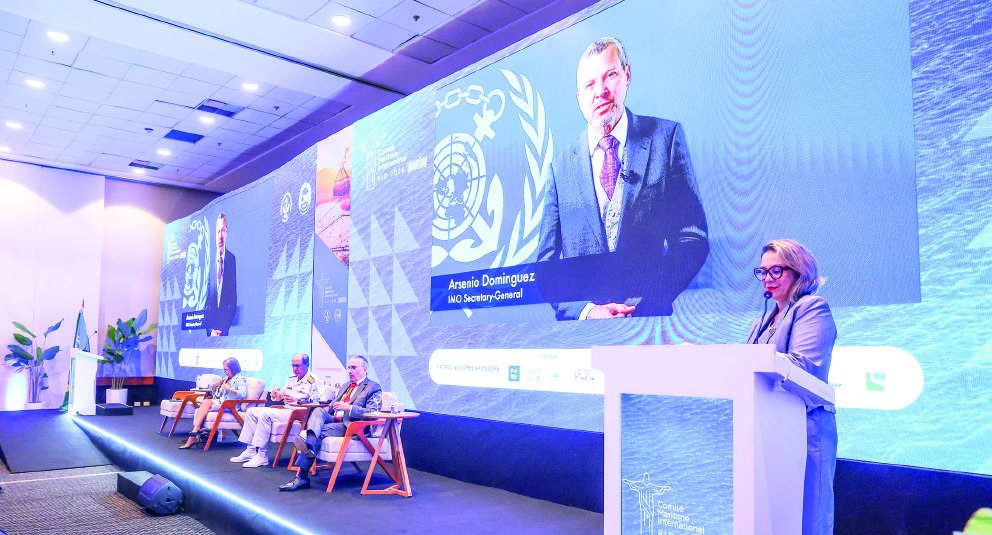
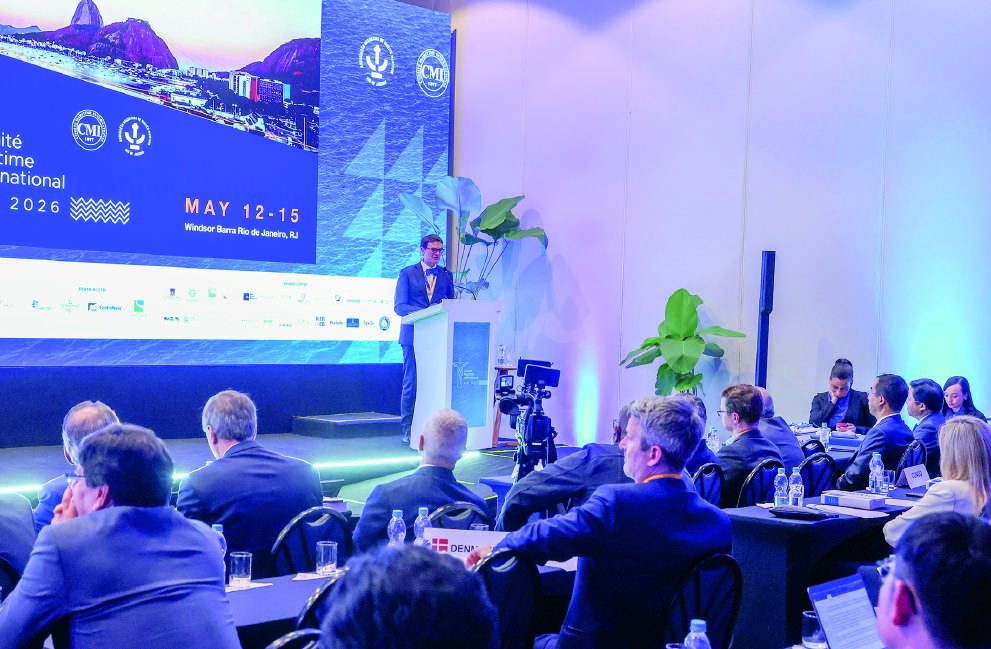
Opening remarks were delivered by CMI President Ann Fenech and the Secretary-General of the International Maritime Organization (IMO), 1 Arsenio Dominguez. In his remarks, Dominguez emphasised how crucial it is to ensure freedom of navigation and effectively protect seafarers’ rights and ensure that seafarers are under no circumstances made victims of armed conflict.
The Future of Limitation of Liability
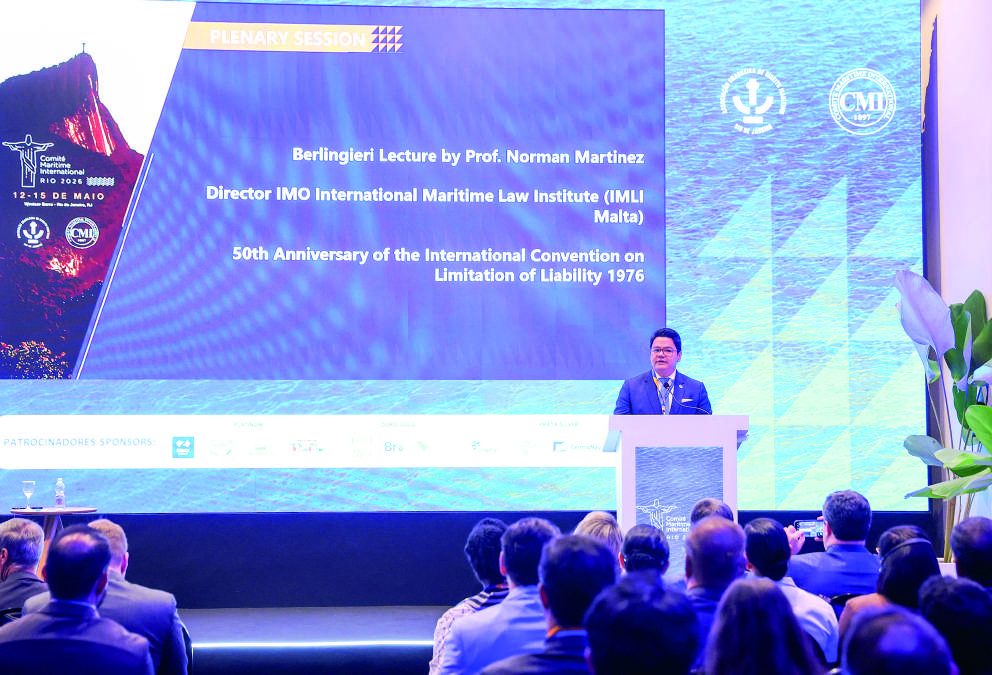
On the colloquium’s first day, the traditional Francesco Berlingieri Lecture was delivered by Professor Norman Martínez, director of the IMO International Maritime Law Institute (IMLI). 2 He is well known in the industry as the author of Limitation of Liability in International Maritime Conventions: The Relationship between Global Limitation Conventions and Particular Liability Regimes.3 His lecture marked the fiftieth anniversary of the 1976 Convention on Limitation of Liability for Maritime Claims (LLMC). 4
The provisions of the instrument are still not interpreted uniformly, notwithstanding the IMO resolution5 adopted five years ago, under which it is virtually impossible to deprive a shipowner of the right to limit liability. In practice, those resolutions make the shipowner’s right to limit liability6“virtually unbreakable.”
The right to limit liability may be lost only on proof of intent, or of “recklessness with knowledge that such loss would probably result.”The draft convention had provided for gross negligence as the disqualifying conduct, but that ground was replaced by the formula just quoted. The choice was no accident: it was the compromise struck in exchange for raising the limits of liability. 7
According to the speaker, the chief practical difficulty in applying limitation of liability today lies in the 1976 Convention and its 1996 Protocol existing simultaneously. They set different limits, which opens the door to forum shopping, whereby the most suitable jurisdiction is then chosen. By way of illustration, Professor Martínez cited the incident involving the Di Matteoя,8in which the vessel anchored in a prohibited area and severed the Malta–Sicily subsea cable in 2019.
Summing up, Professor Martínez observed that limitation of liability remains as much a cornerstone of maritime law today as it was half a century ago. Its future, he argued, will turn on whether states are prepared to overcome the contradictory case law that has grown up around it by harmonising their national legislation.
Safe Escape Routes in the Line of Fire
The impact of armed conflict on merchant shipping proved one of the colloquium’s most animated topics. The experts concluded that, given the extent and frequency of the disruption caused by geopolitical conflict in recent years, the shipping industry can no longer be regarded as neutral infrastructure for global trade.
The past four years have demonstrated that a war erupting anywhere in the world affects the entire freight market: routes shift, sanctions risks and payment disruptions multiply, and the entire approach to insurance shifts. Private companies can no longer treat geopolitics as an external factor since it has become part of daily risk management.
Yet the industry too often forgets that it is ships’ crews who stand on the front line. This spring, for instance, roughly 20,000 seafarers were stranded in the Strait of Hormuz for three months, noted Nick Shaw, chief executive officer (CEO) 9 of the International Group of P&I Clubs:10 “They are the first to take the hit, and they risk their lives doing so.”Hence, at the outset of any hostilities, it is vital to secure “safe escape routes”for evacuating the crews of vessels caught in a conflict zone.
Against this backdrop, the global trade association BIMCO11 recommends using the latest revisions of its war-risk clauses: VOYWAR 2013 for voyage charters and CONWARTIME 2013 for time charters. These clauses define “war risks”broadly, encompassing armed operations that require no formal declaration of war. They rest on three basic principles: – the safety of the crew, the vessel, and the cargo shall be protected, – the shipowner and the master take the decisions needed to secure that safety, – the charterers bear all the consequences of those decisions, including the costs.
The master and the shipowner may therefore decline to follow the charterers’ orders if they judge that transiting a particular area would expose the vessel, the crew, or the cargo to a war risk, explained Pietro Palandri, vice-president of the Italian Maritime Law Association and senior partner at Studio Legale Mordiglia. Every attempt by charterers to challenge that approach, he said, has so far failed.
In the new environment, the complete absence of inter-state litigation also plays an unhelpful role, argued Rafael Zelesco Barretto, a professor of international law. Disputes arising from the current conflicts never reach the International Tribunal for the Law of the Sea, even though its judges are precisely the ones who could clarify certain questions. The standard charterparty forms and insurance conditions, for their part, are in many respects ill-suited to today’s geopolitical crises, Mr Palandri believes: “They were drafted for more familiar situations, in which a charterer sends a vessel into an area whose dangers are known in advance, however, today a ship may find itself in a conflict zone after the voyage has already begun, and the existing terms do not always allocate the risks fairly.”
The “Shadow Fleet”and “False Flags”
The growing popularity of these illicit practices poses a direct threat not only to the international system of maritime safety but to the environment as well. The subject was taken up at a session moderated by Frank Nolan, a former president of the Maritime Law Association of the United States.
Vessels sailing under false flags: the numbers
• Current total: 546 (up from 470 at the end of the previous quarter),
• Average age: 26 years,
• Two-thirds are tankers, 49 of them very large crude carriers (VLCCs), 12
• 63 per cent of such vessels rely on outright fraudulent registries,
• In 2026, the flags of Syria and Myanmar were fraudulently used for the first time.
Source: presentation by Michelle Wiese Bockmann, analyst at Windward, at the CMI Colloquium.
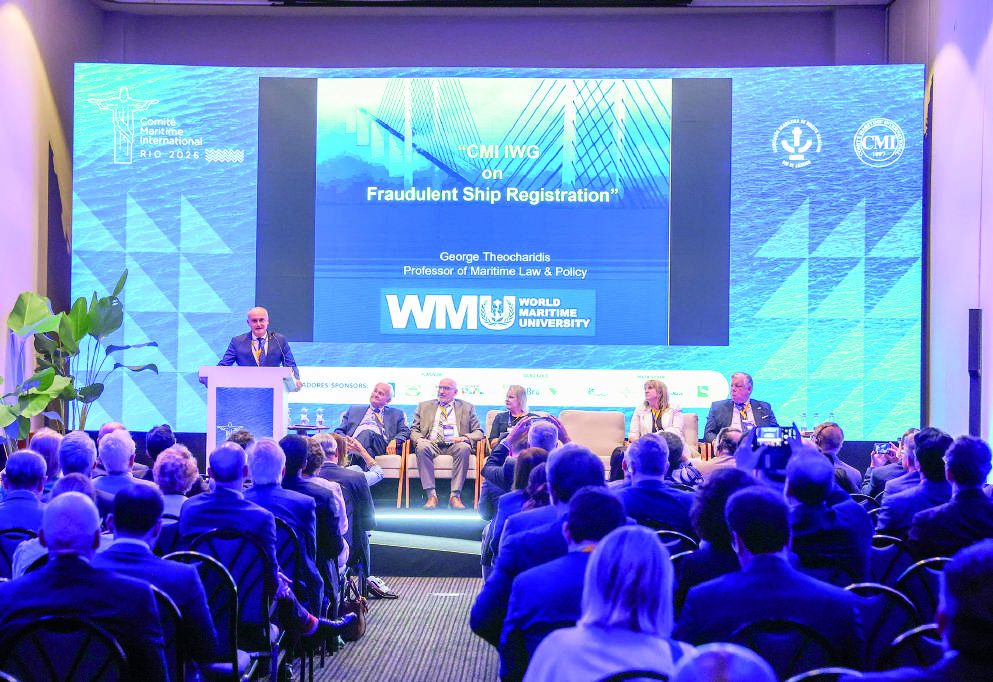
The central legal challenge is that neither “shadow fleets”nor “false flags”are recognised legal terms, a point pressed by George Theocharidis, professor at the World Maritime University. 13 There are at present no binding international rules governing the registration process itself. The 1986 UN Convention on Conditions for Registration of Ships does lay down international standards for entering vessels in a national register, addressing the genuine link, ownership, management, registration, accountability, and the role of the flag state, but it has never entered into force. Articles 91, 92, and 94 of UNCLOS,14meanwhile, supply only general principles, and national laws construe them differently, breeding jurisdictional conflict.
The picture is made worse by the unpredictability of sanctions decisions, as the decision-making process is highly politicised. John Markianos-Daniolos, a well-known maritime lawyer, offered two examples of Greek shipowners “destroyed”by American sanctions over Venezuelan operations that were perfectly lawful when the voyages took place: in the end, not a single flag would accept their vessels, except the fraudulent ones.
“A ship without nationality is not a mediaeval ‘outlaw’ whom anyone may strike. A ship without nationality is a ship that enjoys the protection of no flag state, but that does not make it fair game for all. Besides, there is a crew on board, and their rights, too, must be respected,” stressed Professor Rafael Zelesco Barretto.
In an effort to close at least some of the gaps, the 113th session of the IMO Legal Committee15 approved new guiding principles on ship registration this spring. At the next session, in 2027, the experts have agreed to draw up further recommendations on the registration of shipping companies and to define more clearly the role of port and coastal states in combating unlawful registries.
One way or another, the object of all these measures is to make life as difficult as possible for the unscrupulous shipowner. Fail to do so, the participants in the CMI discussion concluded, and a major disaster (environmental or humanitarian) becomes merely a matter of time.
Remedying Harm to Marine Ecosystems
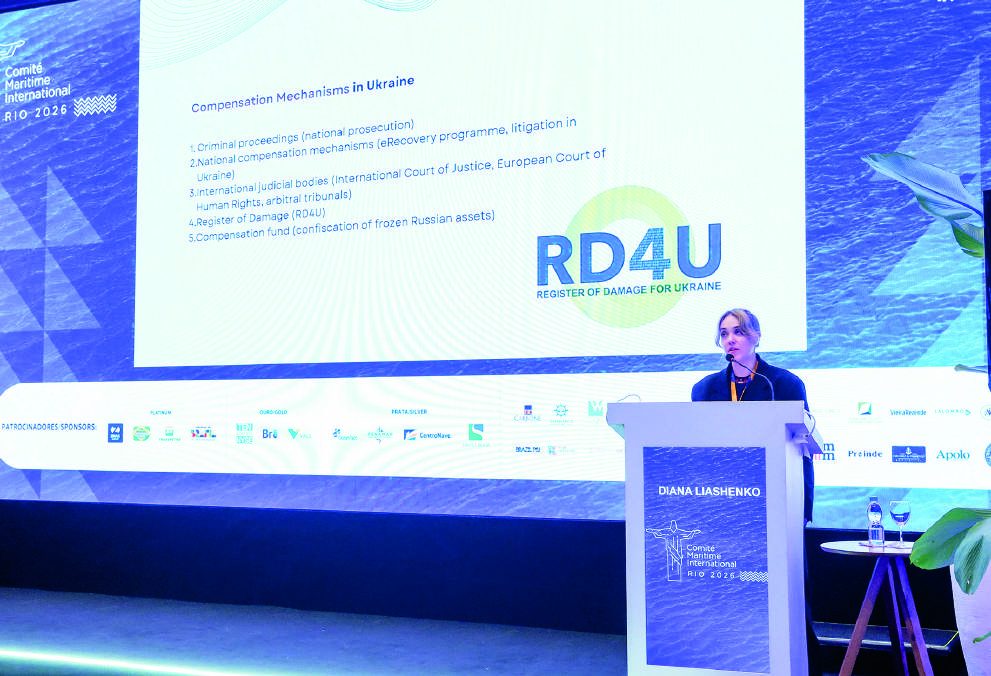
Young CMI (the youth committee) holds an annual maritime-law essay competition, and the winner is invited to present the work at the General Assembly. This year the prize went to Diana Liashenko, a lawyer at Black Sea Law Company. Taking the Iraq-Kuwait conflict as her case study, she offered a detailed analysis of the mechanisms for compensating wartime environmental damage that actually worked, and that remain relevant today.
In 1991, as they retreated from Kuwait, Iraqi forces deliberately discharged between 8 and 11 million barrels of crude oil into the Persian Gulf. It was one of the largest oil spills in history: thousands of seabirds perished, and the mangrove forests, coral reefs, and sea-turtle nesting grounds all but disappeared. Saddam Hussein’s army bombed refineries and oil-storage facilities, compounding the pollution.
In response, the United Nations established the Compensation Commission (UNCC) 16 to administer the payment of compensation for the damage caused by Iraq’s invasion of Kuwait. More than US 1.1 billion, funded from the aggressor’s confiscated oil-export revenues, went towards environmental restoration, including the restoration of marine and coastal ecosystems.
Thus was born an important precedent of international law, Ms Liashenko noted in her essay: states must compensate for the damage they inflict on the environment in the course of hostilities.
She concluded that the aggressor states which have unleashed wars in recent years will likewise have to answer for the harm done to the environment generally and to the marine environment in particular. That will require effective international machinery for enforcing national judgments. No less important are prompt monitoring, so that damage can be assessed accurately, and the creation of dedicated funds capable of operating in conditions of armed conflict.
“The Law Must Keep Pace with the Sea:” The CMI General Assembly
In the space of three hours, the Assembly touched on more than a dozen topics, from the successful advance of the Beijing Convention and the Lex Maritima to plans for new instruments, among them a codification of the general principles of marine insurance.
The signal achievement of the past year was the entry into force of the UN Convention on the International Effects of Judicial Sales of Ships, known as the Beijing Convention. At the time of the CMI General Assembly it had three ratifications: Spain, Barbados, and El Salvador. 17It now falls to the national associations of the major European maritime powers to persuade their governments to ratify.
Participants returned again and again to the CMI”s role as the connective tissue between the different constituencies of the maritime industry. The point was pressed by the Comité”s new administrator, Peter Larsen. In his view, the organisation must know and weigh the interests of a broad circle of actors, from shipowners and insurers to government officials in many countries; otherwise, the legal instruments the CMI produces will prove useless to the shipping market.
Nor was the Lex Maritima overlooked, the first compendium of generally recognised principles of maritime commercial law, designed to harmonise maritime law worldwide. The final text was published on the CMI website last autumn18 and is now being translated into a range of languages. RUMLA will complete the Russian translation this year.
During the Assembly, it emerged that the success of the Lex Maritima has inspired an analogous project: a set of unified principles of marine insurance.
The first stage will be to analyse national regulation in different countries alongside the standard terms of marine insurance. In most jurisdictions, after all, statute sets only a general framework; real practice is shaped by what the parties write into their contracts.
The volume of material will be enormous, so the participants agreed to enlist artificial intelligence for the initial review – while professing, collectively, a “healthy scepticism”about what AI can do. The envisaged working model runs as follows: the national associations supply their statutes, standard terms, and translations; the assembled materials are loaded into an AI tool; a prompt is drafted to steer the analysis along a prescribed structure; and experts then verify the results, form sub-groups, and decide whether common principles can be distilled for particular areas.
The choice of method shows that the CMI is not abandoning traditional legal expertise but seeking to deploy technology judiciously to process a vast and heterogeneous body of documents. In marine insurance, where standard terms are numerous and historically intricate, the approach could pay real dividends, provided the expert verification is rigorous.
Decarbonisation and the Rise of Autonomous Shipping
The transition to ammonia, hydrogen, methanol, and other alternative fuels raises legal questions as well as technical ones. Greenhouse-gas emissions fall, but the approach to ship design, crew safety, port infrastructure, and liability for casualties changes root and branch. The CMI’s working group on decarbonisation is therefore engaging closely with the IMO, working through the questions of liability and compensation for damage arising from the use of alternative, nonhydrocarbon fuels.
The principal questions are these:
• who bears liability in an incident involving an alternative fuel,
• which safety standards apply,
• whether the existing conventions on pollution and liability suffice,
• whether new international instruments are needed.
Decarbonisation, moreover, runs up against more than technological and legal complications: many ports simply lack the bunkering capacity and infrastructure for alternative fuels. That, too, must be taken into account.
The working group on cybersecurity has its own substantial agenda. While the IMO is still developing new approaches to the international regulation of cyber risk, lawyers have a genuine opportunity to shape the process. The field extends well beyond the technical protection of IT systems, reaching from navigation and ship management to the limits of carrier liability and the safety of the crew.
CMI members agreed on the need to bring the cybersecurity specialists into closer contact with colleagues working on autonomous shipping. Uncrewed vessels, maritime autonomous surface ships (MASS), 19 depend on digital systems far more heavily than conventional ships do. A cyberattack on an autonomous vessel therefore threatens not only data integrity but the safety of navigation itself: a moving object that suddenly loses control can do serious damage to other vessels and to port infrastructure.
Hence another topic for discussion in the near future: the investigation of marine casualties involving autonomous ships. The existing legal framework largely presumes a vessel under human control. If the key decisions are taken by an algorithm or a remote operator, the traditional logic of marine casualty investigation will have to be rethought.
New Members, Debts, and Obituaries
The Maritime Law Association of the Dominican Republic was admitted to the Comité Maritime International. The country’s previous association had been expelled in 2017 for prolonged non-payment of membership dues; its successor has agreed to clear the accumulated arrears within three years.
Meanwhile, there are debtors among the current membership too: the national organisations of North Korea and Tanzania. After repeated reminders, the Assembly in Brazil put the question of their expulsion on the table.
The CMI also created a special committee to devise a methodology for calculating membership dues. The idea came from the French Maritime Law Association, on the ground that the funding model of an international industry organisation ought to be transparent, comprehensible, and sustainable.
As tradition requires, the Assembly honoured the memory of colleagues who had died over the past year: Paul Gill and Bent Nielsen. Gill was a distinguished Irish maritime lawyer who devoted particular attention to protecting the rights and interests of seafarers across a broad range of issues, from securing unpaid wages to saving lives in armed conflicts. He never tired of insisting that world trade rests, in the end, on the shoulders of ordinary seafarers.
Nielsen, for his part, played a significant role in the reform of the York-Antwerp Rules on general average and worked extensively on the legal regulation of wreck removal. He had a rare gift for workable compromise among shipowners, cargo interests, and insurers, striking the delicate balance between commercial and public interests.
What Comes Next
Summing up, the participants in the CMI Assembly stressed that, given today’s realities, it is vital to preserve legal depth without sacrificing the speed of decision-making, to respect tradition, and to use new technologies effectively, so as to produce the instruments the industry actually needs.
Nor should it be forgotten that the Comité’s strength lies in its national associations, whose members know their own legal systems intimately and can convey to their governments the significance of international instruments. Beyond building legal expertise, it is equally crucial to collaborate with the IMO, BIMCO, the ICS,20 the P&I Clubs, WISTA,21 universities, insurers, shipowners, financiers, and technical specialists.
The CMI cannot afford to rest on what it has achieved: the international agenda continues to generate new challenges requiring legal responses. For maritime law, indeed, international harmonisation is not an academic dream but a practical necessity. Ships sail, cargoes move, risks evolve, and technologies change, so “the law must keep pace with the sea.”
“This time Russia came up at practically every session. Regrettably, our country was mentioned not for any achievement in maritime law or merchant shipping, but solely in the context of the fight against the ’shadow fleet,’ sanctions evasion, and the mounting risks to the environment,” said Konstantin Krasnokutskiy, president of RUMLA.
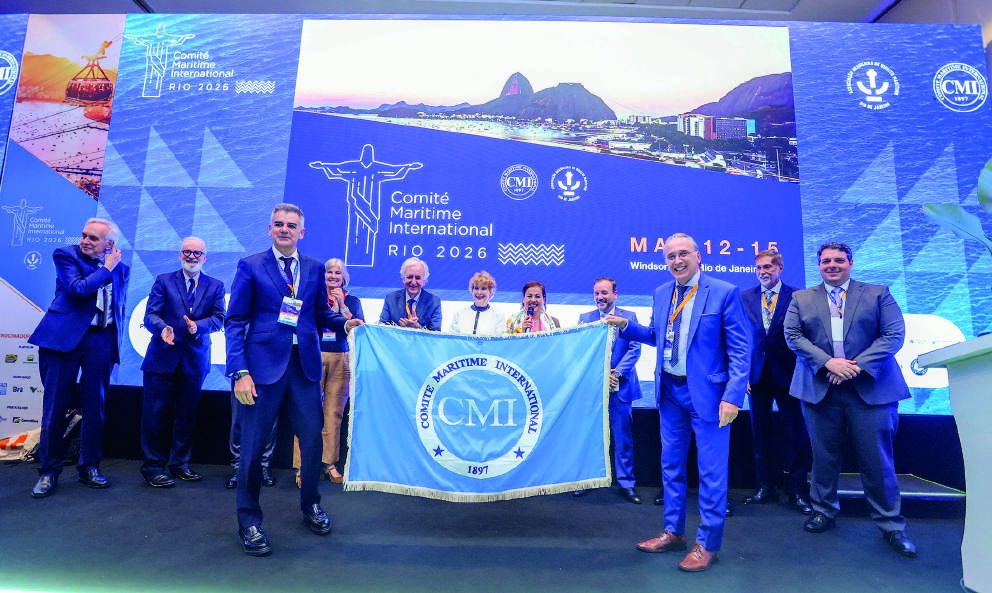
The Assembly closed with the ceremonial handover of the CMI flag, which representatives of the Brazilian maritime law association passed to their Spanish colleagues. The next conference of the Comité Maritime International will take place in Valencia in the spring of 2027.