Article
Foreword
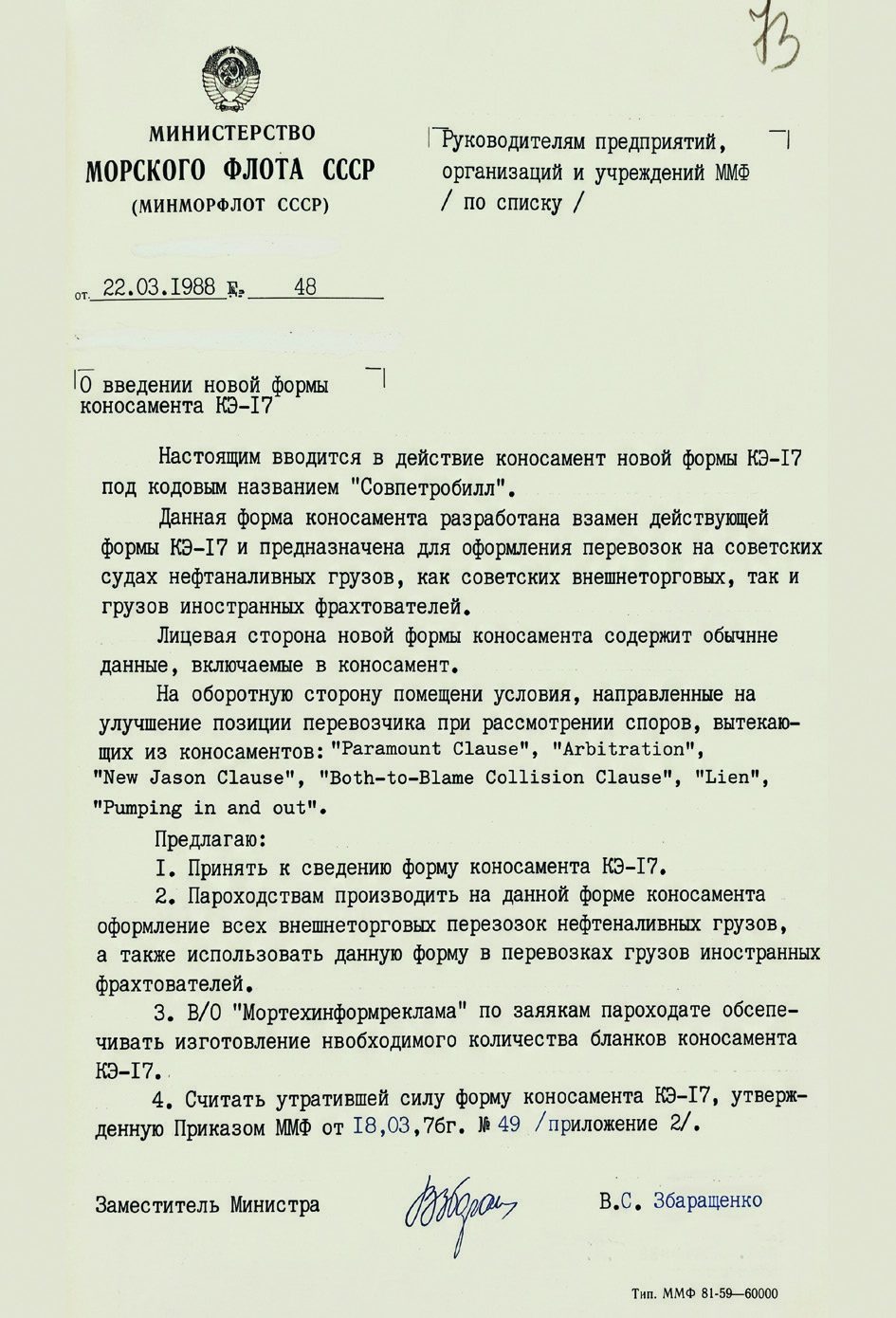
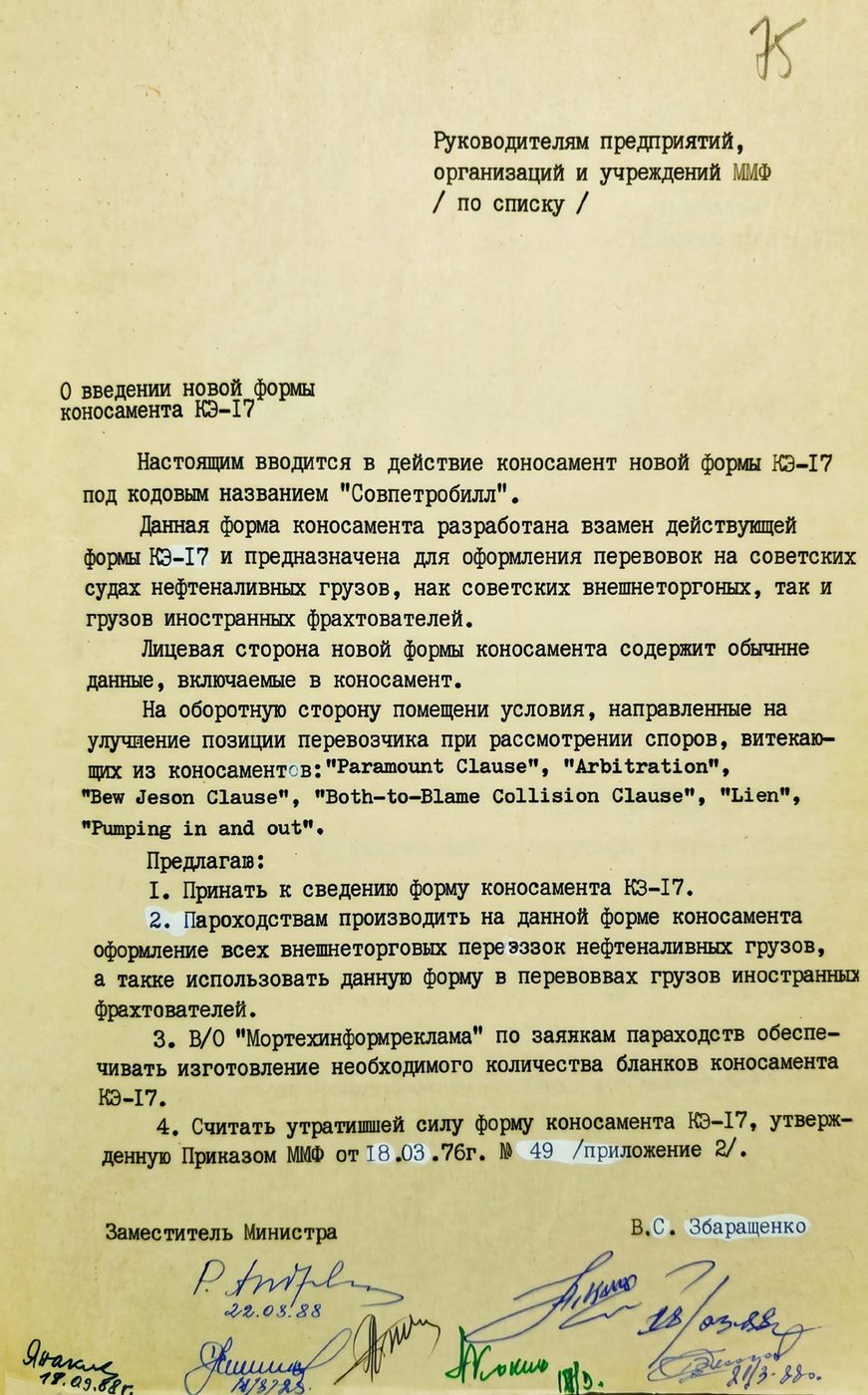
In our regular “Unification of Maritime Law” section, we publish the Sovpetrobill / KE-17 standard-form bill of lading, which was brought into force by Letter No. 48 of the USSR Ministry of the Maritime Fleet of March 22, 1988 (hereinafter, “Minmorflot,” or “MMF”).
The Sovpetrobill bill of lading form is intended for “documenting on Soviet vessels the carriage of bulk oil cargoes on both Soviet foreign-trade cargoes and cargoes of foreign charterers.”
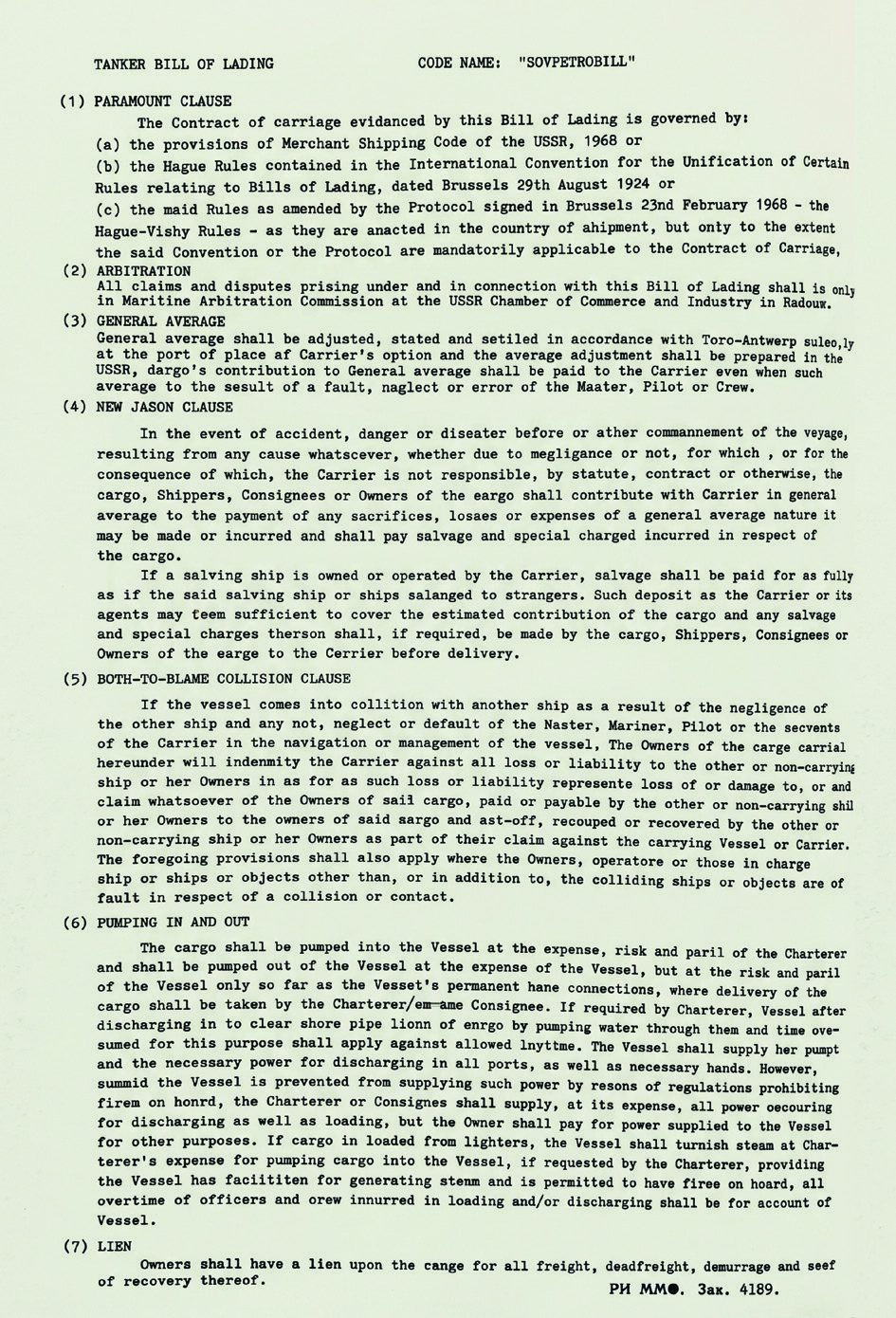
Among the merits of this standard form, Minmorflot identified the clauses printed on the reverse, which were “directed at strengthening the carrier’s position in disputes arising out of bills of lading (“Paramount Clause”, “Arbitration”, “New Jason Clause”, “Both-to-Blame Collision Clause”, “Lien”, “Pumping In and Out”).”
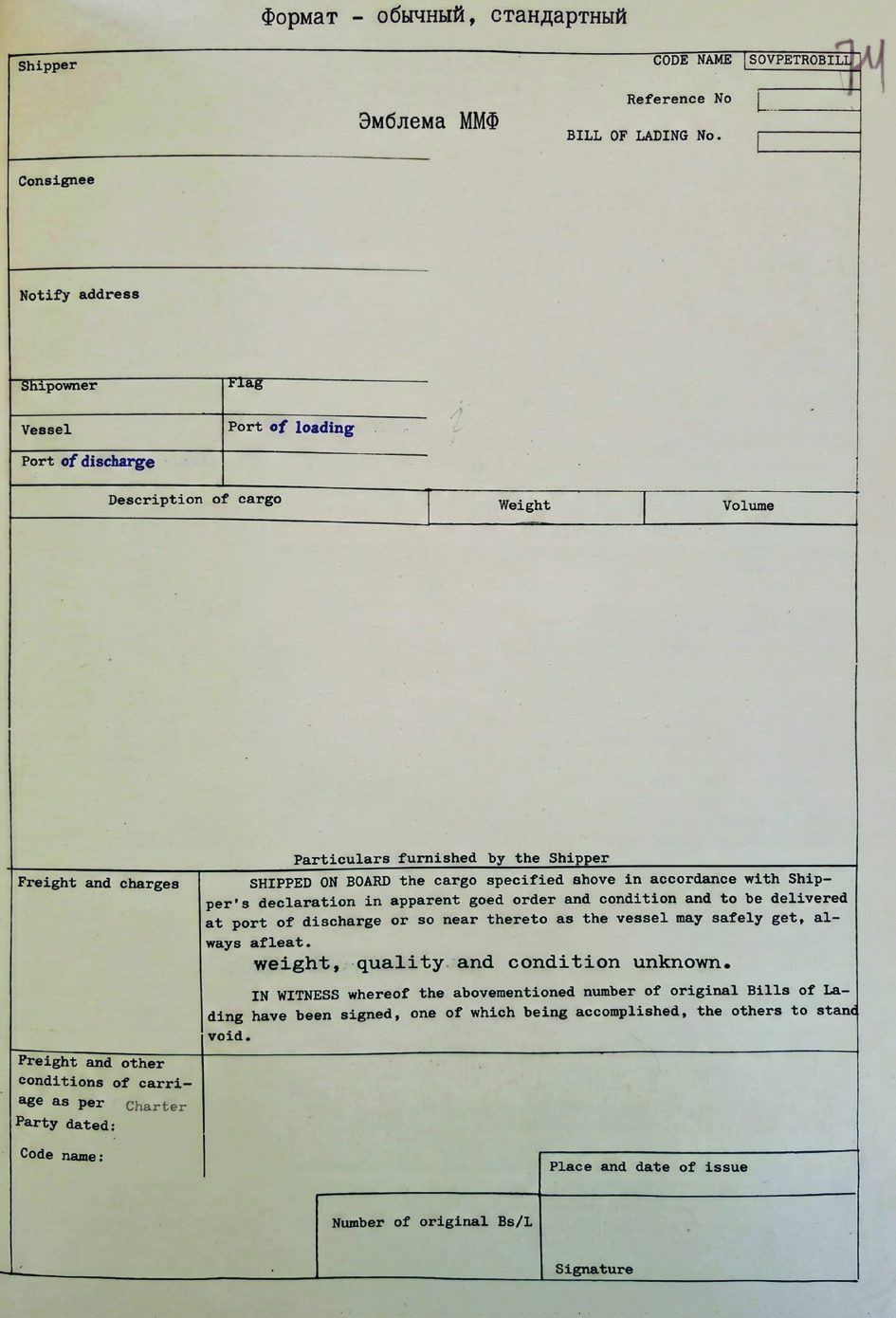
Soviet shipping companies were invited to submit applications to the All-Union Association “Mortechinformreklama” for the production of the required amount of forms. In other words, the bill of lading forms were typeset and printed, and were thereafter filled in by the shipping companies themselves: the front of the bill of lading set out the particulars of the shipper and consignee, the ports of loading and discharge, and the cargo description. The reverse side contained pre-printed terms as to carriage, applicable law, and arbitration.
The All-Union Association “Mortechinformreklama” is, however, best known first and foremost as a publisher of books on maritime transport. Throughout its existence, the association issued an enormous body of literature: from books on navigation and the operation of maritime transport, dictionaries, manuals, rules, and reference works, to collections of scholarly papers on maritime law. It is also worth noting that all documents of the USSR Ministry of the Maritime Fleet orders, letters, etc. were likewise published by “Mortechinformreklama”.
Pursuant to the same Minmorflot letter, Soviet shipping companies were to use Sovpetrobill for all foreign-trade carriage of oil cargoes and of cargoes of foreign charterers.
At the time the Sovpetrobill form was brought into force, the Soviet shipping companies were structurally subordinate to the USSR Ministry of the Maritime Fleet. In those years, the international carriage of oil cargoes was undertaken by the Novorossiysk, Primorsk, and Latvian Shipping Companies, as well as by the joint-stock commercial enterprise Soviet Commercial Fleet (Sovkomflot), established in 1988.
The largest tanker fleet was operated by the Novorossiysk Shipping Company, which is reliably known to have made use of the standard form. This is confirmed by arbitral practices specifically, Case No. 15/1996 of the Maritime Arbitration Commission at the Chamber of Commerce and Industry of the Russian Federation (the “MAC at the CCI of the Russian Federation”), where the award was rendered on June 4, 1997.
That dispute concerned the carrier’s liability for damage caused by a combination of circumstances some for which the carrier is not liable (error in navigation), and others for which the carrier is liable (the carrier’s own negligence). Those proceedings related to the General Average and New Jason Clauses (clauses 3 and 4 of Sovpetrobill).
Within Case No. 15/1996, the MAC at the CCI of the Russian Federation also addressed the question of its own jurisdiction. Clause 2 of Sovpetrobill provides that all disputes arising out of it are to be referred to the Maritime Arbitration Commission at the Chamber of Commerce and Industry.14 The arbitrators held that the MAC at the CCI of the Russian Federation is the legal successor to the Maritime Arbitration Commission at the USSR Chamber of Commerce and Industry, and that it therefore had jurisdiction to resolve disputes pursuant to arbitration agreements concluded in the Soviet period. 15
It appears that no typographically produced blank forms produced by Mortechinformreklama16 for Soviet shipping companies remain in circulation, and it is unlikely that such forms would have any practical, as opposed to aesthetic, significance in our digital age. Even so, a typographically produced blank form would be of considerable interest to our readers: there is something quite different about seeing such documents on authentic paper bearing the MMF emblem, rather than the now-customary A4 sheets in Arial or Times New Roman printed on a laser printer.17
Returning to the practical aspect, it should be emphasized that the printed bill of lading is the appendix to Letter No. 48 of the USSR Minmorflot of March 22, 1988, which was prepared on a typewriter. In the present issue of the journal, we have faithfully reproduced the standard form line by line, so that the text fully matches the original (i.e., the appendix to the MMF letter).
As is sometimes the case with well-made things, Sovpetrobill has outlived the country in which it was created and is today widely used by carriers of oil and petroleum products. Russian and foreign maritime lawyers (English ones, for instance) still encounter disputes arising out of carriage in which the Sovpetrobill standard form figures. The bill of lading is intended for use with charterparties, contracts for the carriage of bulk oil cargoes by sea (voyage charters). In particular, carriers use Sovpetrobill in conjunction with the ASBATANKVOY, BPVOY, SHELLVOY, and EXXONMOBILVOY charter forms.
The popularity of Sovpetrobill is not surprising: carriers select it because the terms of the form are directed at strengthening their position in disputes arising out of bills of lading. That is precisely the purpose for which the document was originally designed. The bill of lading refers to the Hague and Hague-Visby Rules of 1924 and 1968 and, with respect to general average, to the York-Antwerp Rules of 1974. The latter are regarded as among the most favorable for the shipowners. The general trend has been toward reducing the general average expenses that may be allocated to the cargo owner (the 1990 amendments to the 1974 Rules; the 1994, 2004, and 2016 versions). The lien on cargo for freight, dead freight, and demurrage, and for the costs of recovering the same, is also of interest.
In the appendix to Letter No. 48 of the USSR Minmorflot of March 22, 1988, the Sovpetrobill / KE-17 bill of lading appears in English only, owing to its use in international carriage of oil cargoes.
For purposes of promoting maritime law and providing practical assistance to industry participants, in the present issue we publish not only the original bill of lading form, but also its Russian translation.
The translation of certain clauses for example, those on applicable law and arbitration, presents no difficulty. With others, however, the situation is more complex. Many of the clauses are widely encountered and appear in standard bills of lading and charterparty forms, and their Russian translations can be found in legal literature and in published translations of charters and bills of lading.18 The quality of such translations, however, varies considerably: some are generally successful and require only stylistic refinement, while others are so poorly rendered that they lose their meaning altogether.
An illustrative example is the Both-to-Blame Collision Clause. This clause appears, for instance, in the CONGENBILL bill of lading. A Russian translation of that bill of lading is readily available on the Internet at the “Kodeks” website,19 where the source is identified as having been verified against the publication Commercial Practice in River Transport in Foreign-Trade Carriage, Reference Manual, Information Compendium No. 30, Moscow, 1994.
The original English version reads:
(5) BOTH-TO-BLAME COLLISION CLAUSE
If the vessel comes into collision with another ship as a result of the negligence of the other ship and any act, neglect or default of the Master, Mariner, Pilot or the servants of the Carrier in the navigation or management of the vessel, the Owners of the cargo carried hereunder will indemnify the Carrier against all loss or liability to the other or non-carrying ship or her Owners in so far as such loss or liability represents loss of or damage to, or any claim whatsoever of the Owners of said cargo, paid or payable by the other or non-carrying ship or her Owners to the owners of said cargo and set-off, recouped or recovered by the other or non-carrying ship or her Owners as part of their claim against the carrying Vessel or Carrier. The foregoing provisions shall also apply where the Owners, operators or those in charge of any ship or ships or objects other than, or in addition to, the colliding ships or objects are at fault in respect of a collision or contact.
The translation in the source cited above [an unsuccessful translation], if rendered back into English, conveys the following meaning:
..the owners… …of the cargo… …release [the carrier] from any liability towards another… …ship…
The translation of the clause is unwieldy: the first sentence consists of 124 words and the second of 44 words. That said, this is a feature of the original as well - 126 and 39 words respectively. Sentences of such length are difficult to follow. The principal problem, however, lies not in their length but in the difficulty of grasping the meaning of the clause (“the owners… …of the cargo… …release [the carrier] from any liability towards another… …ship”). From the standpoint of Russian law, it is difficult to understand from such language what kind of “release from liability” is meant, and how a cargo owner could release a carrier from liability towards a third party.
The root of the problem in the unsuccessful translation lies in conveying the meaning of the term “to indemnify.” In English-Russian legal dictionaries20 “to indemnify” is rendered, variously, as: to guarantee compensation for harm or damage; to compensate for harm or loss; to release from punishment; and to make whole.
In order to correctly understand the legal nature of the cargo owner’s obligation, one must first understand the purpose pursued by the carrier in incorporating this clause into the contract of carriage (whether bill of lading or charterparty).
The widely applicable Hague Rules21 (and the Hague-Visby Rules,22 hereinafter – the “Rules”) set out an extensive list of risks for which the carrier (or vessel) is not liable. In particular, neither the carrier nor the ship shall be responsible for loss or damage arising or resulting from act, neglect, or default of the master, mariner, pilot or the servants of the carrier in the navigation or in the management of the ship (the so-called “error in navigation” defense). Where damage is caused to cargo as a result of a collision of vessels caused by error in navigation, the cargo owner’s claim cannot be sustained by virtue of Article IV(2)(a) of the Rules (the contract of carriage / charterparty / bill of lading typically incorporates the Rules by reference). An identical rule appears in Article 167 of the Merchant Shipping Code of the Russian Federation (the “MSC RF”). Loss incurred during carriage is governed by the contract, and a contractual claim will not be sustained for the reasons stated above.
A claim in tort is a workaround. The cargo owner may bring a tort claim against the other, non-carrying vessel that was at fault in the collision. The cargo owner’s tort claim is subject neither to the provisions of the contract of carriage (charterparty, bill of lading) nor to the Rules. The other, non-carrying vessel that was at fault in the collision, having compensated the cargo owner for 100% of its losses, will then acquire a recourse claim against the carrying vessel proportionate to its degree of fault in the collision (in the overwhelming majority of cases, the fault of vessels in a collision is shared).
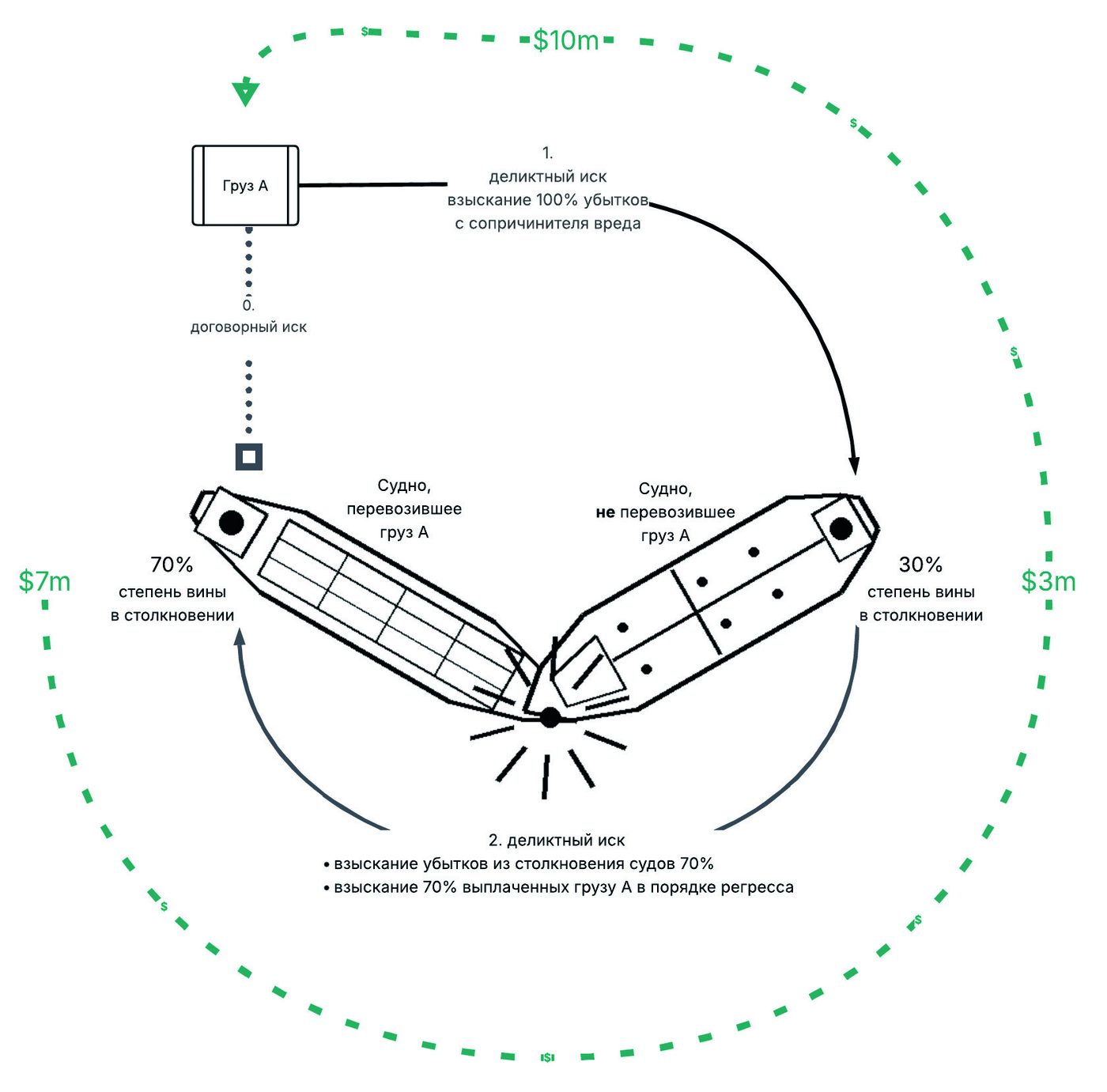
The carrier, initially protected by the contract of carriage (the Rules) from claims where the cargo loss was caused by error in navigation, finds itself in a situation where it in fact compensates (albeit only in part, in proportion to its degree of fault in the collision) the cargo owner for its loss-through the recourse claim of the other vessel, the loss component of which will include the sum paid to the cargo owner. This economic effect can be illustrated in the following diagram (in green):
0. The cargo owner’s contract claim against the carrier cannot be sustained by virtue of Article IV(2)(a) of the Hague / Hague-Visby Rules, which release the carrier from liability for error in navigation. The same rule appears in Article 167 of the MSC RF.
1. Recovery of losses by way of a tort claim by the cargo owner against the owner of the non-carrying vessel. The losses bear a causal connection to the tortfeasor’s conduct even where fault is shared (say, 30%).
2. Recourse recovery by the non-carrying vessel against the carrier, in proportion to the carrier’s degree of fault in the collision, of the sums paid to Cargo A.
Precisely this situation is what the Both-to-Blame Collision Clause is designed to prevent. It does not “release” the carrier from liability towards the other vessel, as in the wrongful translation of the clause into Russian; rather, it imposes on the cargo owner the duty to indemnify the carrier for those losses the carrier might sustain as a result of the recourse claim by the other, non-carrying vessel. In other words, where the cargo owner has obtained recovery from the other vessel, and that other vessel has then recovered the corresponding sum from the carrier, the cargo owner must compensate the carrier for those losses.
From the standpoint of Russian law, following the 2015 reform of civil legislation, this construction corresponds most closely to a loss-indemnity agreement. Prior to the reform, Russian law contained no equivalent to the English concept of indemnity. Following the introduction of Article 406.1 to the Civil Code of the Russian Federation (the “Civil Code”), the institution of indemnification of losses can now be used to explain the legal nature of such clauses in the realities of Russian law.
In the context of Russian law, the Both-to-Blame Collision Clause should be understood as an agreement under which the cargo owner assumes a duty to indemnify the carrier for losses arising from the stipulated circumstances – namely, a recourse claim by another vessel. Such a recourse claim, in turn, arises because the cargo owner first recovered the full amount of his losses from the other, non-carrying vessel, thereby circumventing the contractual limitations on the carrier’s liability. In other words, the meaning of the clause is that it reallocates the risk of indirect recovery of losses from the carrier and restores the parties to the economic outcome that would have resulted had the contract of carriage and the Hague or Hague-Visby Rules been applied directly.
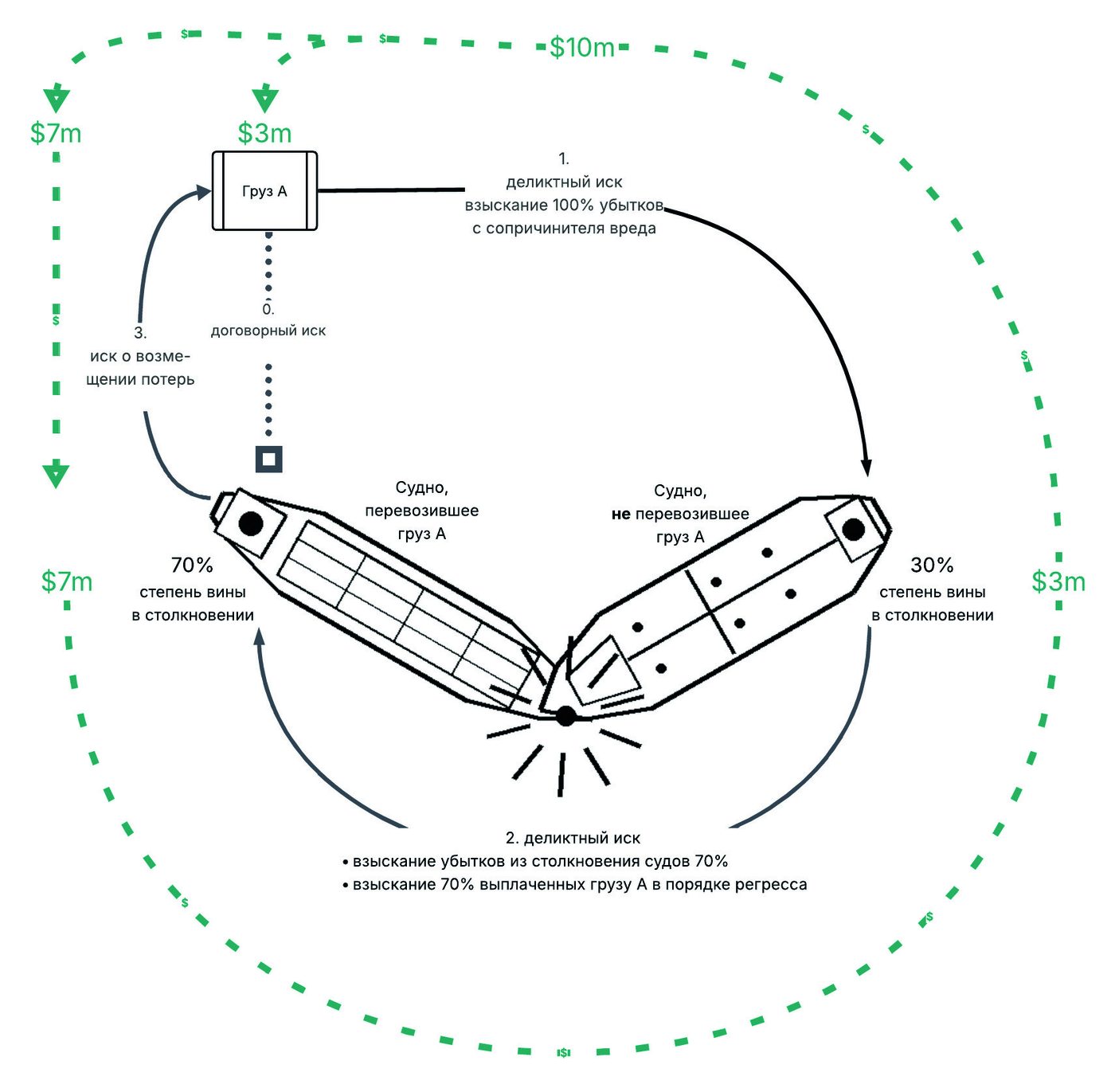
The economic effect of the Both-to-Blame Collision Clause may be demonstrated by the following diagram (in green):
0. The cargo owner’s contract claim against the carrier cannot be sustained by virtue of Article IV(2)(a) of the Hague / Hague-Visby Rules, which release the carrier from liability for error in navigation. The same rule appears in Article 167 of the MSC RF.
1. Recovery of losses by way of a tort claim by the cargo owner against the owner of the non-carrying vessel. The losses bear a causal connection to the tortfeasor’s conduct even where fault is shared (say, 30%).
2. Recourse recovery by the non-carrying vessel against the carrier, in proportion to the carrier’s degree of fault in the collision, of the sums paid to Cargo A.
3. Indemnity claim by the carrier against the cargo owner for the amount paid out under the recourse claim.
Without resorting to the concept of “indemnification of losses”, which did not exist in Russian law at the time, G. G. Ivanov explained the meaning of the Both-to-Blame Collision Clause using the construction “undertakes to reimburse to the vessel”: “…the cargo owner may recover 100% of his losses from the vessel that did not carry the cargo, irrespective of the degree of fault of that vessel in the collision. To avoid such consequences, carriers developed a special clause for inclusion in charters and bills of lading (the Both-to-Blame Collision Clause) for use under U.S. law. Pursuant to this clause, the cargo owner undertakes to reimburse to the vessel on which the cargo was carried that portion of the losses, which the vessel is required to pay to the second vessel involved in the collision, and from which 100% of the cargo losses have been recovered (the cargo owner does so because, under the Hague-Visby Rules, the carrier is released from liability for error in navigation).”23
G. G. Ivanov notes the use of this clause under U.S. law. The question is whether it makes sense to use such a clause under Russian law. The general rule of Article 1080 of the Civil Code provides that persons who jointly cause harm are jointly and severally liable to the victim. If harm has been caused as a result of a tort (e.g. a collision of two vessels) can a tort claim under Russian law be brought against the non-carrying vessel that was at fault in the collision on the basis of this rule?
In such a case, the special rule of Article 313 of the MSC RF will apply. Under that rule, in respect of damage caused to the property of third parties, the owners of the vessels at fault in the collision are liable in proportion to their degrees of fault. An exception is made for liability to third parties for damage caused by death or personal injury, which is joint and several, with the right of recourse of the shipowner that has paid more than his proper share against the other shipowners.
Article 313 of the MSC RF reproduces virtually verbatim Article 4(1) of the Convention for the Unification of Certain Rules of Law with respect to Collision between Vessels, Brussels, September 23, 1910 (hereinafter, the “1910 Collision Convention”).
Accordingly, the Both-to-Blame Collision Clause is meaningful only in those jurisdictions in which the rules of the 1910 Collision Convention do not apply, 24 or whose domestic legislation contains no provisions analogous to those of the 1910 Collision Convention concerning proportional, rather than joint and several, liability.25
The aim of the Comité Maritime International (CMI) is the unification of maritime law in all its aspects.26 The Russian Maritime Law Association (RUMLA), as the CMI member for Russia, shares this aim and contributes to such unification, including by means of the publication of the Maritime Law Journal. Taking this opportunity, I should like to remind our readers that the Maritime Law Journal has previously published the following items in its “Foreign Law” and “Unification of Maritime Law” sections:
Issue
• Translation of the Marine Insurance Act 1906 3/2021
• Translation of the Insurance Act 2015 2/2022
• An article on the Unified Interpretation on the Test for Breaking the Owner’s Right to Limit Liability under the IMO Liability and Compensation Conventions, together with a table setting out parallel translations of the term «recklessly» in the international treaties of the USSR and the Russian Federation 4/2022
• The IOPC Funds’ Claims Manual 1/2024
• The CMI Guidelines Relating to General Average; General Average Security Forms; the York-Antwerp Rules 2016 1/2025