
Journal news
CMI Conference in Montreal
The Comité Maritime International (CMI) held its 2023 Conference and Assembly from June 14 to 16 in Montreal, Quebec, hosted by the Canadian Maritime Law Association (CMLA). This event took place at the Le Centre Sheraton Montreal Hotel and brought together global experts and leaders in maritime law to discuss pressing issues and advancements in the field.
On June 14th several closed International Working Group (IWG) and Standing Committee (SC) meetins took place, namely, Judicial Sales IWG, Offshore Activities IWG, Lex Maritima IWG, Polar Shipping IWG, Mass IWG, Collision Convention IWG, Ratification Rotterdam Rules SC, as well as open meetings of Mass IWG, Cybercrime IWG, Marine Insurance SC.
Opening of the Colloquium – Thursday, June 15, 2023
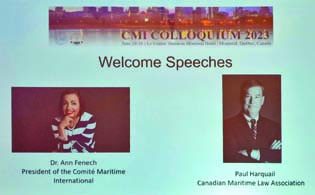
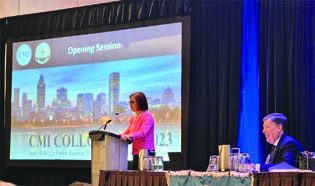
The Colloquium was opened on June 15th, 2023 with a speech by Ann Fenech, the President of the Comité Maritime International (CMI), who welcomed attendees with a powerful message that stressed the importance of cooperation and progress within the field of maritime law. Fenech articulated a clear vision for the conference, emphasizing its role as a pivotal gathering for maritime law professionals from around the globe to exchange ideas, confront emerging challenges, and work towards harmonizing maritime law across different jurisdictions.
Fenech’s speech highlighted the complex dynamics of modern maritime issues, including the impacts of technological advancements like autonomous shipping and the increasing urgency of environmental sustainability in maritime practices. She called attention to the pivotal role of maritime law in facilitating international trade, protecting marine environments, and ensuring maritime safety.
The role of the CMI was pointed out in the working on the Draft Convention on the international effects of judicial sales of ships with UNCITRAL working group, which lead to the adoption of the convention by the General Assembly of the United Nations on the 7th December 2022.
Emphasizing the rich history of maritime law and its foundational importance to the global economy, Fenech encouraged the participants to consider both the legacy and the future of maritime law.
J. Paul M. Harquail, President of the Canada Maritime Law Association, delivered a welcoming speech at the Montreal Colloquium that emphasized significance of holding the colloquium in Montreal, a city with a rich maritime heritage and a vital role in North American maritime trade.
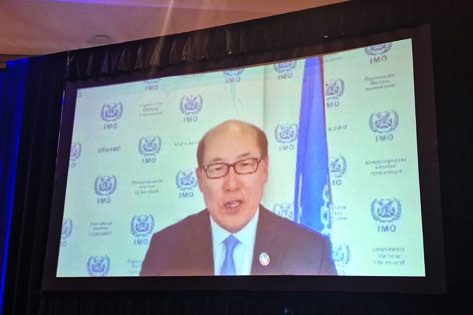
Mr. Kitak Lim Secretary General of the IMO welcomed the attendees of the Colloquium and noted the important role of the CMI in the unfication of maritime law and assistance to the IMO
This was followed by video message by Mr. Kitack Lim, Secretary-General of the IMO and then followed by video speech by the Honourable Omar Alghabra, Minister of Transportation, Canada.
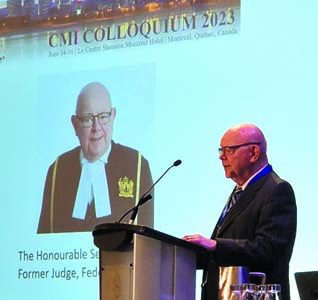
The Berlingieri Lecture at the Montreal Colloquium, delivered by the Honourable Sean J. Harrington, was a significant highlight of the event, focusing on Canada’s Contribution to Maritime Law. This lecture provided an in-depth look at Canada’s historical and current roles in shaping global maritime law, emphasizing the country’s contributions and the influences that have shaped its maritime legal practices.
Convention on the International Effects of Judicial Sales of Ships and its Ratification
The most notable seesion was on the Convention on the International Effects of Judicial Sales of Ships and its Ratification. By popular demand, the speakers dealt with different aspects of this Convention. Focus was be placed on the efforts which need to be made to encourage member states to ratify this important convention and the role of the CMI in assisting with the ratification process. This session was particularly significant given its focus on the recent developments and the impact of the Convention. The speakers and discussions revolved around several key aspects, providing a comprehensive overview of the current state and future directions of the judicial sale of ships under maritime law.
Ann Fenech presented an analysis of the “Bright Star” case, which highlighted the practical applications and challenges of Article 8 of the Convention on the International Effects of Judicial Sales of Ships. This article deals with the recognition of judicial sales in foreign jurisdictions, which is a critical aspect for ensuring clear title transfer free of all encumbrances. The case served as a basis for discussing the efficacy of the Convention in resolving conflicts of law where multiple jurisdictions are involved.
Henry Hai Li talked about the purpose and effects of the Convention, and its journet to the adoption of the convention.
Tomotaka Fujita addressed the scope of the Convention, clarifying what is covered and what remains outside its purview. This discussion was crucial for understanding the limitations and the extent to which stakeholders can rely on the Convention to address issues arising from judicial sales. The clarification helped delineate the boundaries of the Convention’s application, ensuring that practitioners and stakeholders are aware of its applicability and limitations.
Frank Nolan’s presentation on Article 4 emphasized the importance of proper notice in judicial sales. The discussion covered the procedural requirements for notifying potential buyers and interested parties, which is fundamental to ensuring the legitimacy and legality of the judicial sale process. This part of the session highlighted the procedural safeguards that protect the interests of all parties involved in a judicial sale.
Jan-Erik Pötschke discussed Article 5, which involves the issuance of a certificate of judicial sale. This certificate is crucial as it serves as a definitive proof of the change of ownership and is recognized internationally. The discussion focused on the legal weight of the certificate and its role in facilitating smooth transitions of ownership without subsequent disputes.
Peter Laurijssen focused on the aftermath of a judicial sale of ships, particularly addressing the procedural and legal steps that follow the issuance of a certificate of judicial sale. This includes the implications for the new ownership in terms of legal recognition, responsibilities, and the broader impacts on international maritime law. Laurijssen highlighted the importance of understanding what obligations, rights, and potential challenges new ship owners might face after a judicial sale is finalized and the certificate is issued.
Alexander von Ziegler, who explored the broader challenges associated with the judicial sale of ships and its effects, touching on Articles 9 and 10 of the Convention, the aftermath of a judicial sale and the practical issues that arise, such as the recognition of new ownership across different jurisdictions.
Frederick J. Kenney focused on Article 11 – IMO as Repository, and shared how the IMO facilitates the administration and effective implementation of the convention’s provisions internationally. He outlined the IMO’s Global Integrated Shipping Information System (GISIS) and the processes through which the IMO manages, stores, and disseminates crucial data related to judicial sales of ships, ensuring that compliance and cooperation among signatory states are maintained.
Stuart Hetherington’s covered Articles 16 through 23 and Explanatory Note. The explanatory note accompanying these articles provide additional clarity and guidance on interpreting the articles’ stipulations and their practical applications within various jurisdictions.
Climate Change – Impact on Ports and Inland Waterways
The panel discussed how climate change will impact operations at ports and inland waterways, including short term weather events and long-term changes in water levels. The panel explored the legal issues that arise from climate change disruptions and consequent breaches of contracts and obligations
Promoting and Enforcing Ethics and Diversity in the Maritime Legal Community
The panel discussed how firms can promote and enforce ethics, diversity and inclusion in their maritime law practice. The discussion included how to prioritize ethics, diversity and inclusion at the senior management level and discuss initiatives in leadership and staff meetings. Setting and implementing goals for communication, hiring, training, enforcement and termination were outlined. The panel discussed the benefits and obstacles in implementing modern policies.
Maritime Autonomous Surface Ships (MASS) – The Future Regulation of Unmanned Shipping – Where We Are and Where We Are Going
The CMI international working group on MASS has been working on the possible approaches to the regulation of MASS in conjunction with both the IMO Legal Committee and the Maritime Safety Committee. This session updated the participants on the current position.
Mobile Offshore Renewables Units: Examining the Need for Unification of Maritime Law
Around the world, states are producing electrical power in their territorial seas from a variety of offshore renewable energy resources. From traditional wind turbine generators mounted on fixed-bottom foundations, newer and more advantageous technology is beginning to emerge in the form of non-fixed, floating offshore renewable energy technologies. These floating technologies generate electrical power not only from the wind, but also waves, tides, the sun and differences in ocean water temperatures – mobile offshore renewables units (MORUs). They could produce power directly or produce power for more traditional oil and gas producing installations. Because of their mobility and adaptability to a variety of conditions MORUs possess a number of potential territorial, technological, economic advantages over fixed-bottom and onshore renewable energy technologies and are set to grow in number. What is the legal nature of MORUs and does their internationally mobile characteristic suggest that they should be treated more as ships or watercraft than as installations? The need for unification of law in this respect has been discussed. The session was chaired by Shelley Chapelski and Lawrence Teh, with Session panellists: Alexander Severance, William Sharpe, and Jurriaan Kien.
Arctic Shipping
The panel discussed operational and legal issues for shipping in the Arctic regions. The panel reviewed the current risks of Arctic shipping focused on extreme weather conditions, the lack of infrastructure in the coastal regions of the main arctic routes, and the increased risk of human error due to inexperienced crews under unconventional conditions. Environmental policies in the Polar Code have been considered.
Harmonising The Interpretation of Art 4 Of LLMC 76
Through implementation of limitation of liability conventions, many countries recognise a shipowner’s right to limit liability for certain maritime claims. These rights are available except in situations where a prescribed type of fault or culpability on the part of the shipowner can be shown by the claimant. However, limitation conventions and, in particular, the prescribed fault necessary to break limitation of liability have not been uniformly interpreted by courts around the world; as some recent high-profile cases have shown. These cases in turn raise serious questions over limitation of liability conventions as a reliable factor in the planning of shipowners’ business and threaten the efficiency of providing transportation services. This session explored the work undertaken at the IMO to develop and agree a Unified Interpretation (UI)1 of the test for breaking shipowners’ right to limit liability (the background to that work, the process involved in developing such a UI and the agreement that was ultimately reached). Speakers included a number of persons who were involved in this work and who represent the shipowning, P&I and legal industries at the IMO.
The CMI Lex Maritima Project – Latest Draft and Further Planning
The colloquim resumed on the Friday, June 16, 2023 with a notable session on the CMI’s Lex Maritima project, which is the very first attempt to put in writing the globally accepted principles of maritime law. The Lex Maritima can be considered the Lex Mercatoria for maritime matters.
Maritime law is supported by a long tradition of international uniformity. In recent years, however, the development of a universal maritime legal order by the adoption of unifying conventions has slowed. At the same time general, non-maritime contract law has started to find a way to wider harmonisation. The existence of a Lex Maritima consisting of a complex of internationally accepted rules of maritime law that may be traced in particular back to usage and general principles is widely, and even increasingly subscribed to by legal doctrine. Moreover, this view finds support in numerous elements of positive law, including case law and recently adopted national codification of maritime law.
On the other hand, there is no instrument of practical use available in which this virtually mythical Lex Maritima with all its customs, usages and principles is clearly articulated. Preparing and promoting such a compilation is quintessentially a task for the Comité Maritime International in the exercise of its research and education role, and with the broad aim of the promotion of harmonisation of maritime laws.
The CMI IWG on the Lex Maritima is preparing an elementary – that is, concise and flexible – description of the typical concepts and rules of maritime law that may be regarded as being internationally accepted and common to most, if not all legal systems and traditions. In other words, it is an exposition of the foundations of positive maritime law, such as those encountered in the conventions, national laws and the more specific and thematic self-regulating sources. In other words, this is a search for the innermost core of maritime law, as it is expressed in the concrete, practical legal rules in daily use in the maritime and legal community. The main difference between the proposed Lex Maritima principles and previous unification efforts is that the former explore and focus on common ground, rather than tackle issues of disagreement and divergence that require resolution. Such a compliation of selected general principles of maritime law could promote the satisfactory functioning of maritime law.
Cyber Threat in the Maritime Sector – A Storm on the Horizon
Cyber threat has increased globally since the invasion of Ukraine. The increasing reliance on technology, increased digitisation and automation have created a significant threat matrix for those intent on disrupting global trade weather, politically, environmentally or terrorist based. The CMI working group on cybercrime discussed how the treat is real and developing and investigate real solutions and the need to revisit legislation and regulation best to protect our sector.
The Collison Convention 1910: Is CMI’S Oldest Convention in Need of Modernization?
The 1910 Collision Convention was CMI’s first international convention. Recently a CMI questionnaire was circulated amongst the members on the need for revising the 1910 Convention. A discussion was be held on the expediency of modernization of the 1910 Convention. Assuming the amendments are justified, does the risk of creating a new convention, which might not be as universally adopted as the 1910 Convention lead to the overall conclusion that the Convention should remain as it is at present.
The 1910 Collision Convention, originally designed to address maritime collisions, does not define “vessel,” leaving ambiguity around what constitutes such for its purposes. It applies to sea-going and inland navigation vessels in cases of collisions but does not encompass collisions involving only inland navigation vessels. The question arises whether the revised convention should expand its definition of vessel to include all floating structures and whether it should cover all collisions irrespective of vessel types.
The original convention also does not define “collision,” leading to questions about including non-contact damage caused by the maneuvering of one vessel affecting another, scenarios involving towing, or when both colliding vessels have the same owner.
Regarding scope, the 1910 Convention currently applies if all involved vessels are registered under the flag of contracting states. Suggestions for the revised convention include applying it universally within the waters of a contracting state or if any colliding vessel flies the flag of a contracting state, irrespective of other conditions. Additionally, the inclusion of a clause to allow regional economic integration organizations like the EU to participate is considered.
The liability concept is based on the fault of the vessel, with no strict liability. The Convention does not identify the persons who must act negligently, but merely refers to “the vessel” being in fault and does not specify the responsible persons. The discussion extends to whether this should continue or if specific actors should be identified as liable. There’s also debate over who should have the right to sue under the Convention, as it is silent as to who is entitled to bring an action against the liable “vessel”, proposing potentially that registered shipowners or bareboat charterers might have this ability.
The convention’s approach to liability includes scenarios where multiple vessels are involved, suggesting a proportionate sharing of liability based on each vessel’s fault. However, it doesn’t cover third-party property damage not aboard a vessel, usually leaving such issues to national laws. There’s a suggestion to possibly extend joint liability to third-party property damage not aboard the vessels involved.
Under the 1910 Convention, the vessel owner will not be liable if the collision was caused by some defect in the vessel which the owner, by applying due diligence in all respects, was unable to detect. Another aspect under review is whether vessel owners should be strictly liable for defects in their vessels they couldn’t have detected with due diligence, and whether the convention should define such “defects.”
As for legal presumptions, the current convention does not apply them in determining liability, prompting discussions on whether recognized international presumptions should be incorporated to facilitate fault determination.
Recoverable damages are also not explicitly detailed in the convention. The proposal questions whether these rules should be integrated into the revised convention. The Lisbon Rules 1987, issued by CMI, include detailed principles as to the recoverable damages and their assessment in typical collision cases.
Regarding insurance, the 1910 Convention does not require vessel owners to maintain liability insurance, unlike some international liability conventions. The revised convention might introduce mandatory insurance requirements, allowing direct actions against insurers, which could reshape liability cover dynamics, including addressing insolvency or specific contractual clauses in insurance policies. In Europe, EU-Directive 2009/20 provides that the vessel owner must maintain insurance that covers claims up to the limitation amounts of the 1996 LLMC relevant for the vessel. The Directive does not provide for direct action against the vessel’s liability insurers.
On the international law front, the 1910 Convention lacks provisions on applying laws to various claims, potentially leading to inconsistencies. The revised convention might include a unified approach to choosing applicable laws, possibly aligning with the CMI 1977 Rio Draft Convention principles. Concerning jurisdiction, the 1910 Convention has no stipulations, leaving a gap that might be filled by adopting jurisdictional rules similar to those in the CMI 1977 Rio Draft or other international conventions.
The emergence of Maritime Automated Surface Ships (MASS) or autonomous ships poses new challenges, prompting discussions on whether the revised convention should explicitly cover autonomous vessels and, if so, establish specific rules for collisions involving such ships.
Finally, the overall need to revise the 1910 Convention is debated, weighing the potential benefits of modernization against the risks of reduced universal acceptance compared to the current convention.
The Master: An Endangered Species? Responsibilites and Liabilites in Today’s Climate
This session’s discussion pivoted around the evolving role of shipmasters against the backdrop of contemporary maritime regulations and operational realities. The overarching theme centered on whether the traditional roles of shipmasters are under threat due to increased legal liabilities and regulatory oversight. Since the days of old, the Master has played a pivotal role in shipping practice and maritime law. Once a figure of great authority, the focus has shifted and the Master has now become a figure of great liabilities, including criminal liability. With the advent of autonomous vessels, the focus is shifting again, and the Master seems to be in danger of disappearing altogether.
The conference highlighted the complexities faced by today’s shipmasters, underscored by increasing criminalization and liability for maritime incidents. Discussions revealed that masters find themselves precariously positioned between compliance obligations and operational exigencies. Presenters provided a deep dive into incidents where masters were held accountable for offenses related to maritime pollution, drawing on the analytical framework.
One particularly poignant aspect of the discourse involved the fair treatment of seafarers. The conference revisited the “Fair Treatment of Seafarers” guidelines, echoing sentiments from various legal documents and historical precedents, which underscore the need for equitable treatment of seafarers detained on suspicion of maritime offenses. This dialogue stressed the importance of safeguarding human rights within the ambit of maritime law, as explicated in the International Maritime Organization (IMO) discussions and proposals for guidelines revisions.
Contributions at the conference also engaged with broader legal and ethical considerations, such as the impact of international conventions on national legislation, and the practical difficulties in implementing guidelines designed to protect seafarers. The discussions referenced the challenges in harmonizing international standards with domestic legal frameworks, illuminating the ongoing efforts to enhance the regulatory landscape for maritime operations.
This session reaffirmed the critical nature of understanding the nuanced responsibilities and liabilities of shipmasters in today’s stringent regulatory climate, highlighting the ongoing need for legal frameworks that support both the authority and protection of this key maritime figure.
CMI General Assembly: June 20232
The CMI held a General Assembly meeting in Montreal starting at 13:30 hours on June 16 at the end of a very successful CMI colloquium.
The President opened the meeting with a report on her activities over the past year.
The Assembly then heard memorials for two outstanding former member who had passed away: Dr. Frank Wiswall Jr. of the United States and Prof. Hrvoje Kačić of Croatia.
The Assembly then approved the financial statements and heard reports from the audit committee, on outstanding contributions and on the CMI charitable trust.
The assembly then approved 11 new Titulary members and conferred the title of honorary officers on Stuart Hetherington (President Honoris Causa), on Johanne Gauthier (Vice President Honoris Causa) and on Alexander von Ziegler (Secretary General Honoris Causa).
Thereafter, the Assembly dealt with several issues of concern. Three MLAs were unfortunately expelled form membership in CMI due to long-outstanding unpaid subscriptions: the East Africa Regional MLA, the Israeli MLA and the Senegalese MLA.
On a more positive note, Bangladesh was admitted as a new MLA member.
The Assembly then heard reports from the chairs of International Working Groups and Standing Committees.
The Assembly welcomed the 2022 prize winner: Rosalie Van Dael of New Zealand. The title of her essay: “Relief in Cross-Border Insolvency and Maritime Law”3
Elections were then held and Rosalie Balkin was elected as Secretary General, Frank Nolan as Executive Councillor and Johannes Grove Nielsen as a member of the CMI Nominating Committee.
The Assembly then conferred the authority on Jean Francois Peeters to fulfil all required formalities and to sign all necessary documents recording these appointments and decisions of the Assembly.
A written report from Prof. Miriam Goldby on: UNCITRAL Working Group V1 on Negotiable Multi-Modal Transport Documents was tabled.
A written report from Dr. Vincent Power on: Selected recent developments in European Union Shipping Law was tabled as well.
Following which the Assembly rose at 17:00 hours June 16th, 2023.
* * *
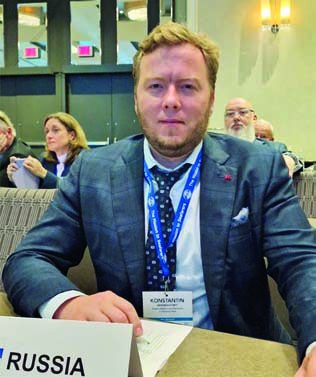
At the Colloquium in Montreal in June 2023, Russia was represented by Konstantin Krasnokutskiy, President of the Russian Maritime Law Association (RUMLA).
Notes