
Article
Russian Maritime Law Society at the beginning of the 20th century: Origins, Founders, and Purpose
Jurist, Bankruptcy practice
1. Historical Background: Law Codification and Maritime Trade Growth Trends. First Prerequisites for the Establishment of the Russian Maritime Law Society
The 20th century, when the Society was founded, coincided with a boom in commercial shipping, which enhanced the role of the Navy in the economy of the Empire and exposed a number of weaknesses in both national maritime legislation and the state of shipping practices at the time.
This, in turn, required not only closer attention but also active engagement from the government of the Russian Empire in maritime affairs.
There are several sources that provide insights into the acute challenges in this field, which prompted a series of key governmental decisions and reforms.
Therefore, one of these sources is the report by Georgy Timofeevich Rybchevsky, a full member and the Inspector General of the Moscow Imperial Association for Supporting the Development of Russian Merchant Shipping, the Collegial Counselor. In 1904, he investigated the reasons behind the poor development of the Russian merchant fleet and proposed a set of measures aimed at resolving the identified problems.
His research resulted in two extensive reports, one of which is of particular interest to us1. In it, Rybchevsky lists several factors that he believes are hindering the development of the Empire’s shipping sector.
The first factor he mentions is the enclosed nature of the Russian European seas, as they are accessed only through narrow straits controlled by foreign states. Should these states initiate hostilities, their naval vessels could easily capture Russian merchant ships passing through these straits.
The second factor contributing to the poor development of maritime shipping, as noted by Rybchevsky, is the isolation of the Russian people from the maritime industry, primarily due to the country’s geographical location. Among other issues, the author emphasized the insufficient development of commercial and naval shipbuilding, which led to vast amounts of capital being transferred into the hands of foreign shipbuilding companies.
Another valuable source providing insights into the state of Russian merchant shipping and the corresponding legislation at the beginning of the 20th century is the first thematic review of foreign press, covering the first two months of 19042. This experimental format publication was carried out by the Merchant Shipping Department, which at the time operated within the structure of the General Directorate of Merchant Shipping and Ports.
The publications studied by the Department covered national maritime legislation, the state of merchant shipping, shipbuilding, engineering, and fluctuations in freight rates during the preceding year across various countries (England, Germany, France, Spain, Japan, and the United States). Additionally, these foreign periodicals served as reference materials to support legislative initiatives being developed by the Department3.
In its first review, the Department observed that both government and public interest in the fate of merchant shipping was growing, as efforts were being made to promote and support maritime trade. This sector was also beginning to occupy an increasingly prominent place in the economic life of various countries.
Another conclusion was linked to the ongoing Russo-Japanese War. The Department noted at the time that the belligerent states were expected to issue a list of goods classified as war contraband. Due to the prevailing uncertainty surrounding maritime law, it became impossible to charter Russian vessels in England. «We cannot help but believe that the comprehensive explanations published by the magazines regarding the terms of neutral trade will help to restore commercial relations,» the Directorate expressed hope.
The next noteworthy document discovered in the same archive is an article from the German newspaper Hansa, published on January 16, 1904. It is devoted to the measures undertaken by the General Directorate to support merchant shipping.
The article makes it clear that the Russian Empire had indeed begun to actively reform its merchant shipping sector. The government was developing incentives for shipbuilding and revising the existing legal framework.
“The newly established General Directorate of Merchant Shipping and Ports is working intensively in two directions: it is drafting legislation to regulate merchant shipping and is trying to promote and expand this sector in Russia, so that the country may assume its rightful place among the other nations,” the author of the article explained.
The article states that the Directorate was drafting new legislation on maritime matters, principally concerning maritime accidents. However, greater administrative significance was attached to another law, already fully developed – the port law.
One of the incentive measures introduced by the Directorate to promote merchant shipping, according to the article, was the ship mortgage law under development, which would allow the State Bank to issue loans for wooden, iron and steel vessels. There were other support measures, such as financial rewards for building ships in Russia and subsidies in the form of navigation incentives. In 1903, some members of the Imperial Society for promoting Russian Merchant Shipping strongly opposed the latter, although they acknowledged the importance of stimulating routes of significant commercial value.
“Thus, Russia is soon to embark on an artificially stimulated development of merchant shipping,” Hanza concluded. “This initiative by the Russian government appears all the more questionable given that a similar experiment in artificially boosting industry — through prohibitive tariffs, massive state contracts, and various privileges — had only recently produced disappointing results. Admittedly, the goal was initially achieved: the industrial sector advanced rapidly in a short time. But as soon as the system of state support weakened and government orders declined, it became clear that what had been cultivated was a hothouse plant — unable to survive on its own.”
Reflecting on the severe consequences of the industrial crisis, the author predicts a similar fate for the merchant shipping sector. “Even if there is a chance that navigation initiatives will expand Russian merchant fleet significantly, it remains uncertain whether this will truly serve the public good. While the new ventures may bring some results, lacking a foundation in sound economic principles, they are bound to perish — like a hothouse plant deprived of its artificial atmosphere,” Hansa concluded.
The legislative regulation of merchant shipping at the beginning of the 20th century gave rise to additional issues.
At the beginning of the 20th century, the regulation of commercial shipping in Russia was largely based on norms of advisory nature, which imposed no clear sanctions for their violation and offered no effective mechanisms for ensuring compliance. This created fertile ground for arbitrary interpretation of the rules — and, consequently, for their violation.
The second problem was the absence of a dedicated law on merchant shipping. Related matters were governed by the Commercial Charter (Ustav Torgovy) — a body of laws that applied to, among other things, merchant shipping, but primarily regulated commercial law overall. However, with the rapid growth of global trade and maritime business, the Russian Empire — lacking specific legislation on maritime commerce at the time — faced an urgent need to adopt such laws.
This led to a wave of active study of foreign periodicals and analysis of international experience in maritime lawmaking, and from 1902, Russia undertook a large-scale effort to codify specialized legislation and draft the Code of Merchant Shipping.
For this purpose, on November 23, 1901, a Special Council4 was established following a report by Sergei Yulievich Witte, former Minister of Finance and Secretary of State. Its mission was to draw up a new code of merchant shipping, which would present a comprehensive legal codification of all relevant regulations based on the accumulated experience and the current state of the law.
The Council, chaired by Grand Duke Alexander Mikhailovich, who served as Chief Executive of Merchant Shipping and Ports, held its first session on March 4, 1902. Among its members were representatives of the Ministry of the Navy, as well as the Ministries of Foreign Affairs, Finance, and Justice. The Ministry of the Navy was represented by Georgy Georgievich Steblin-Kamensky, Full State Councillor and head of codification work; Ivan Egorovich Steblin-Kamensky, legal adviser to the Ministry; and Ivan Alexandrovich Ovchinnikov, professor at the Nikolaev Naval Academy and Colonel of the Imperial Russian Navy. In 1905, the chairmanship of the Council passed to Iosif Ivanovich Karnitsky, a lawyer, senator, and Full Privy Councillor.
In order to address specific issues of maritime law and to examine current practices, the Council not only heard from its staff members but also engaged lawyers, experts, and practitioners in the maritime field. Sessions were frequently attended by representatives of steamship and transport companies, insurance societies, seafarers’ unions, port-based merchants, and shipping promotion associations.
The Council aimed to ensure the transparency of its work and actively sought feedback on draft legislation from all interested institutions and individuals. In particular, it reached out to committees and boards of steamship societies, and welcomed contributions from private individuals “who, through practical familiarity with maritime affairs, could offer insights drawn from their real-life experience in maritime affairs,” regardless of whether they held any official position.
The members of the Council also actively studied the laws and codes on merchant shipping from England, Germany, Italy, and Norway.
The materials collected in this process formed part of the foundation for the future Code5.
It is important to note that during the Council’s initial sessions, specialists focused on matters of maritime law deemed “particularly urgent,” which required immediate drafting and separate legislative approval prior to the adoption of the Code as a whole.
The first of these urgent issues was the determination of the conditions under which a vessel could be recognized as Russian and, consequently, entitled to fly the national flag. The second pressing matter was the introduction of maritime mortgages to secure loans against ships. In addition, the Council prioritized the development of draft laws on the limitation of liability for shipowners, as well as on the professional and academic qualifications required of navigators and engineers serving in the merchant fleet.
“The urgency of the matter was becoming increasingly clear, driven by the immediate needs of maritime commerce and the obvious benefit of letting interested institutions and individuals see the draft as a single, cohesive code rather than as a collection of separate proposals, in order for its provisions to be properly understood in their broader context,” was how the need for accelerated legislative work in these areas was explained6.
The drafting of the Code was completed in 1909. The reasons why the much-needed Code of Merchant Shipping was never formally adopted remain unclear. All that remains at our disposal is the draft itself, the accompanying explanatory notes, and a summary of the Special Council’s work. From these materials, one can clearly see the immense scope of work carried out by the Council’s members and experts, as well as their clear determination to systematically and thoroughly organize the scattered regulations governing merchant shipping.
At last, it becomes clear what legal challenges in the field of maritime law awaited the future members of the Russian Maritime Law Society – most of whom had worked on the draft Code of Merchant Shipping under the auspices of the Special Council.
2. Initiatives of the Comité Maritime International (CMI)
The need to establish an association of maritime law specialists in Russia was steadily growing – not only within the country itself, but also well beyond its borders.
This reflected a broader trend that emerged in the second half of the 19th century — the growing effort to unify legal norms. Merchant shipping was no exception. Legal professionals specializing in maritime affairs began collaborating across countries to establish an international body that would take the lead in setting common standards in the maritime legislation. That body became the Comité Maritime International (CMI), founded in 1897 to promote the unification of maritime law through international research on special issues and development of draft proposals for international conventions. The Committee brought together national maritime law societies from countries with at least some involvement in maritime trade.
In 1899, it was the CMI that first took the initiative to establish a national maritime law association in the Russian Empire. On November 18 of that year, the Committee’s Secretary General in Antwerp sent a letter to the Imperial Envoy in Brussels, noting that, in order to promote the proper unification of maritime law, the Committee was interested in the creation of national associations in various countries7.
Each of these associations dealt with issues frequently raised at international meetings, while the Committee fostered regular interaction among them, coordinated their efforts, and monitored their activities. In the three years since its founding, the CMI had successfully established national groups in Germany, England, Belgium, Denmark, the United States, France, Holland, Italy, and Norway. Russia, however, remained unrepresented in the CMI, raising the prospect that the Committee’s upcoming 1900 conference in Paris would proceed without a single Russian delegate.
“We would strongly welcome the establishment of a local association or committee in Russia,” the Secretary urged. “Your great country plays a vital role in global trade, and we deeply regret this glaring absence — something that inevitably limits the impact of our work.”
The Committee also laid out several expectations regarding the members of the national associations: “It is highly desirable that these national associations include not only legal professionals, but also shipowners, partners, neutral figures, and merchants.” When proposing that the future Russian Society should include nine members, the author of the letter acknowledged the Committee’s difficulty in obtaining reliable information about individuals best suited for these roles. To that end, the Secretary requested informal input from both the Imperial Envoy and Fyodor Fyodorovich Martens–one of the Committee’s founders and an honorary member – to help guide the search for suitable candidates for the Russian association of the CMI.
Within a few months, in March 1900, the letter from the CMI was brought to the attention of Witte8.
In July 1900, the Committee followed up with another message – this time addressed to Foreign Minister Vladimir Nikolaevich Lamsdorf – regarding the founding of the Russian association9. It noted that the CMI had already secured support from many countries, assisted in the creation of 11 national associations, and – looking ahead to its upcoming conference – once again invited the Russian Empire to join its efforts.
“The Russian Empire has always played a great role in development of international law, and its noble commitment to reducing tensions between nations only makes our continued lack of engagement in this matter all the more regrettable,” the Committee wrote indignantly.
The July letter also acknowledged — and highly valued–the contributions of Martens and Mikhail Aleksandrovich von Taube. Before Russia established a national Society and formally joined the CMI, its participation in CMI conferences was limited to honorary members only. Alongside Martens and von Taube, this included the previously mentioned Ovchinnikov.
The letter further sheds light on how the Committee operated in preparation for its conferences. The Central Committee in Antwerp would first circulate a list of questions to national maritime law associations, outlining the issues scheduled for discussion. In response, the associations submitted written reports presenting their conclusions on the proposed topics. Based on these submissions, the CMI could assess the views of national experts with recognized competence in maritime law regarding the reforms under consideration.
Soon this letter was forwarded to Witte, and once again, the CMI awaited the minister’s reply.
The next document in the correspondence regarding the establishment of a CMI branch in Russia is dated August 16, 1904. It refers to a letter from Kir Alekseevich Alekseev, Head of the Merchant Shipping Department, stating that there were no plans to appoint a Russian representative — likely for participation in Committee conferences — until a national CMI branch had been formally established10.
According to an attached note, the Ministry of Foreign Affairs had, around the same time, confirmed that the issue of establishing a CMI branch in the Empire — which was essential for participating in key events on maritime law — had already been raised on multiple occasions, dating back as early as 1900. In conclusion, Kir Alekseevich suggested reaching out to Sergei Petrovich Veselago to explore the option of regularly sending a delegate to the CMI conference11.
The Imperial Shipping Society later attempted to address the issue of Russia’s lack of representation in the CMI.
In 1905, it proposed the establishment of a department dedicated to developing matters of international maritime law and participating in CMI congresses. However, this required amending the Society’s charter to expand its official scope of authority.
For this purpose, in February 1905, the Chairman of the Imperial Shipping Society sent a letter to the General Directorate of Merchant Shipping and Ports, stating, “Recognizing that many provisions of maritime commercial law, by their very nature, must be governed through international agreements — and that Russia, regrettably, has played no part in the work of the Comité Maritime International, which has been operating for the past eight years with this very aim — the Imperial Shipping Society resolved, at its General Meeting on December 11 of last year, to establish a special department dedicated to developing merchant shipping matters that require consideration at the international level.”12
To make this possible, the Society requested an amendment to Article 3 of its Charter, proposing to add a new objective: to contribute to the unification of maritime law.
In June of that year, the Imperial Shipping Society received a formal reply from the General Directorate of Merchant Shipping and Ports. The response stated that there was no reason to amend the Society’s Charter, as a new organization — the Russian Maritime Law Society — had already been established.
3. A Brief History of the Russian Maritime Law Society
It is difficult to say with certainty who first initiated the founding of the Russian Maritime Law Society. Perhaps the idea originated with Russian lawyers specializing in maritime law, who maintained close ties with foreign colleagues involved in creating the Comité Maritime International. Still, it seems unlikely that the Society would have come into being without the support of the Grand Duke.
Established on May 18, 1905, in Saint Peterburg, the Society brought together 54 lawyers and experts in maritime law. It was chaired by Sergei Vasilyevich Rukhlov, Minister of Railways and Transport, with Senator Iosif Karnitsky elected as his deputy.
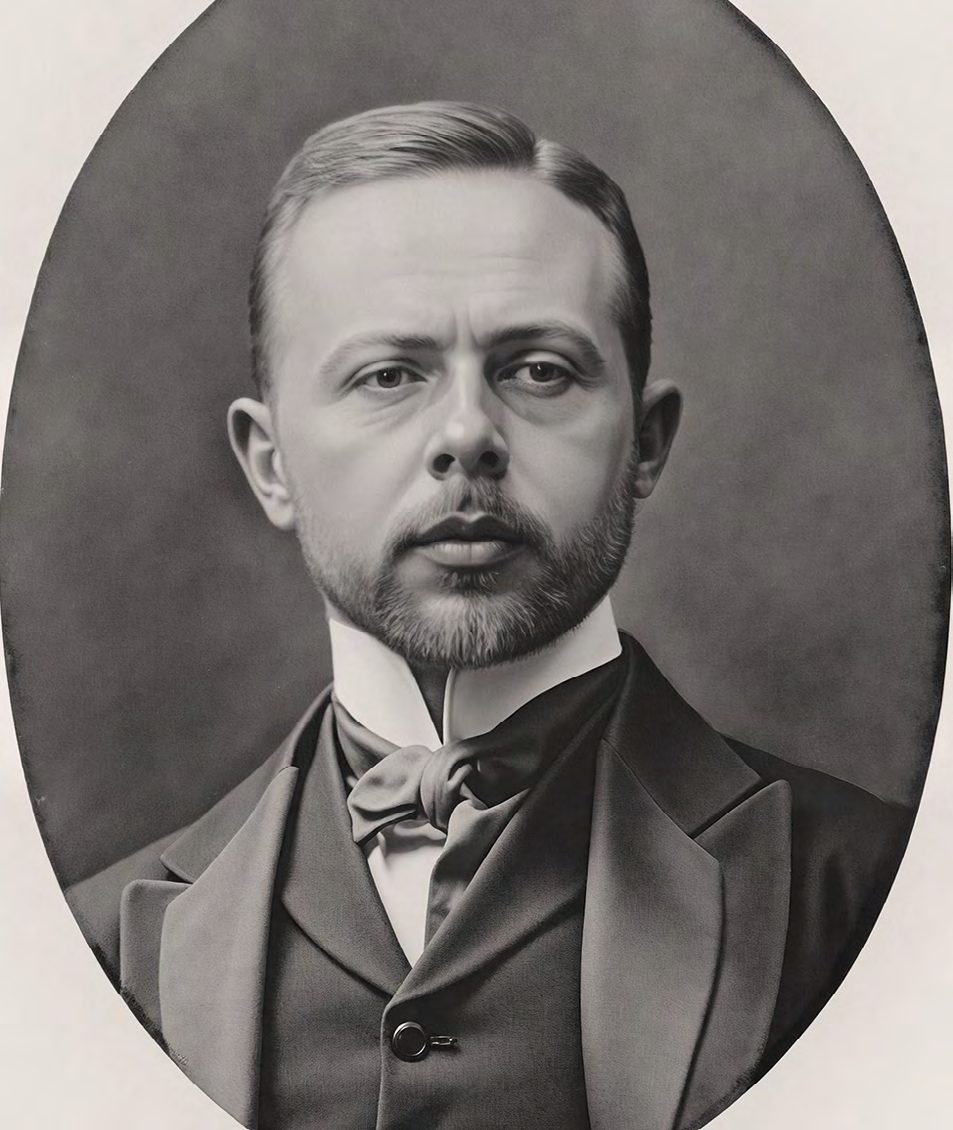
Sergei Vasilyevich Rukhlov (1852–1918)
Public official, lawyer, Minister of Railways, member of the State Council, State Secretary to the Emperor, and Full Privy Councillor. From 1905 to 1910, he served as the first Сhairman of the Russian Maritime Law Society.
Rukhlov graduated from the Faculty of Law at Saint Petersburg University in 1873 with the degree of Candidate of Laws. That same year, he entered the Ministry of Internal Affairs.
After six years of service, Sergei Vasilyevich transferred to the Main Prison Department, where he was appointed Chief Clerk. In 1892, Rukhlov became Assistant State Secretary of the State Council, and five years later was promoted to State Secretary.
From 1903 to 1905, he served as deputy to Rear Admiral Grand Duke Alexander Mikhailovich, the Chief Administrator of Merchant Shipping and Ports. After the department was dissolved, Rukhlov was appointed to the State Council, where he served until 1917.
From 1905 to 1910, Sergei Vasilyevich was the first Chair of the the Russian Maritime Law Society.
Between 1909 and 1915, Rukhlov held the post of Minister of Railways. In 1912, he was appointed State Secretary to the Emperor, and the following year was granted the rank of Full Privy Councillor. In 1914, he joined the Finance Committee but retired the following year due to health reasons.
Rukhlov was arrested during the February Revolution. After his release, he left for the North Caucasus. On August 29, 1918, he was arrested again in Essentuki by the North Caucasus Cheka. He was imprisoned in Pyatigorsk as a part of a group held hostage and accused in the case known as “The Plot to Assassinate the Leaders of the Proletariat”. He was executed with the others–cut down by sabers on Mount Mashuk13. The exact date of Rukhlov’s death remains unknown; various sources cite October 21, 27, or 31, 1918.
Iosif Ivanovich (Martin-Joseph-Ivan) Karnitsky (1840-1914)
Polish and Russian lawyer, senator, full Privy Counselor.
Karnitsky graduated from the Faculty of Law at the Sorbonne in 1861. After receiving the degree of Licentiate (Master) of Laws, he began his career at the Warsaw Civil Tribunal, where he served until 1864.
Within three years, he worked in the Chancellery of the State Council of the Kingdom of Poland, and from 1867 to 1869, he served as Assistant Prosecutor at the Kingdom’s Court of Appeal. He later held posts of the Assessor (1869–1870), Judge of the Warsaw Civil Tribunal (1870–1872), Chief Executive of the Chancellery of the Government Commission of Justice (1872–1873), and Member of the Emeritus Commission of the Kingdom of Poland (1873–1876).
From 1877 to 1882 (according to some sources, until 1883), he served as Deputy Chief Prosecutor of the Civil Cassation Department of the Senate. In 1895, he was appointed senator. Karnitsky continued working in the Civil Cassation Department until 1898, after which he joined the First General Assembly.
Karnitsky joined the editorial commission responsible for drafting the Civil Code at its inception in 1882 and remained a member until the work was completed. From 1900 to 1904, he served as deputy chairman. Following the death of the commission’s chairman, A. A. Knirim, Karnitsky succeeded him and led the commission until 1906.
In 1905, he was appointed deputy chairman of the Russian Maritime Law Society, a position he continued to hold at least until September 1907.
Karnitsky also played a prominent role in the civil division of the Law Society at Saint Petersburg University. He was a full member from 1877 to 1907, and from 1907 onward, he held honorary membership. He served as secretary from 1882 to 1890, as a member of the editorial committee from 1882 to 1891, as deputy chairman from 1892 to 1899, and ultimately as chairman from 1900 to 1905.
He died in 1914 while undergoing medical treatment in the Bavarian spa town of Bad Wörishofen.
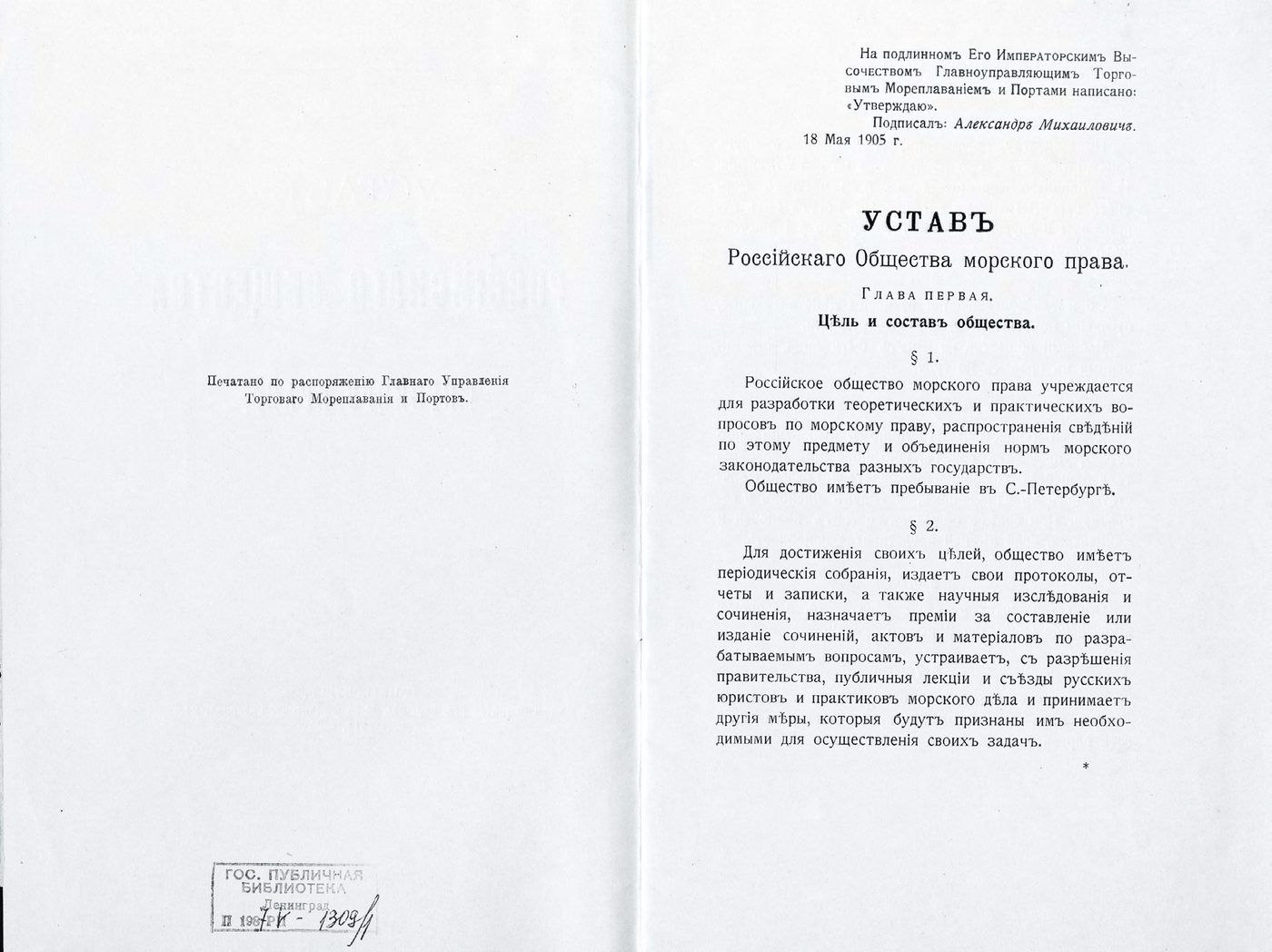
The Charter of the Russian Maritime Law Society was signed on May 18, 1905, by Grand Duke Alexander Mikhailovich, Chief Administrator of Merchant Shipping and Ports.
First of all, the document outlined the Society’s core mandate necessary to achieve its principal goals. These included holding regular meetings; publishing minutes, reports, memoranda, academic research, and scholarly studies; awarding prizes for the composition or publication of studies, acts, and material on topics under development; organizing public lectures and congresses for Russian lawyers and practitioners of maritime affairs (with government approval); and pursuing any other initiatives the members deemed necessary to fulfill the Society’s mission.
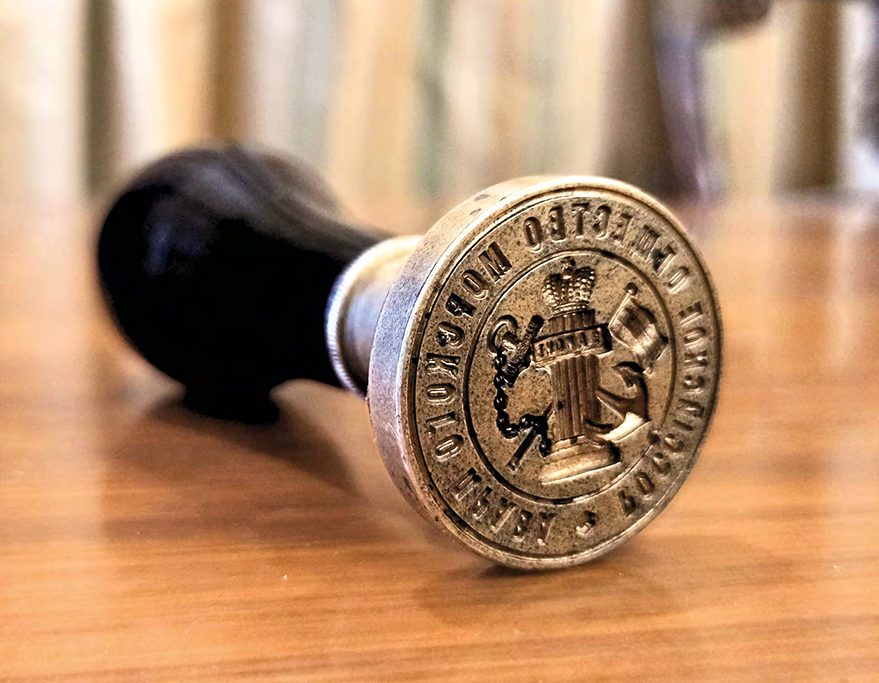
The Society had its own seal, which featured the Russian flag, an imperial crown, and an anchor. Its annual budget was set at 270 rubles.
In that same year, 1905, during the CMI conference in Liverpool, its president, Louis Franck, informed the participants that two new national maritime law associations were in the process of being formed — one of them in Russia.
By 1907, the Russian Society had formally become the Empire’s representative within the CMI. Its first delegation included Sergei Rukhlov, Iosif Karnitsky, and Valerian Eduardovich Graves, a notary and the Society’s secretary. The Empire formally recognized Martens, Taube, and Ovchinnikov as its members of the CMI at the first conference14.
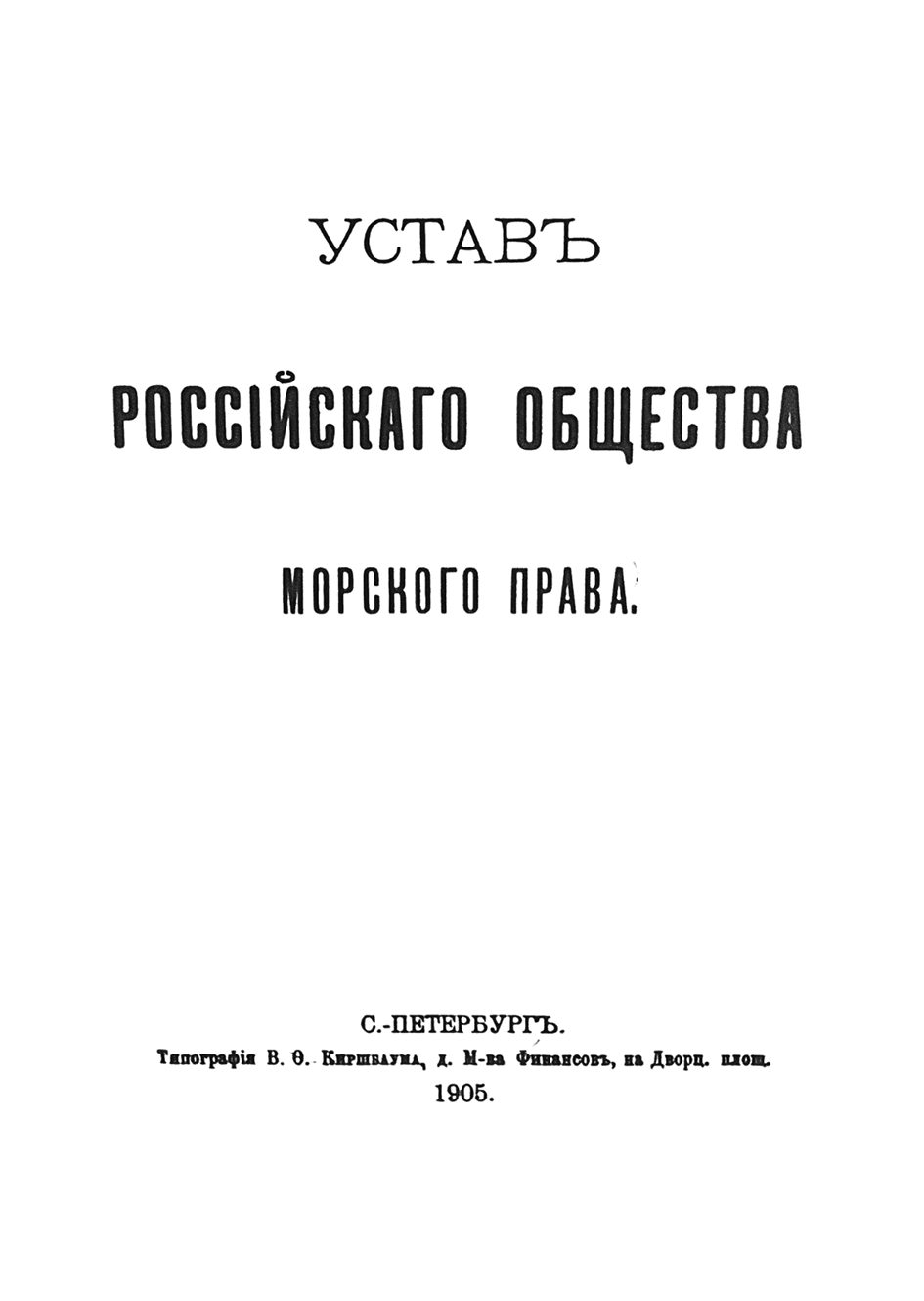
Front cover of the Charter of the Russian Maritime Law Society
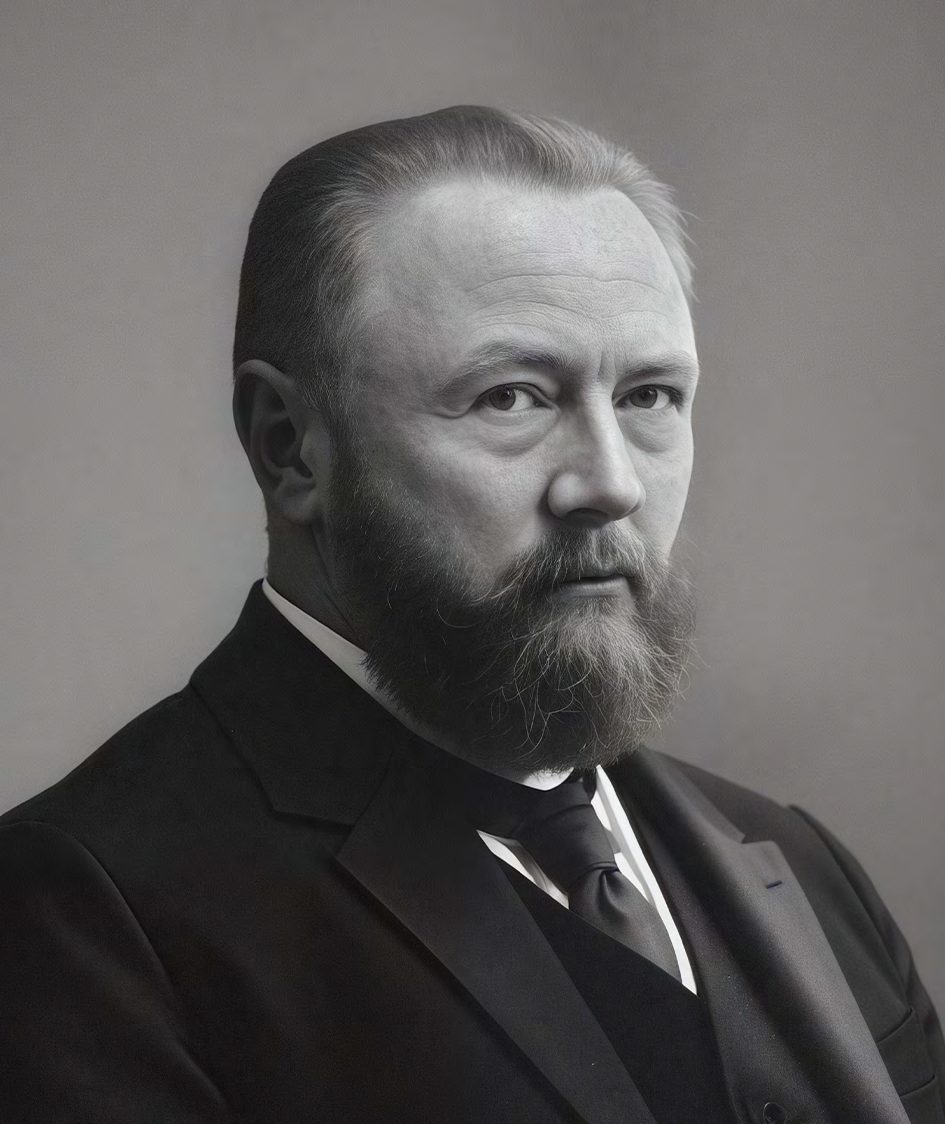
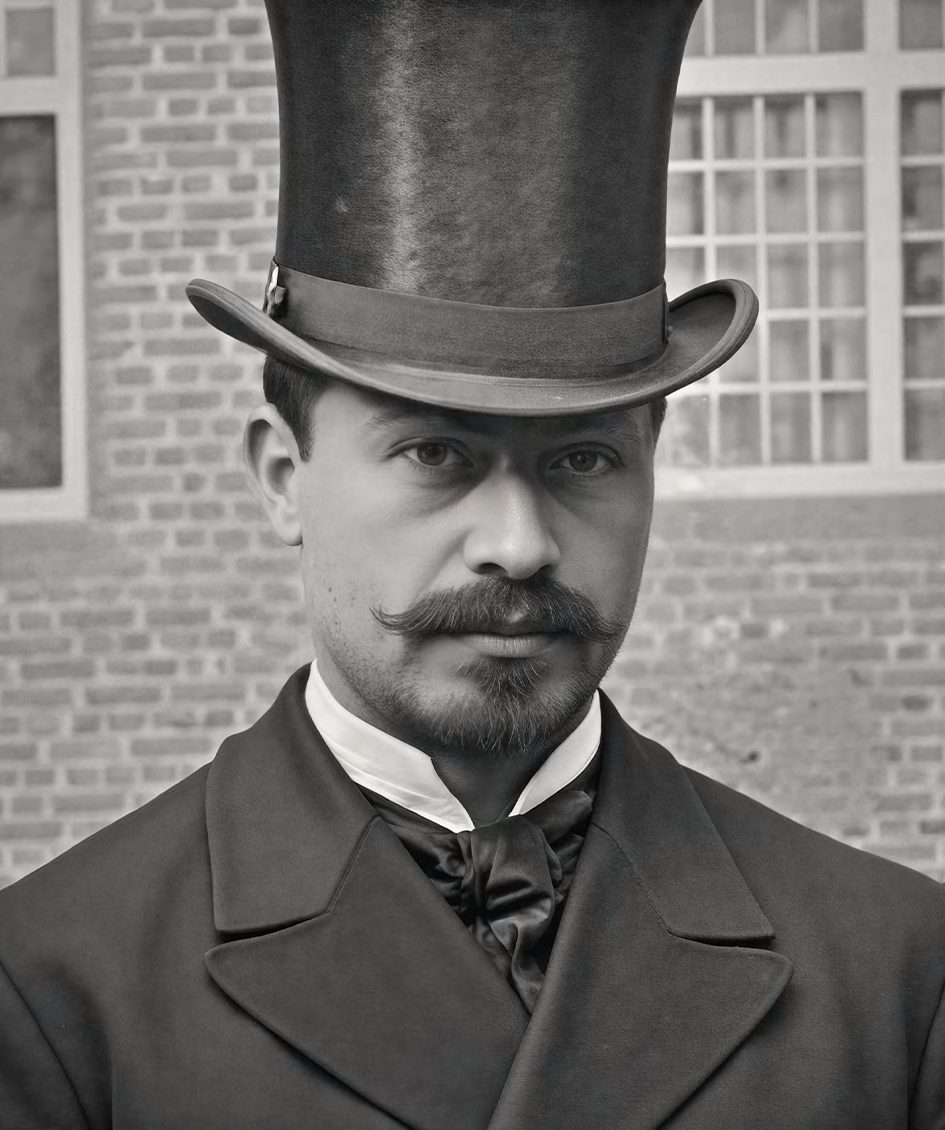
Fyodor Fyodorovich (Friedrich Fromhold) Martens (1845–1909)
A diplomat of Estonian origin and a scholar of international law, he was also a member of the Council of the Ministry of Foreign Affairs.
Martens graduated from the Faculty of Law at Saint Petersburg University with a master’s degree in international law. In January 1871, he was appointed Trustee of the Saint Petersburg Academic District and was granted the title of Chief Associate Professor. Two years later, he defended his doctoral thesis. In 1876, he was appointed Professor Ordinarius at St. Petersburg University, where he taught until 1905. From 1874 to 1906, he held the title of Professor Emeritus of International Law at the university’s Faculty of Law.
Starting in 1869, Martens began working closely with the Ministry of Foreign Affairs. In 1873, he was granted access to the Ministry’s archives to compile a comprehensive collection of all international treaties ever concluded by Russia with other countries. The first volume was published the following year, and the fifteenth and final one appeared in 190915). In 1874, he also took part in the Brussels Conference, which focused on codifying the laws and customs of war.
In 1879, Martens was appointed Special Official to State Chancellor Alexander M. Gorchakov, and in 1881, he became a permanent member of the Council of the Ministry of Foreign Affairs.
He was awarded an honorary Doctor of Laws (honoris causa) degree by the University of Edinburgh in 1884, followed by the same honor from the University of Cambridge in 1895.
From 1886, Fyodor Fyodorovich taught international law at the Imperial Alexander Lyceum and became a member of the Russian Red Cross Society.
From the 1880s onwards, Martens represented Russia at almost every major international conference: the 1889 Brussels Conference on trade and maritime law, the Anti-Slavery Conference (Brussels, 1889-1890), sessions of the Permanent Chamber of the The Hague Arbitration Court, and international conferences of the Red Cross. Martens also served as a government delegate to the Hague Conference on Private International Law in 1893, 1894, 1900, and 1904.
In 1900, he was elected Foreign Member of the French Academy of Moral and Political Sciences, and in 1908, a Corresponding Member of the Saint Petersburg Academy of Sciences.
According to the online archive of the Nobel Peace Prize, Martens received more nominations for the award than any other nominee from the Russian Empire or the Soviet Union combined — 24 in total16.
Martens died of a sudden cardiac arrest on June 7, 1909, while en route to Saint Petersburg.
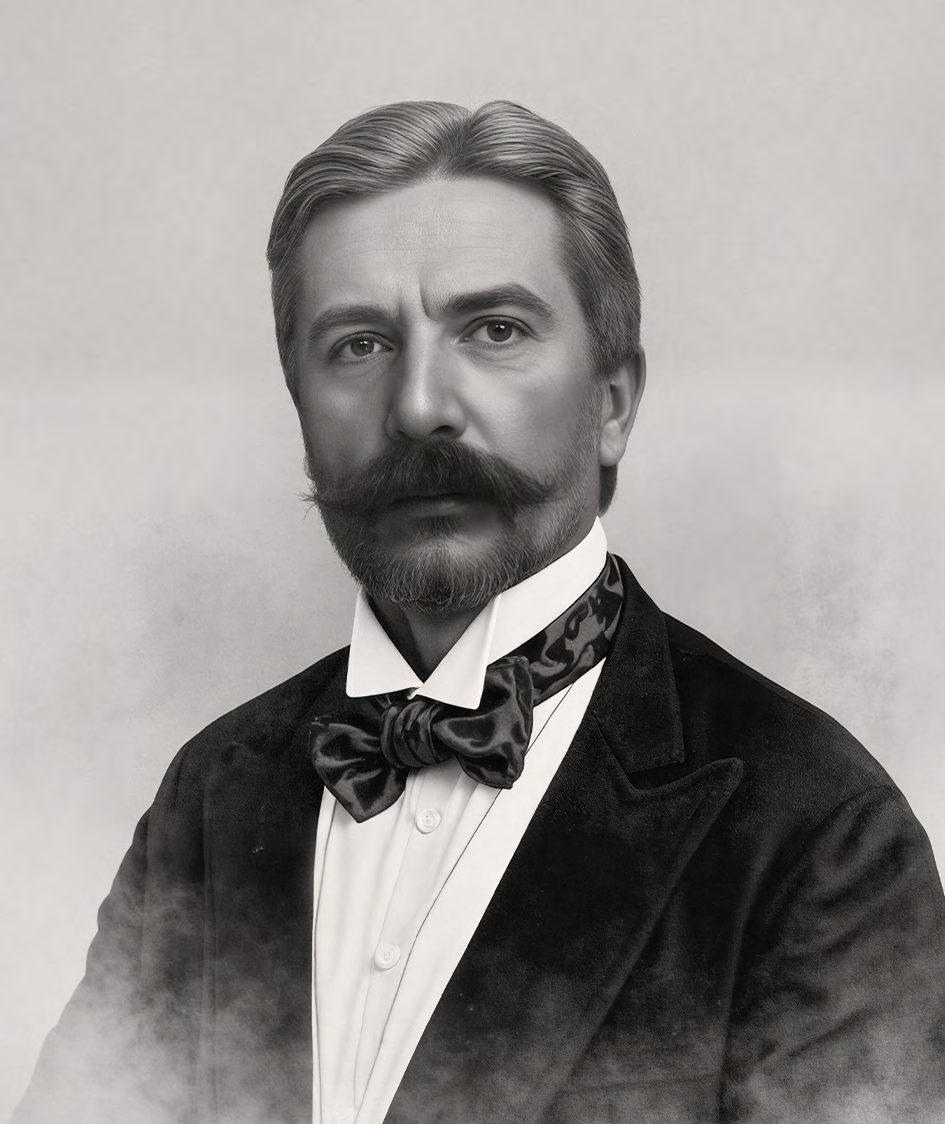
Mikhail Alexandrovich von Taube (1869–1961)
Russian and French international lawyer, diplomat, historian, counselor, professor, and public official.
Mikhail von Taube graduated from the Faculty of Law at Saint Petersburg University in 1891 and stayed on to pursue the title of Professor of International Law. A student of the renowned Fyodor Martens, he earned his master’s degree in international law in 1896 and defended his Ph.D three years later. He lectured at the universities of Kharkov and Saint Petersburg, as well as at the School of Jurisprudence.
In 1892, Taube was assigned to the Ministry of Foreign Affairs, where he worked in the legal advisory department under Martens’ supervision. At the ministry, he steadily climbed the career ladder, rising from a rank-and-file position to a seat on the Ministry’s Council.
In 1904–1905, Taube represented Russia on the international commission in Paris that investigated the Dogger Bank incident. In 1908–1909, he took part in the London Naval Conference, and from November 1909, he served as a member of the Permanent Chamber of the The Hague Arbitration Court.
He was also an honorary member of the CMI.
From 1911, he held the post of Deputy Minister of Public Education, and in 1915, he was appointed senator with the rank of Privy Councillor. Two years later, he became a member of the State Council by decree.
Since 1912, Taube was a full member of the Imperial Russian Historical Society, and in 1914 he joined the Imperial Society for the Promotion of Historical Enlightenment. He was also an honorary member of the Moscow Archaeological Institute (1912), as well as of a number of provincial scholarly archival commissions. In 1897, he took part in drafting the charter of the Russian Genealogical Society, became one of its founding members, and later served as its deputy chairman.
From 1917, Taube lived in exile. He resided, worked, and lectured on history in Finland, Sweden, France, Germany, and Belgium. He was a member of the Special Committee for Russian Affairs in Finland (1918), the Academy of International Law in The Hague, the Russian Historical and Genealogical Society in America, and served on the academic council of the Russian Scientific Institute in Berlin.
Mikhail Alexandrovich passed away on November 29, 1961, in Paris. He was buried alongside his children at the Sainte-Geneviève-des-Bois Cemetery (grave No. 5416).
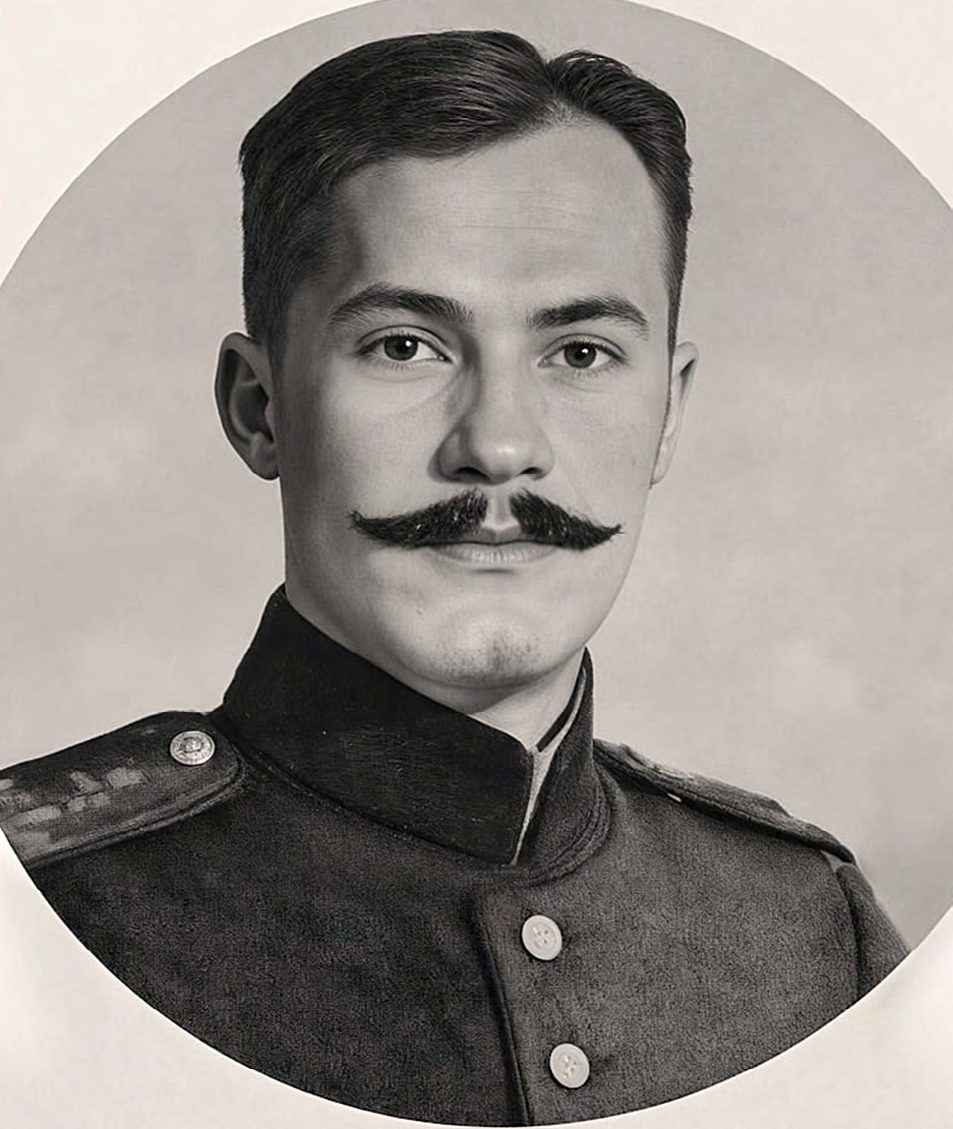
Ivan Alexandrovich Ovchinnikov (1865–1917)
Military legal officer, international maritime law expert, lieutenant general of the navy, professor.
In 1892, Ivan Alexandrovich graduated from the Military Law Academy, and between 1894 and 1895, he attended lectures at the Faculty of Law at the University of Lausanne. In 1896, he was appointed lecturer in maritime international law at the Nikolaev Naval Academy and also taught full-time at the Naval Cadet Corps17. A year later, he joined the teaching staff of the Military Law Academy, where he taught international law classes.
From 1907 to 1917, Ovchinnikov was a professor at the Alexander Military Law Academy. At the Nikolaev Naval Academy, he served as professor of international law and, from 1910, as head of the department. At both institutions, he had been teaching international law as a full-time lecturer since 190018. From 1911 to 1914, he also held a teaching position at the Naval Corps19.
He was an honorary member of the CMI.
In December 1914, Ovchinnikov was appointed acting Head of the Central Reference Bureau for Prisoners of War under the Main Directorate of the Russian Red Cross Society20.
In 1916, he was awarded the title of Professor Emeritus at the Nikolaev Naval Academy21.
On April 28, 1899, he began representing the Naval Ministry at several major international conferences — in The Hague (1899, 1907), Brussels (1905, 1910), Geneva (1906), and London (1909)22. He was appointed to the Drafting Commission for the proposed Merchant Shipping Code on March 15, 1902, and on April 30, 1909, he joined the commission tasked with reviewing existing regulations on prize awards23.
Ovchinnikov published extensively on international law and maritime prize law.
His military career advanced alongside his academic work: he was promoted to lieutenant colonel in 1903, and in 1904 he became a field officer for special assignments under the Chief of the Admiralty Naval Staff. In 1907, he was promoted to colonel; in 1911, to major general; and in 1915, to lieutenant general of the fleet.
In 1917, Ivan Alexandrovich Ovchinnikov was killed along with his family during a bandit attack in Sochi.
Russian Maritime Law Society regularly sent delegates to the Bremen (September 1909), Paris (October 1911) and Copenhagen (May 1913) CMI conferences.
During this period, the Society saw a change in leadership: it came under the direction of G.G. Steblin-Kamensky, who, on May 24, 1913 — three days before the official announcement–informed Veselago that he had been elected deputy chairman, and expressed hope that Veselago’s valued contribution “would help the Society expand its work, particularly in advancing broad and substantive initiatives in the field of maritime legal affairs24.”
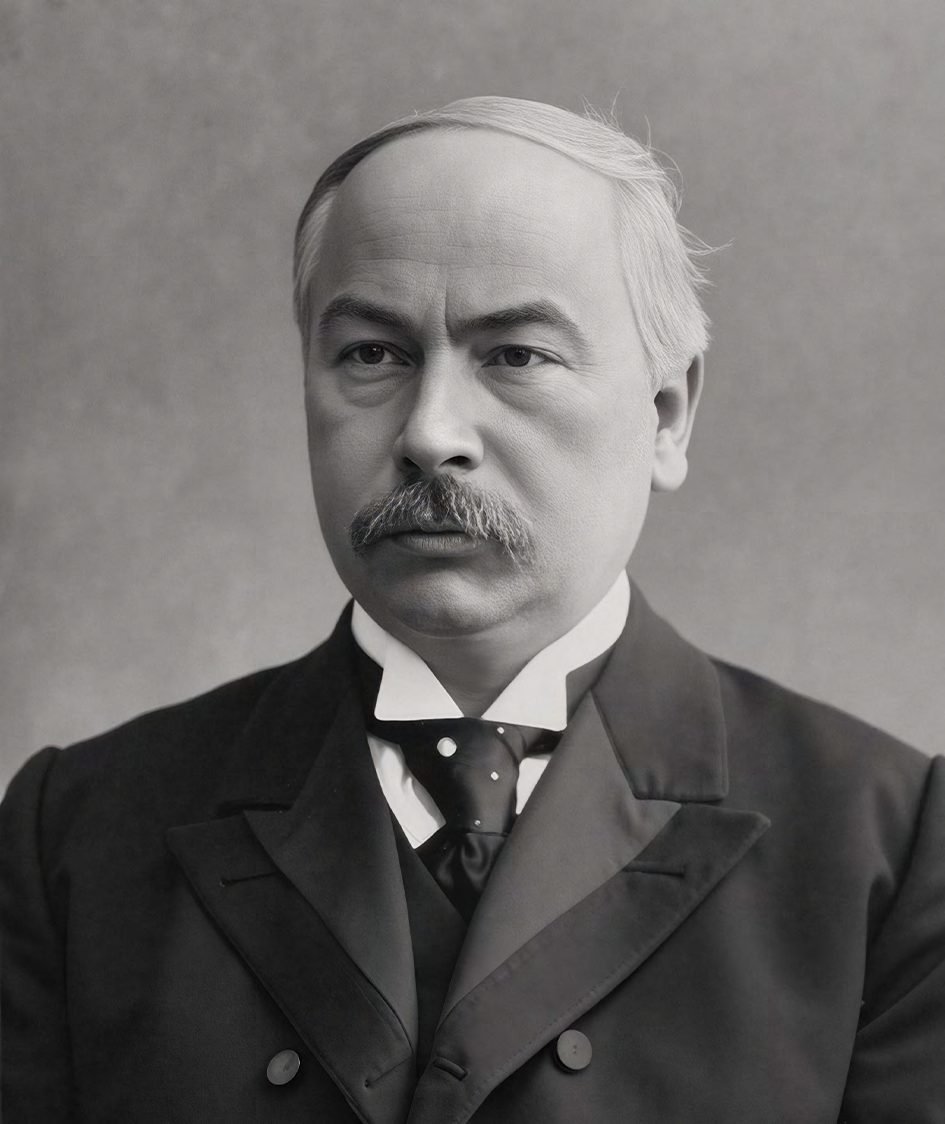
Georgy Georgievich Steblin-Kamensky (March 20, 1853 – no earlier than 1935)
Privy Councillor, Chief Executive of the Chancellery of the Ministry of the Navy, and Senator of the Governing Senate serving in both the Department of Heraldry and the Judicial Department.
Steblin-Kamensky graduated from the Faculty of Law at Saint Petersburg University in 1876 with a degree of Candidate of Laws (1876).
Starting in 1877, he served in the Ministry of Justice as a senior candidate for judicial appointments to the Warsaw Court of Appeal. The following year, he was promoted to assistant secretary of the same court. Over the next five years, he held a number of positions until 1883, when he started working at the Kalisz District Court.
That same year, he transferred to the Ministry of the Navy, where he initially served as an assistant legal advisor. He rose through the ranks, holding positions as chief clerk of the Chancellery, acting state counsellor, head of legislative codification, and ultimately director of the Chancellery. In 1905, Steblin-Kamensky was promoted to Privy Councillor.
In 1910, Steblin-Kamensky was elected chairman of the Russian Maritime Law Society. A year later, he was appointed Prosecutor of the Supreme Prize Court.
In October 1911, he was assigned to the Senate, where he served in the Heraldry Department of the Governing Senate. By 1915, he had transferred to the Judicial Department, and in 1917, he was once again serving in the Senate.
After the October Revolution, Steblin-Kamensky appears to have remained in the USSR. Indirect evidence of his continued presence comes from the 1923 All Petrograd yearly directory, where he is listed — under the abbreviated surname ‘Steblin’25 — as a lawyer. His exact date of death remains unknown, although available sources suggest that he was still alive as late as 1935.
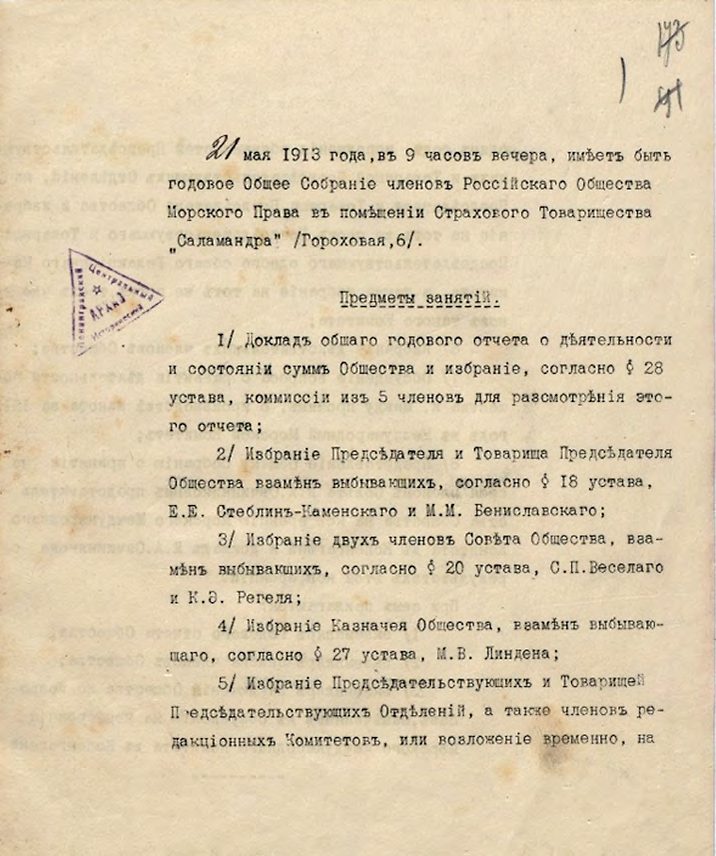
That same year, on May 21, 1913, the Society convened its annual general meeting. The main item on the agenda was the presentation of its report on activities carried out during 1912–1913.
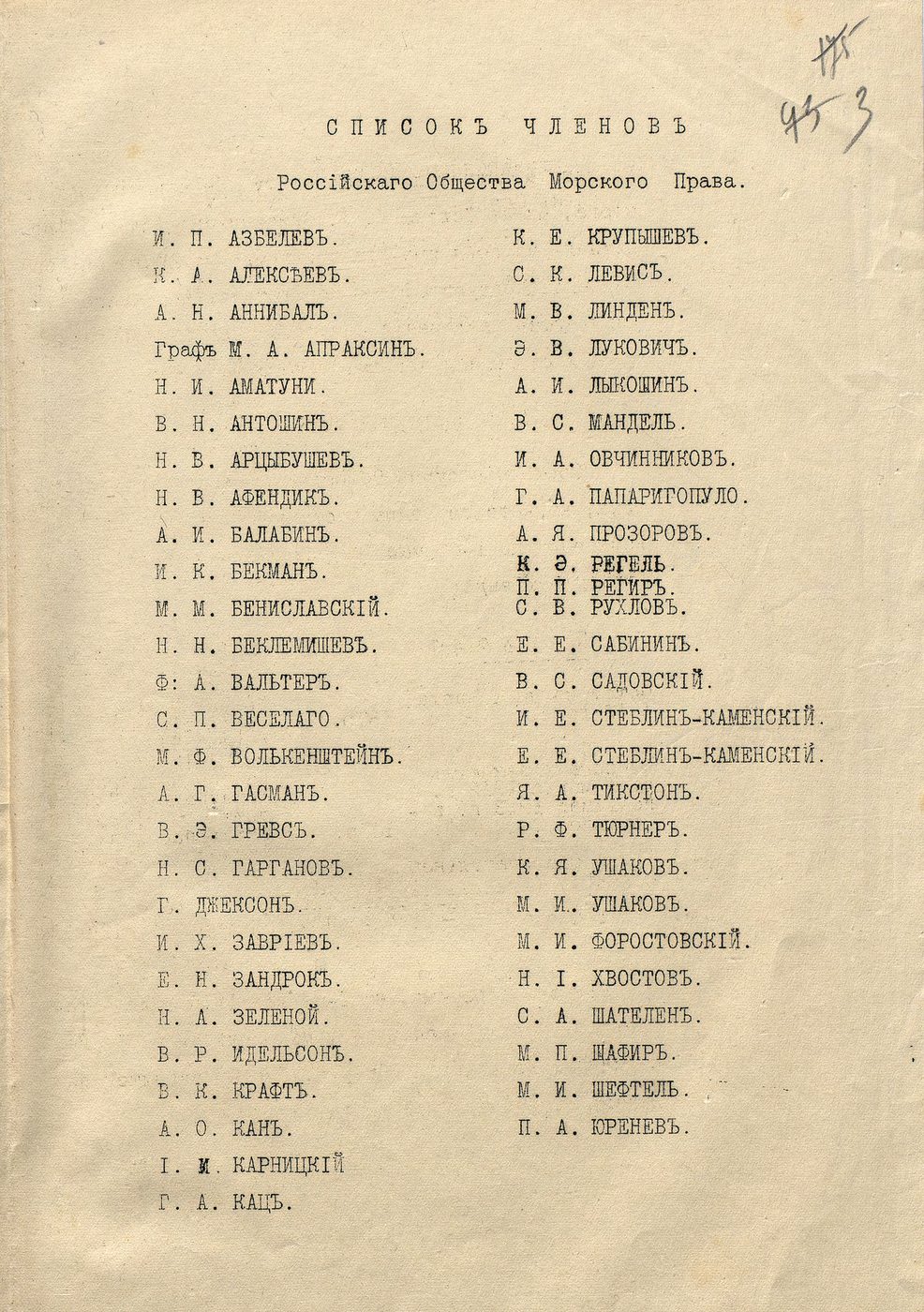
A surviving copy of the minutes, preserved in the archives of the Northern Steamship Company, has made it possible to reconstruct a complete list of the Society’s members at that time — 53 individuals in total26.
List of Russian Maritime Law Society Members
1. Ivan Pavlovich Azbelev
2. Kir Alekseevich Alekseev
3. Arkady Nestorovich Annibal
4. Count Matvey Alexandrovich Apraksin
5. Nikodim Isaevich Amatuni
6. Vasily Nikolaevich Antoshin
7. Nikolai Vasilievich Artsybushev
8. Nikolai Vasilievich Afendik
9. A. I. Balabin
10. I. K. Bekman
11. Mikhail Mikhailovich Benislavsky
12. N. N. Beklemishev
13. Filipp Antonovich Walter
14. Sergei Petrovich Veselago
15. Mikhail Filippovich Volkenstein
16. Anatoly Grigoryevich Gasman
17. Valerian Eduardovich Grevs
18. Nikolai Sergeevich Garganov
19. G. Jackson
20. Yakov Khristoforovich Zavriev
21. Evgeny Nikolaevich Zandrok
22. Nikolai Alexandrovich Zelenoy
23. Vladimir Robertovich Idelson
24. Viktor Karlovich Kraft
25. A. O. Kan
26. Iosif Ivanovich Karnitsky
27. G. A. Katz
28. Konstantin Egorovich Krupyshev
29. S. K. Levis
30. M. V. Linden
31. E. V. Lukovich
32. Alexander Ivanovich Lykoshin
33. Veniamin Semyonovich Mandel
34. Ivan Alexandrovich Ovchinnikov
35. Georgy Alexandrovich Paparigopulo
36. Alexei Yakovlevich Prozorov
37. Karl Eduardovich Regel
38. Petr Petrovich Regir
39. Sergei Vasilievich Rukhlov
40. Evgeny Evgrafovich Sabinin
41. Vladimir Stepanovich Sadovsky
42. Ivan Egorovich Steblin-Kamensky
43. Georgy Georgievich Steblin-Kamensky
44. Yakov Andreyevich Tikston
45. R. F. Turner
46. K. Ya. Ushakov
47. Mikhail Ivanovich Ushakov
48. M. I. Forostovsky
49. N. I. Khvorostov
50. Sergei Andreyevich Shatelein
51. Mark Porfiryevich Shafir
52. Mikhail Isaakovich Sheftel
53. Petr Alexandrovich Yurenev
RSHA: Record Group 111, Series 1, File Unit 76, P. 3
The Society ceased its activities after the Revolution of 1917, which also marked the end of its participation in the work of the CMI. No records of the Society — whether in archival holdings, online publications, or CMI bulletins from after 1917 or the Soviet period — have been found.
4. How the Russian Maritime Law Society Operated: Membership Criteria, Meetings, and Conference Preparation
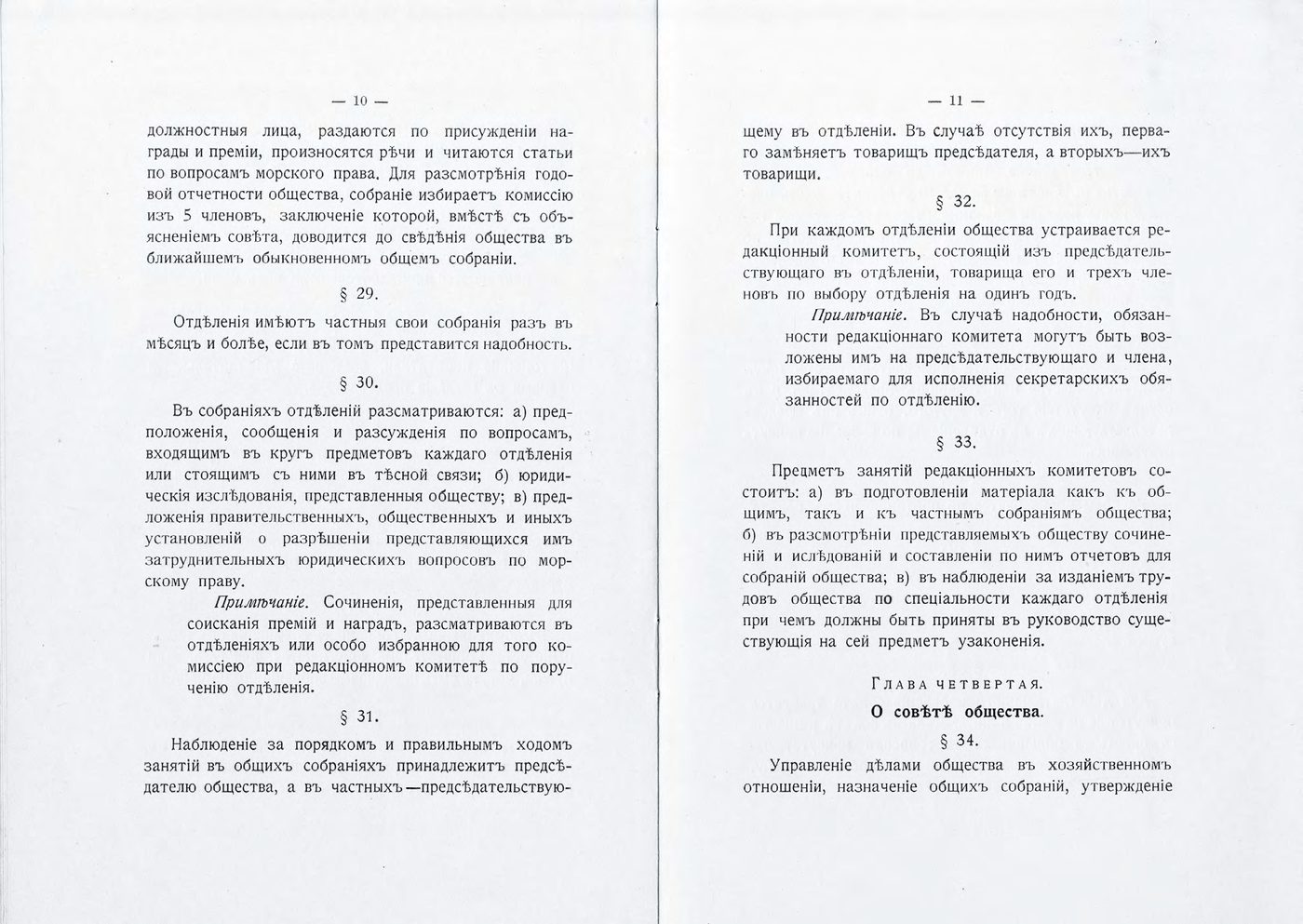
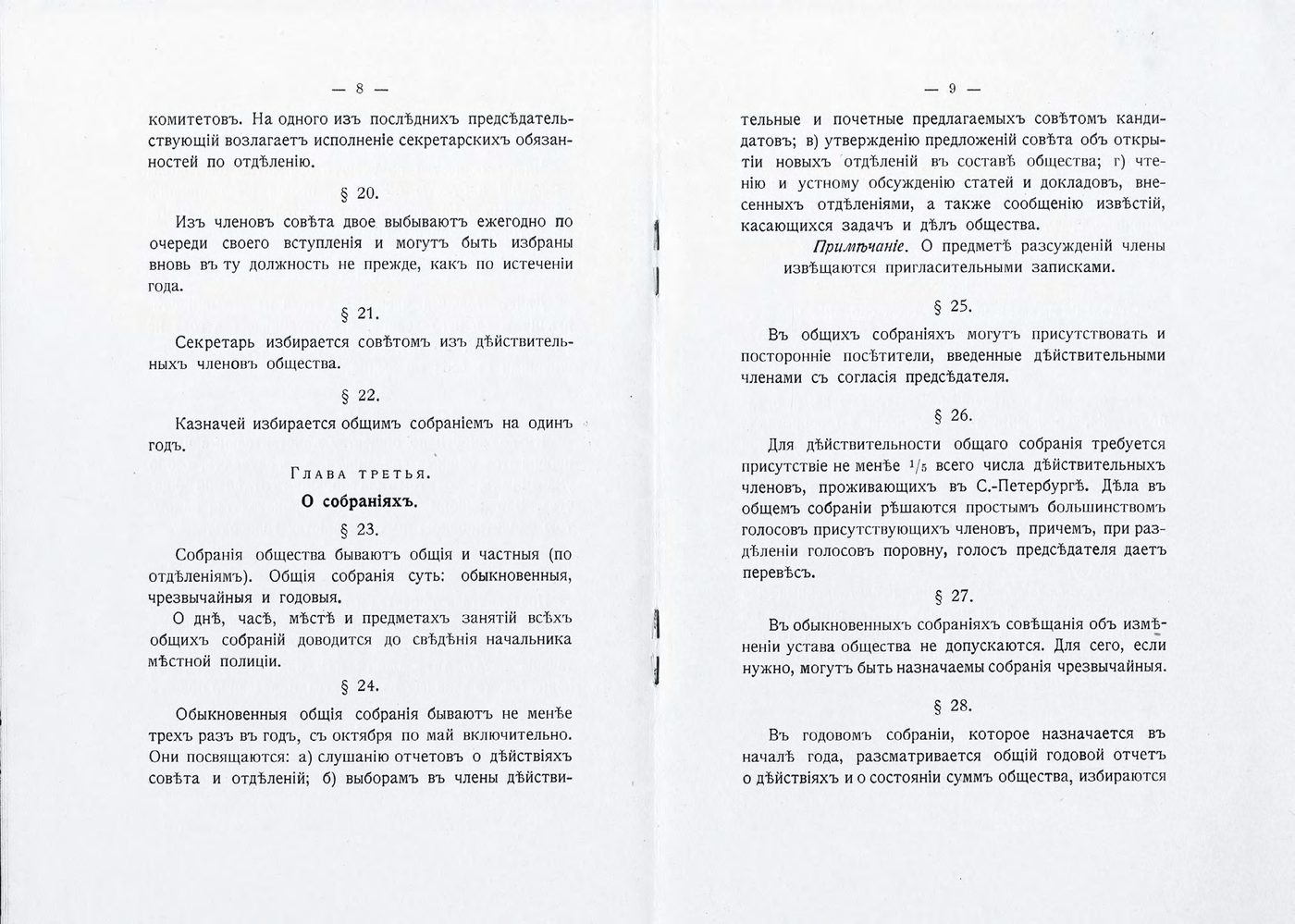
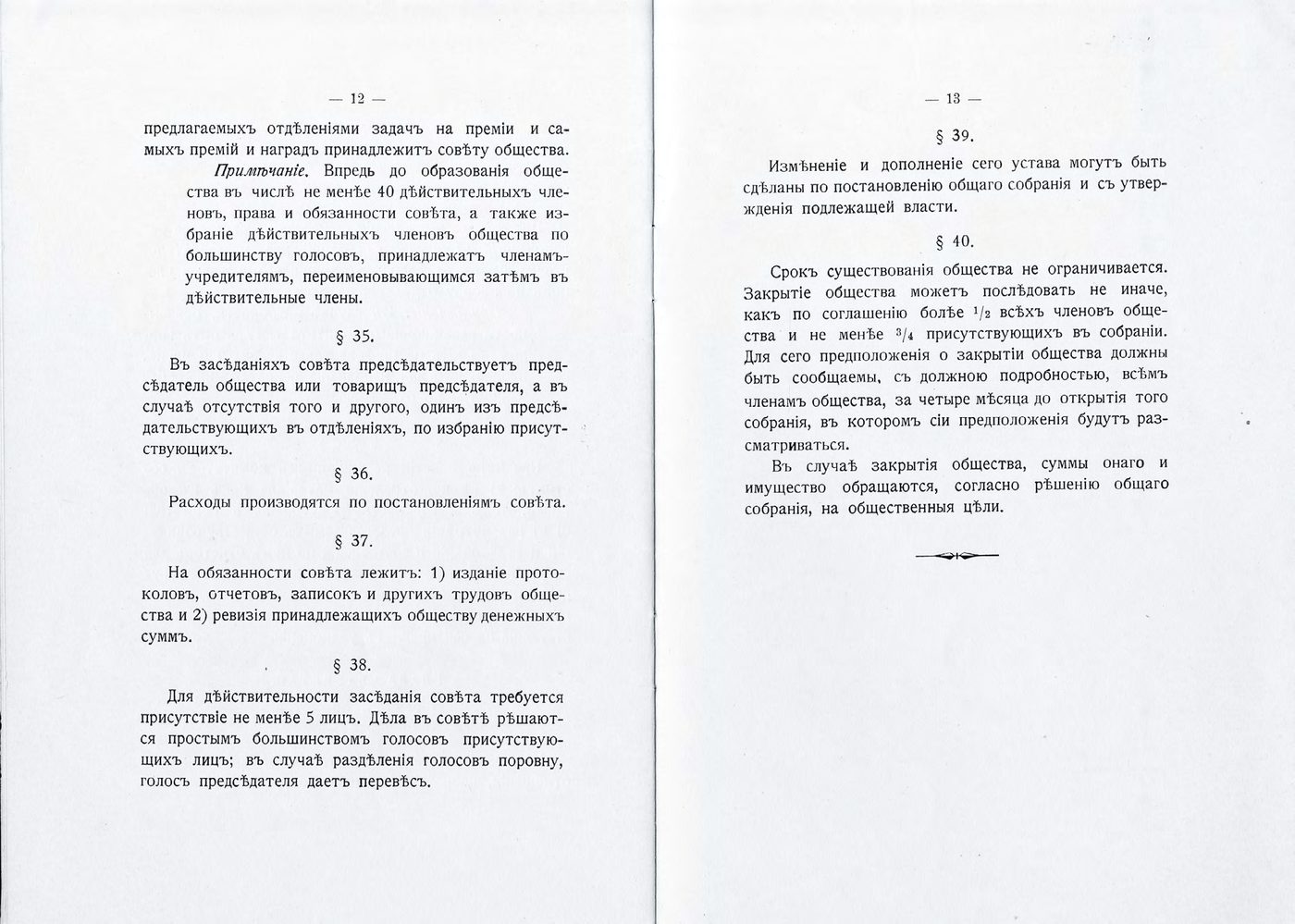
Much of what is known about the Society’s structure, the criteria for membership, and the conduct of its general meetings comes from its charter27.
According to the document, the Society was organized into two main divisions — public maritime law and private maritime law — based on the nature of the subjects it addressed. Additional divisions could be created as needed.
Archival records28 show that the Society had 54 members at the time of its founding, including full members, honorary members, and associate members.
Membership was open only to individuals who had not been legally deprived of their civil rights by a court.
The council oversaw all aspects of the Society’s operations. It consisted of a Chairman, a Deputy Chairman, the heads of each division, four council members, and a secretary. The council also included a treasurer and a chancellery.
Although Society’s lifespan was not defined, its members reserved the right to dissolve it. Such a decision would be valid only if supported by more than half of the total membership and by at least three-quarters of those present at the meeting. Any proposal to dissolve the Society had to be communicated to all members no later than four months prior to the meeting at which it would be considered. The Society’s charter stipulated that, in the event of dissolution, its property and funds would be allocated to public purposes, as determined by a resolution of the general meeting.
The Chairman of the Society and his Deputy were elected for two-year terms, chosen from among three candidates nominated for each position by the Council. If either position was vacated before the end of the term, the vacancy was to be filled immediately through a new election.
Each division of the Society elected its own chairman, deputy chairman, and three editorial committee members.
Record of the Proceedings of the Second General Meeting of the Russian Maritime Law Society
Each year, two members of the Council stepped down in accordance with the order of their appointment. They were eligible for re-election to the same position, but only after a one-year interval.
The Secretary was elected by the Council from among the full members of the Society, while the treasurer – appointed for a one-year term–was chosen by the general meeting.
Eligibility for full membership was reserved for individuals ‘recognized for their scholarly or professional contributions in the field of maritime law or seafaring.’ The founding members of the Society were granted full membership automatically. Any new candidate for full membership had to be nominated by two existing full members, who were also required to vouch for the nominee’s reputation and provide information about their professional background. The Council would then consider candidates and, if approved, put them forward to the general meeting for election by majority vote, conducted by secret ballot.
Full members were elected and were eligible for election to any position within the Society.
Petition for a Subsidy to Cover the Society’s Membership Fee to the CMI
They were required to pay an annual due of no less than 5 rubles, or they could make a one-time contribution of 100 rubles to the Society ‘s treasury. Any full member who failed to fulfill this obligation for two consecutive years was considered to have relinquished their membership.
Honorary membership was conferred upon individuals who had made outstanding contributions to the advancement of maritime law or had provided notable support to the Society. Such appointments were made upon the recommendation of the Council.
Associate members were individuals who expressed a willingness to contribute to the work of the Society. They were admitted to membership through nominations from divisions and with the approval of the Council. Associate members held only an advisory vote at meetings and were exempt from dues. However, if they failed to participate in the Society’s activities for two years, they were deemed to have forfeited their associate status.
The Society held two types of meetings: general gatherings and private sessions conducted by its divisions. Private meetings were convened once a month or more frequently, if necessary.
General meetings fell into three categories: regular, extraordinary, and annual. In addition to Society members, the local chief of police was also notified in advance of any general meeting.
As for extraordinary general meetings, no information about them has survived.
Regular General Meetings
These were held at least three times a year, from October through May. Attendees received reports from the Council and the divisions, shared updates on the Society’s tasks and activities, voted on the admission of new full and honorary members, approved Council proposals for the formation of new divisions, and read and discussed papers and reports submitted by the divisions.
In order for a regular general meeting to be considered valid, at least one-fifth of the total number of full members residing in Saint Petersburg had to be present. All matters within such a meeting were resolved by a simple majority of the votes of the present members, and when the votes were equally divided, the chairman’s vote prevailed.
The dates of six general meetings of the Society have come down to us.
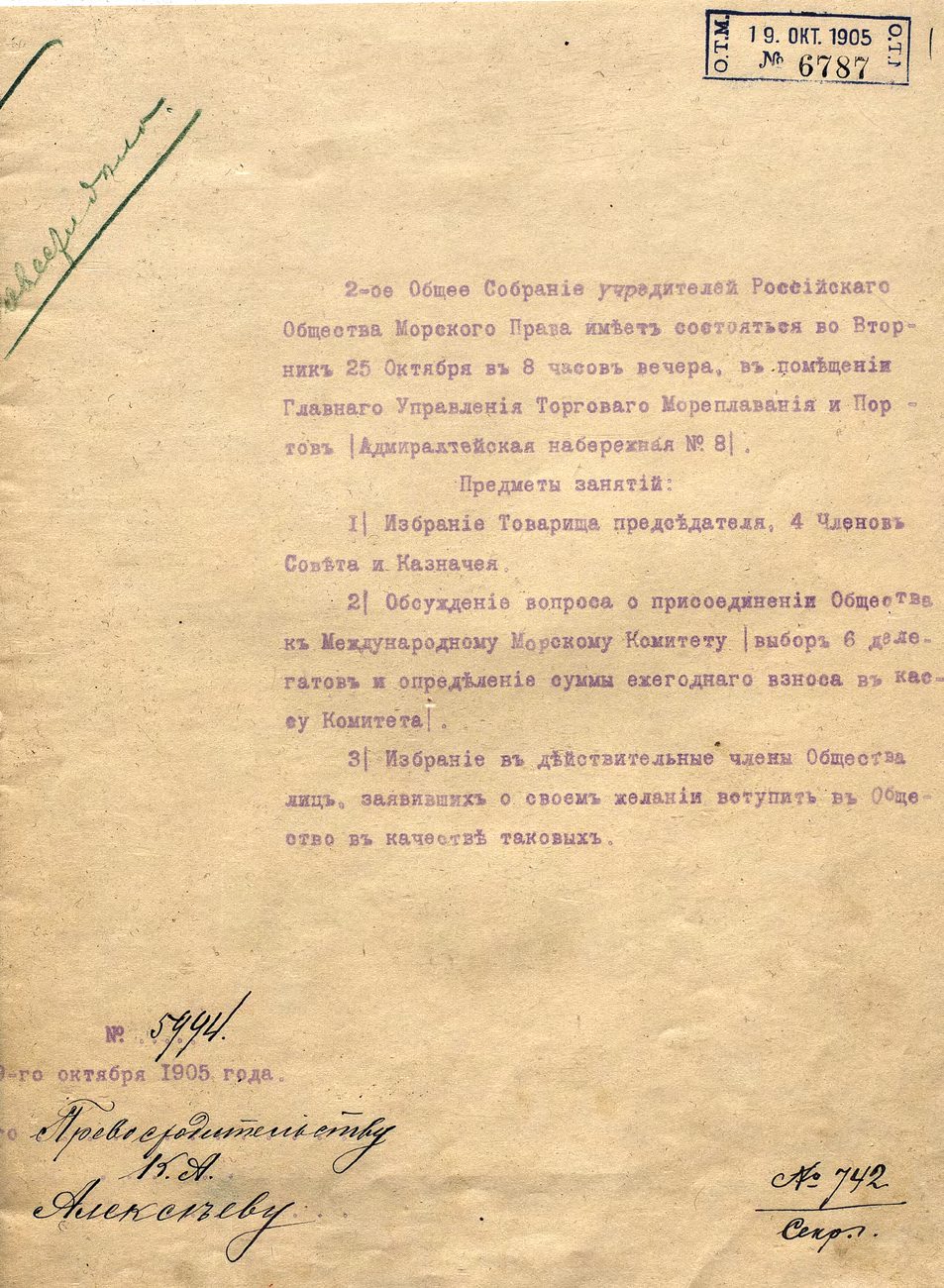
The first — namely, the meeting of its founding members — is mentioned in a notice sent to Alekseev, Head of the Merchant Shipping Department, on October 19, 190529. The notice stated that the Second General Meeting of the Society’s founders was scheduled for October 25, to be held at 8 Admiralteyskaya Embankment, Saint Petersburg.
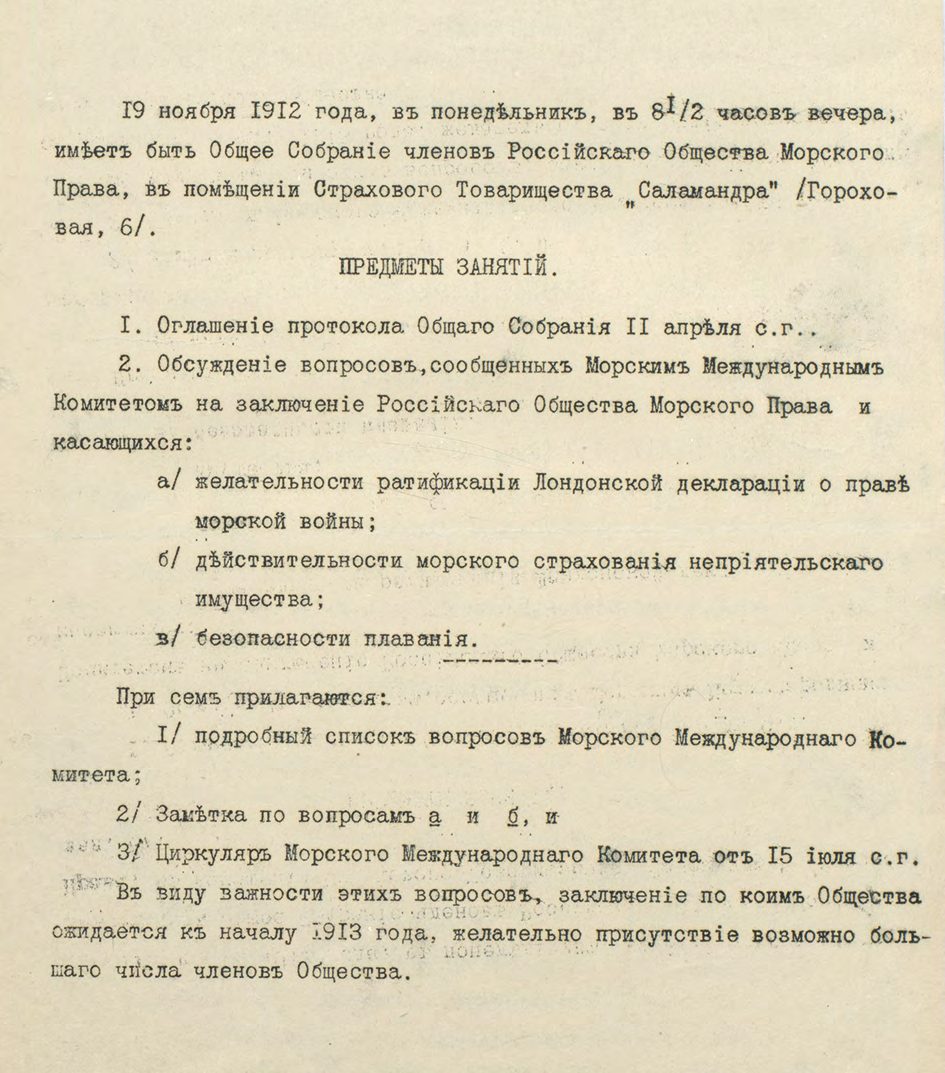
Record of the Proceedings of the General Meeting of the Society’s Members on November 19, 1912
The agenda for the meeting was as follows:
1) Election of the deputy chairman, four Council members, and the treasurer.
2) Discussion of the proposal to join the CMI, selection of six delegates, and determination of the annual dues payable to the Committee’s fund;.
3) Vote on the admission of individuals who had expressed a desire to join the Society as full members.
Unfortunately, the full record of the meeting has not been found in the archives. Nonetheless, some of its decisions can be pieced together from related documents and correspondence.
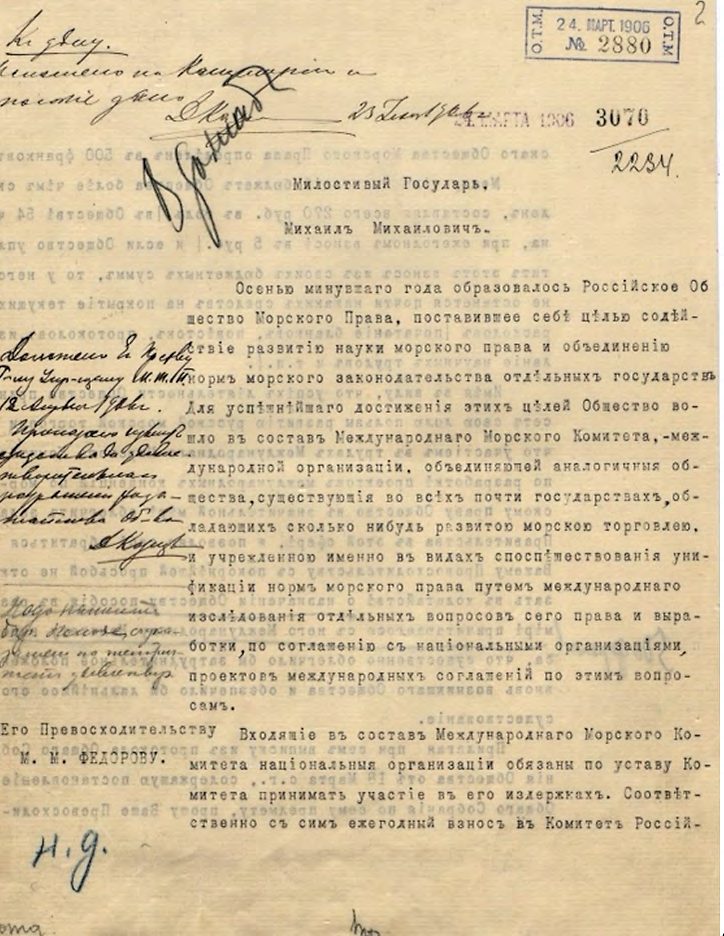
On March 22, 1906, Sergei Rukhlov — presumably acting in his capacity as chairman of the Society — addressed Mikhail Mikhailovich Fedorov, Minister of Trade and Industry, to report the financial difficulties faced by the newly established Society as it prepared to join the CMI30.
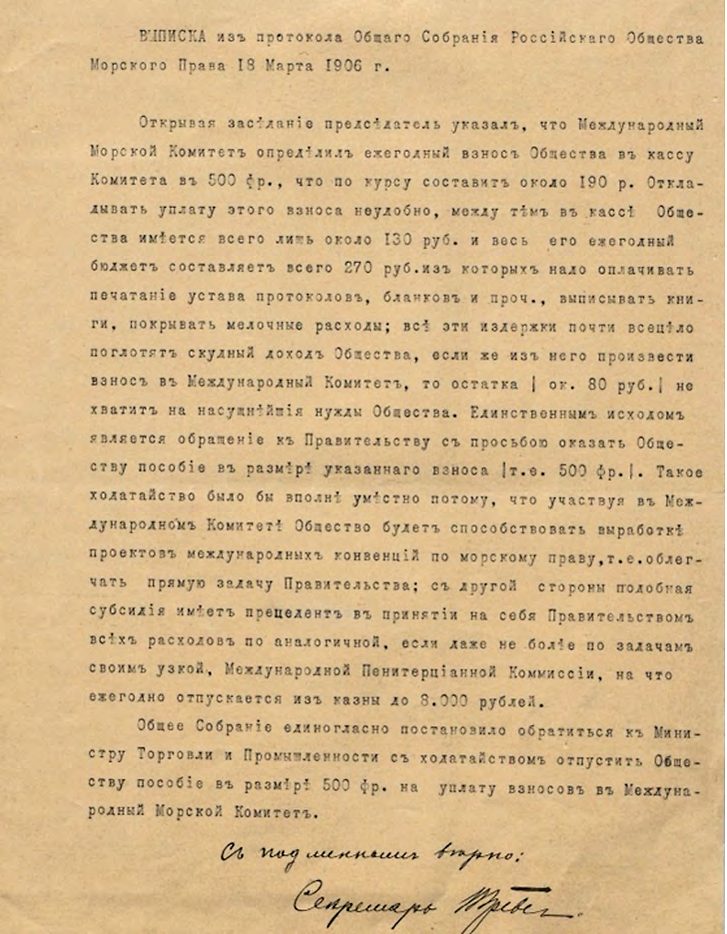
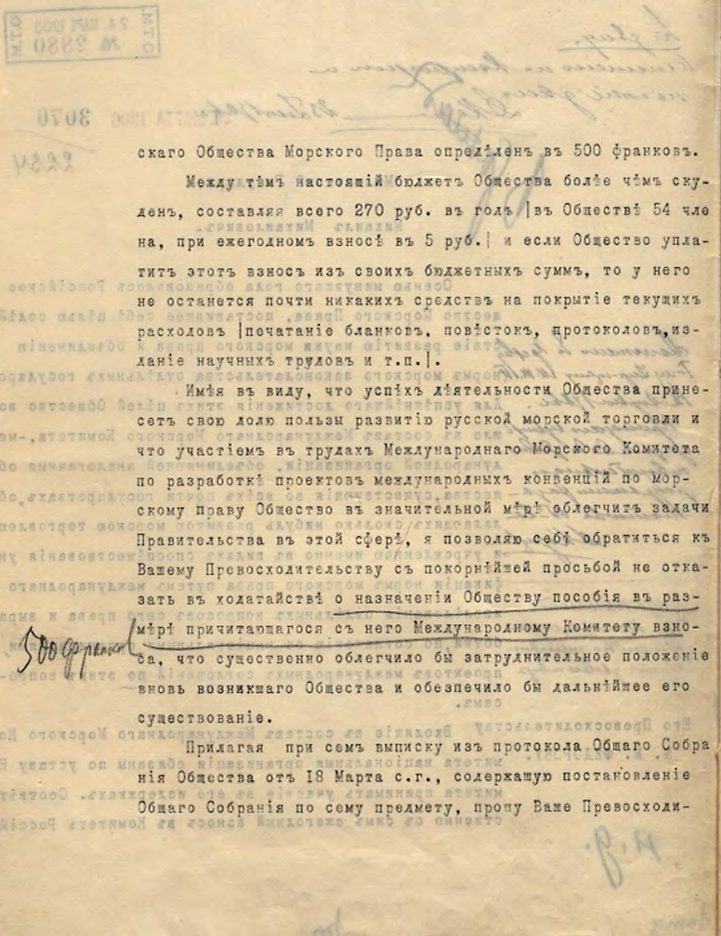
Under the CMI’s charter, national member societies were required to contribute to its operating expenses. A payment of 500 francs (approximately 190 rubles at the time), Rukhlov warned, would drain the Society’s already ‘meager budget’ — 270 rubles annually, based on dues of 5 rubles from each of its 54 members — leaving it unable to meet day-to-day costs and placing its continued existence in jeopardy.
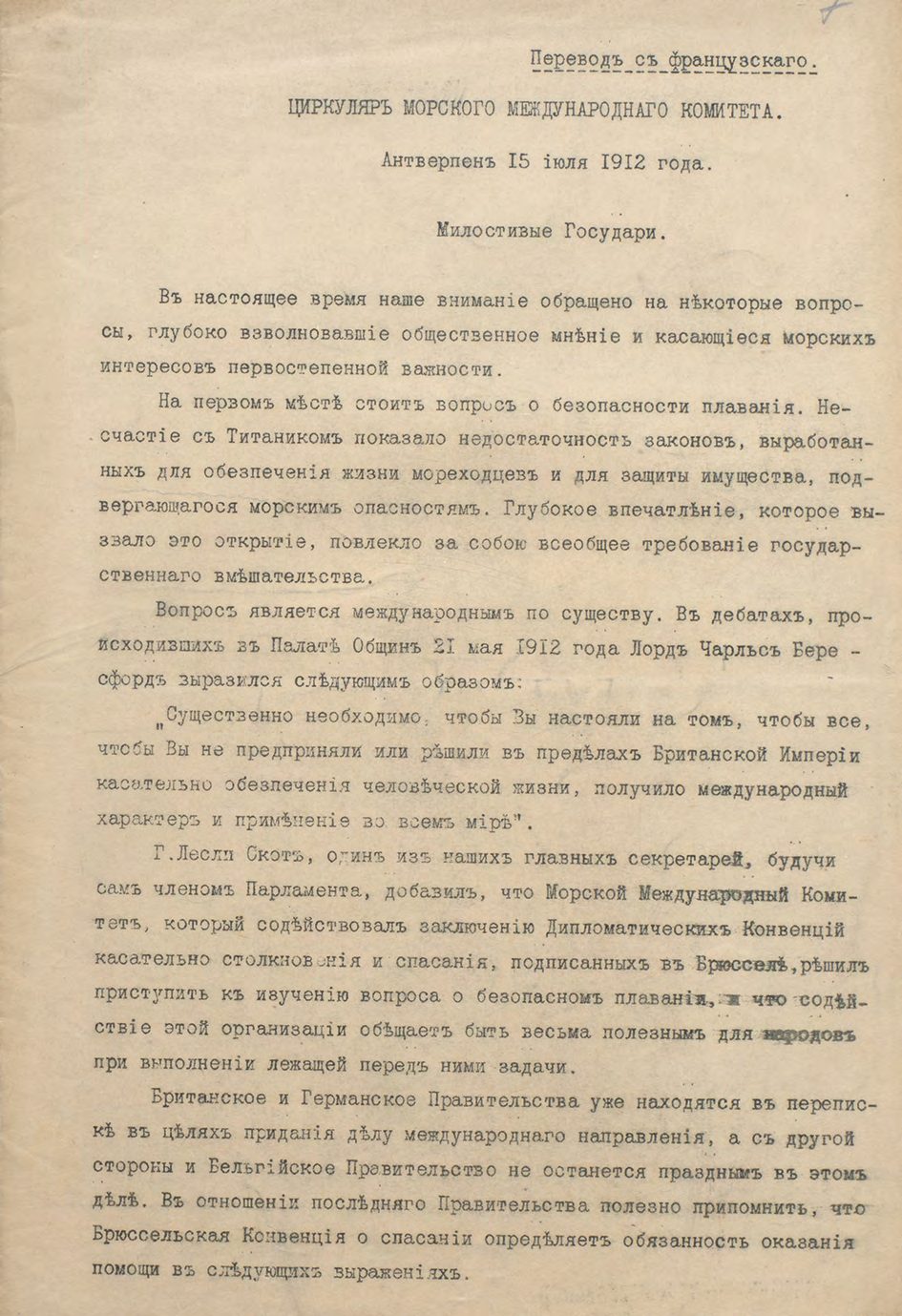
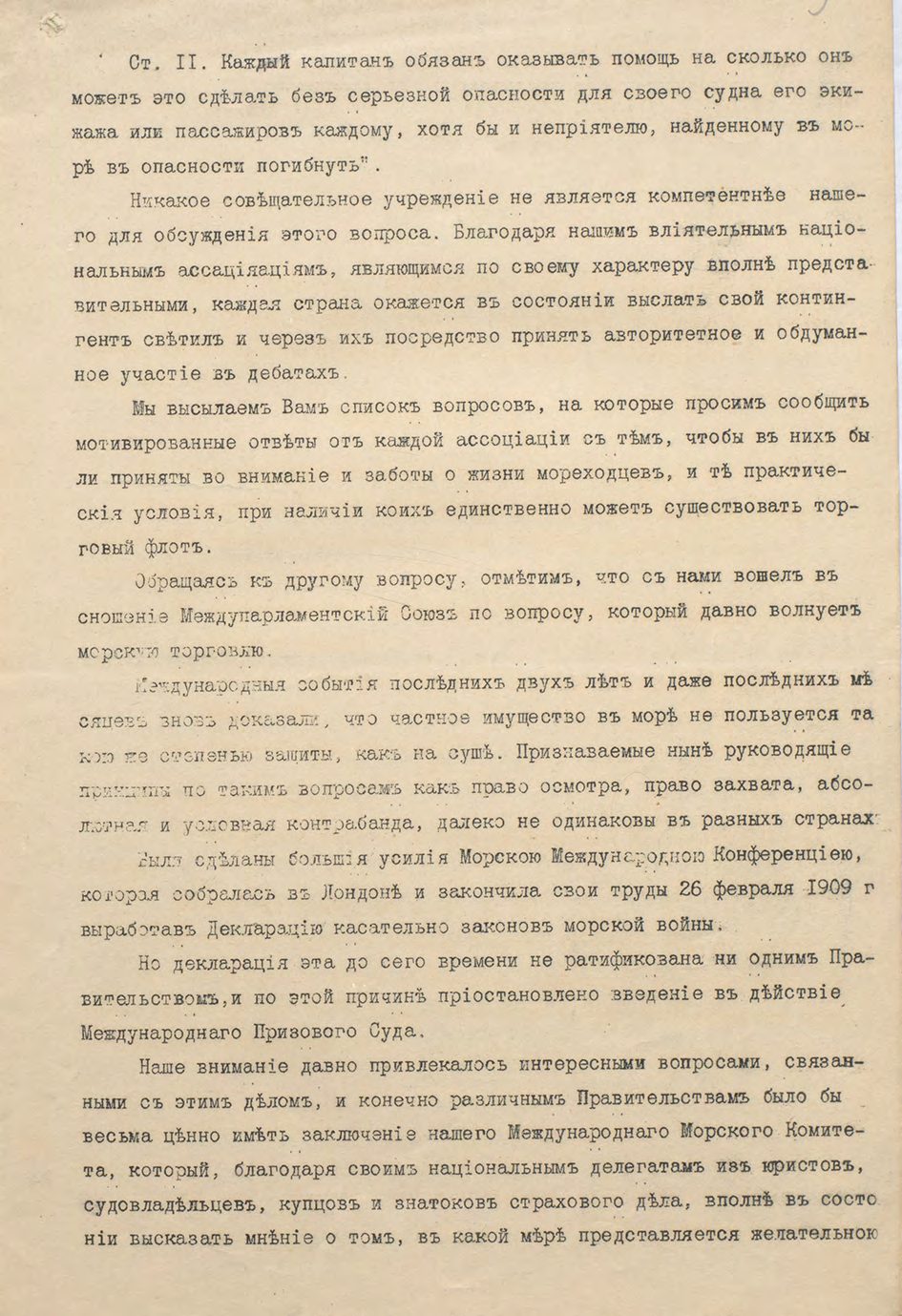
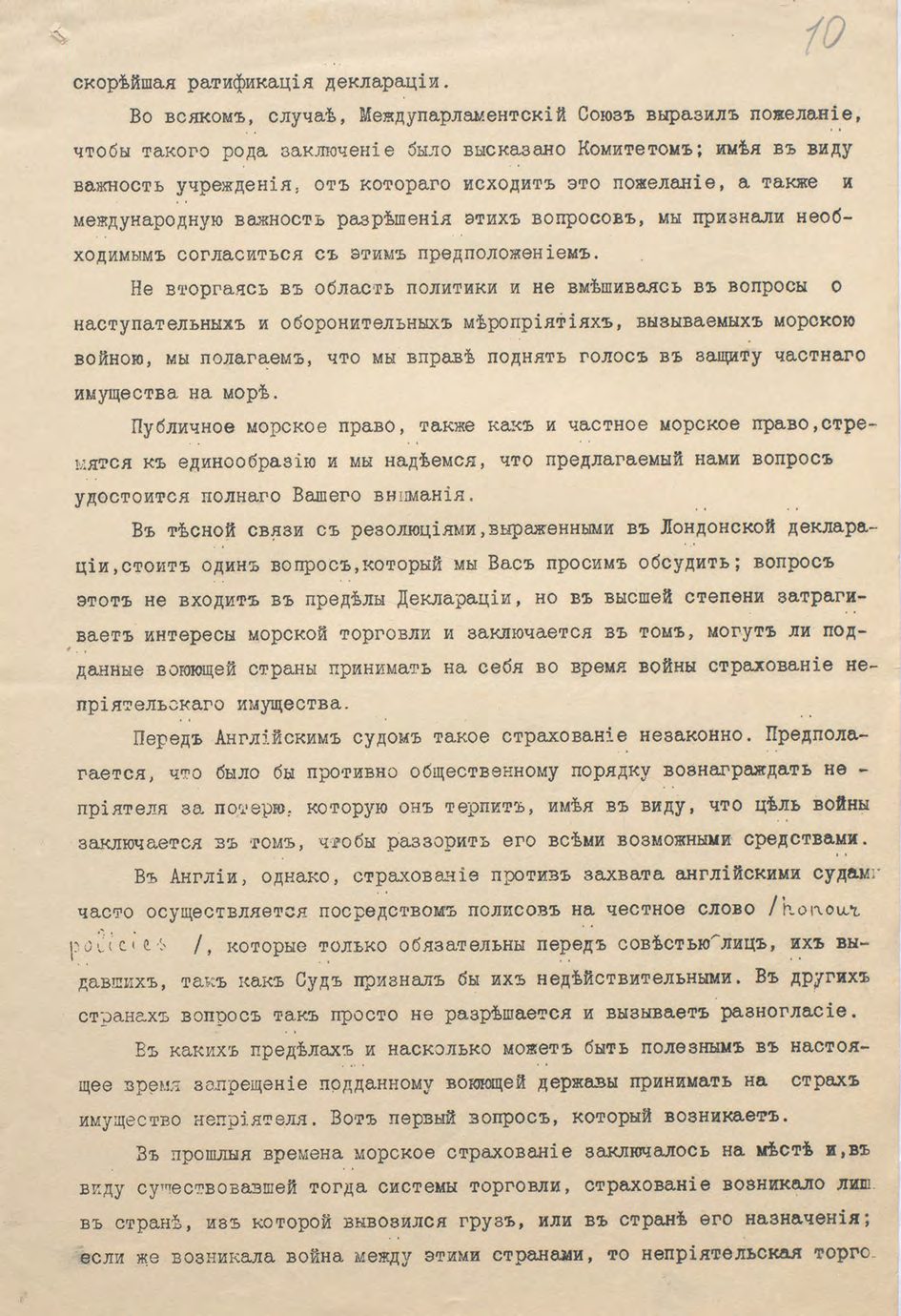
CMI Circular of July 15, 1912
Given that ‘the success of the Society’s work will serve the advancement of Russian maritime trade, and that through its participation in the Comité Maritime International and the drafting of international maritime conventions, the Society would greatly ease the burden on the Government in this field31,’ Rukhlov appealed to the Minister to grant a subsidy covering the required CMI contribution.
The excerpt from the minutes of the Society’s meeting held on March 18 of that year, enclosed with the appeal, makes it clear that although the members found it ‘inconvenient to postpone payment of the contribution,’ ‘the Society’s treasury held only around 130 rubles32.’ Meanwhile, the Society’s annual budget still had to cover the cost of the printing of the charter, proceedings, and official forms, as well as the purchase of books and other miscellaneous expenses. In considering the Society’s chances of receiving a government subsidy, those present at the meeting recalled that similar assistance had previously been granted to the International Penitentiary Commission, which, as they noted, pursued objectives arguably even narrower in scope. At the time, the state treasury had allocated up to 8,000 rubles a year to support its work.
It is unknown what outcome this correspondence ultimately produced or what decision the government reached in response to Rukhlov’s appeal. However, the fact that the Society continued its work for more than a decade afterward strongly suggests that the request was granted.
Further general meetings of the Society took place in May 1907. This is noted in the bulletin of the Venice Conference of CMI, held in September of that same year33. According to the bulletin, during sessions held between May 17 and 30 (the exact number of meetings is not specified), the Society formally approved a report by member V. E. Grevs concerning a draft convention on maritime liens.
Two additional general meetings are referenced in the minutes dated November 19, 1912, which took place at the offices of the Salamandra Insurance Association (6 Gorokhovaya Street, Saint Petersburg)34.
Record of the Proceedings of the Annual General Meeting of the Society’s Members on May 21, 1913
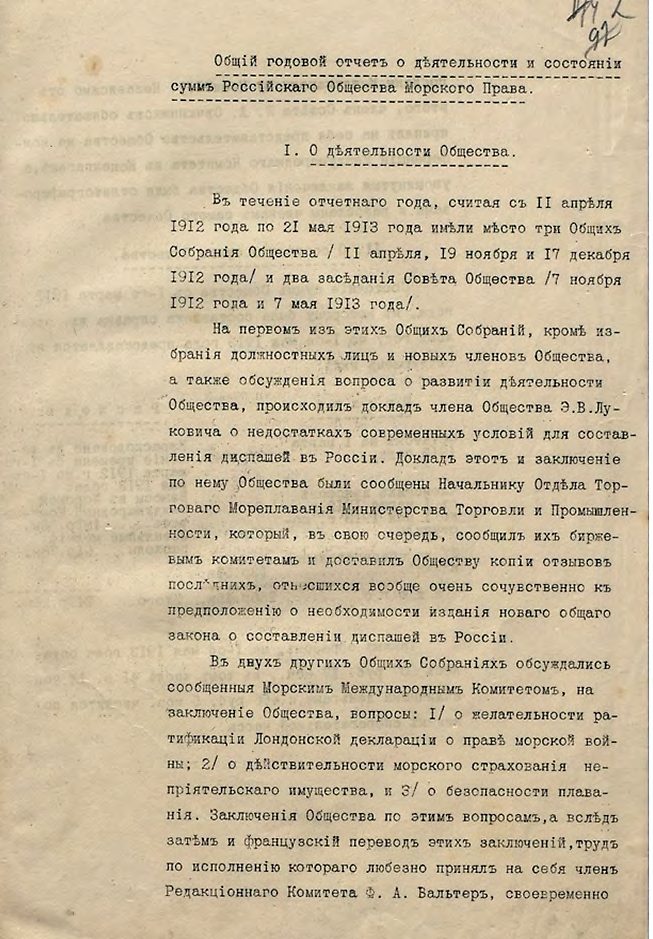
General Annual Report on the Activities of the Society for 1912–1913
The agenda included the following items:
1. Presentation of the minutes from the general meeting held earlier that year, on April 11.
2. Discussion of questions proposed by the CMI for the Society’s consideration, specifically:
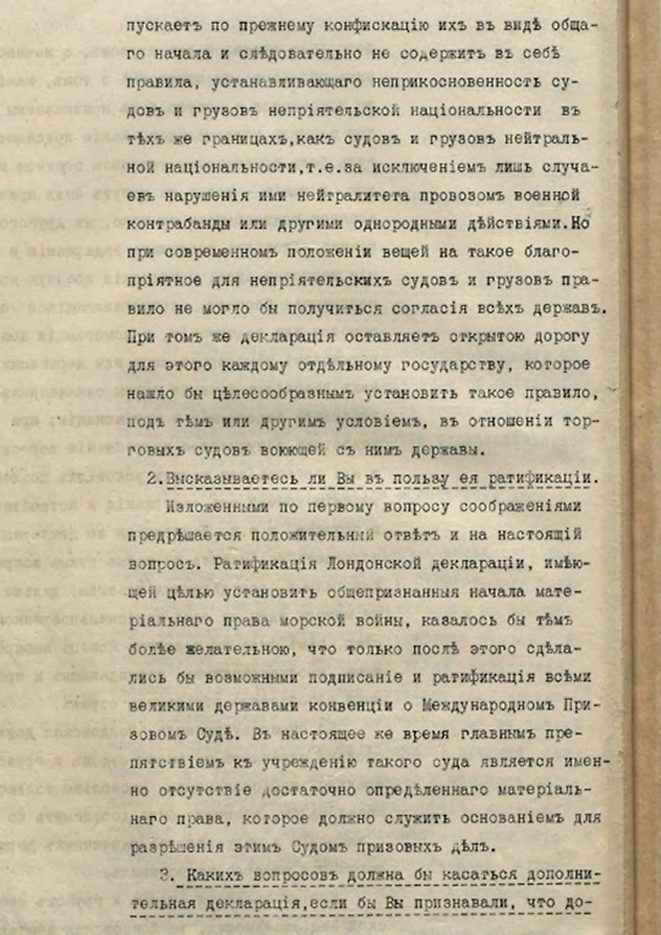
a. the advisability of ratifying the London Declaration concerning the Laws of Naval War.
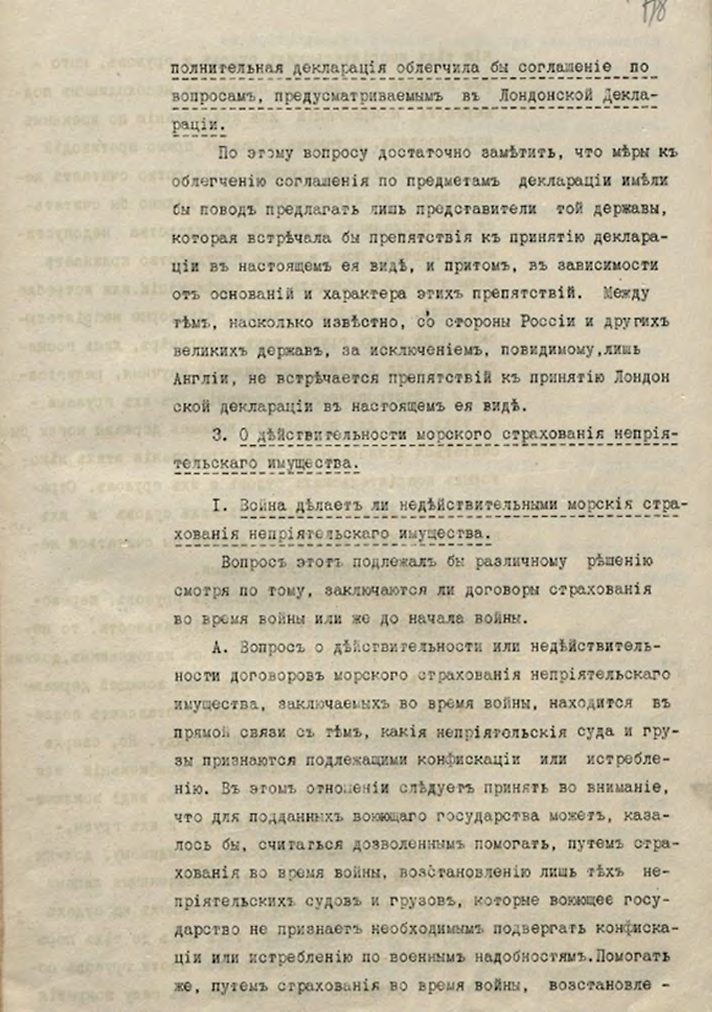
b. the legal enforceability of marine insurance policies covering enemy-owned property;
c. the safety of navigation.
According to the transcript of the November meeting, the following documents were appended:
1. A detailed questionnaire prepared by the CMI.
2. A position paper addressing items (a) and (b).
3. A circular letter issued by the CMI on July 15, 1912.
The proceedings emphasize that, due to the significance of the issues under consideration – on which a formal position was expected by early 1913 – the presence of as many members as possible was strongly encouraged.
The original transcript from the April 11, 1912, meeting has not survived in the archives. However, many of the matters discussed on that date are reflected in the Society’s 1912–1913 annual report35, which we will turn to shortly.
The April 11 meeting included the election of officers and new members, a discussion on expanding the Society’s work, and a presentation by Lukovich on the shortcomings of the existing procedures for drawing up average adjustment reports (dispasches36) in Russia.
Another general meeting took place not long after the one in November — on December 17. This event is also referenced in the Society’s annual report.
At both the November and December meetings, members discussed Council member Ovchinnikov’s decision to represent the Society at the upcoming CMI conference in Copenhagen, along with a number of issues the CMI had referred for consultation.
To that end, the CMI circulated a list of pre-conference questions to its national associations for thorough preliminary discussion. In 1912, the Russian Maritime Law Society — like its international counterparts — held sessions to consider whether it was advisable to ratify the London Declaration concerning the Laws of Naval War, the legal enforceability of marine insurance policies covering enemy property, and the broader issue of navigation safety.
The meeting record emphasizes that the Society’s conclusions were submitted to the CMI in due time. Nonetheless, Ovchinnikov formally assumed the role of the delegate to the forthcoming conference.
Additionally, according to the same annual report, the Society held two further sessions during the year — on November 7, 1912, and May 7, 1913.
Annual General Meetings
At the annual meeting, members reviewed the general report on the Society’s activities and finances, elected officers, conferred awards and remunerations, delivered speeches, and presented papers on maritime law issues. One such meeting, previously mentioned, was held on May 21, 1913, at the Salamandra building. It was convened to summarize the Society’s work for the 1912–1913 term. The agenda included the following items:
– A financial report on the Society’s accounts, followed by the election of a five-member committee to review it.
– The election of a new chairman and deputy chairman to succeed Steblin-Kamensky and Benislavsky (as noted earlier, Veselago was elected deputy).
– The election of a treasurer to replace the retiring Linden.
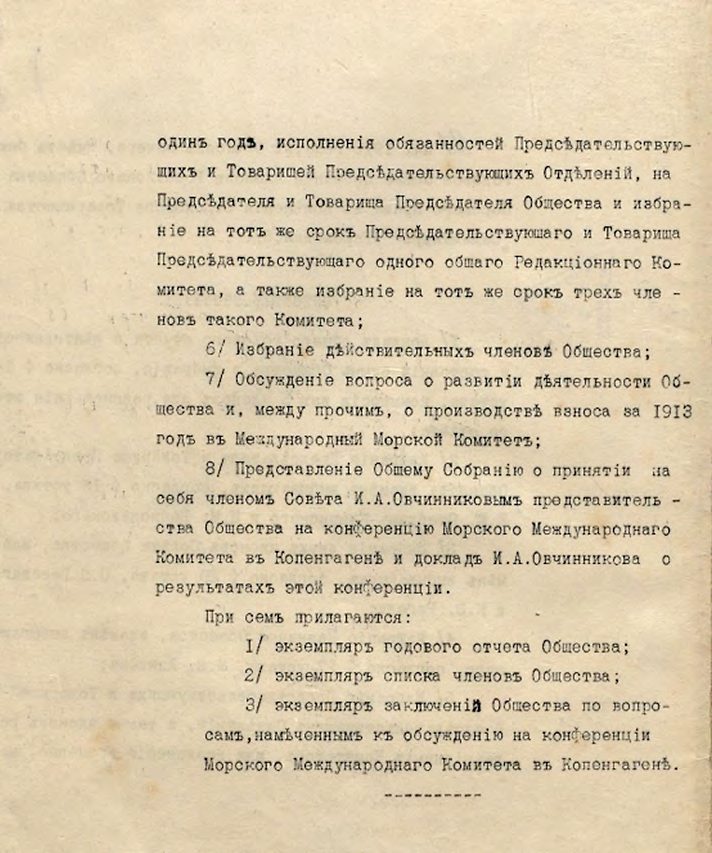
– The re-election of branch chairs, their deputies, and members of the editorial committees — or, alternatively, a one-year interim assignment of their duties to the existing chair and deputy.
– The admission of new full members to the Society.
– A discussion on expanding the Society’s work and on payment of the 1913 membership fee to the CMI.
– A formal presentation to the general meeting of Council member Ovchinnikov’s willingness to represent the Society at the upcoming CMI Conference in Copenhagen, along with his report on the conference outcomes.
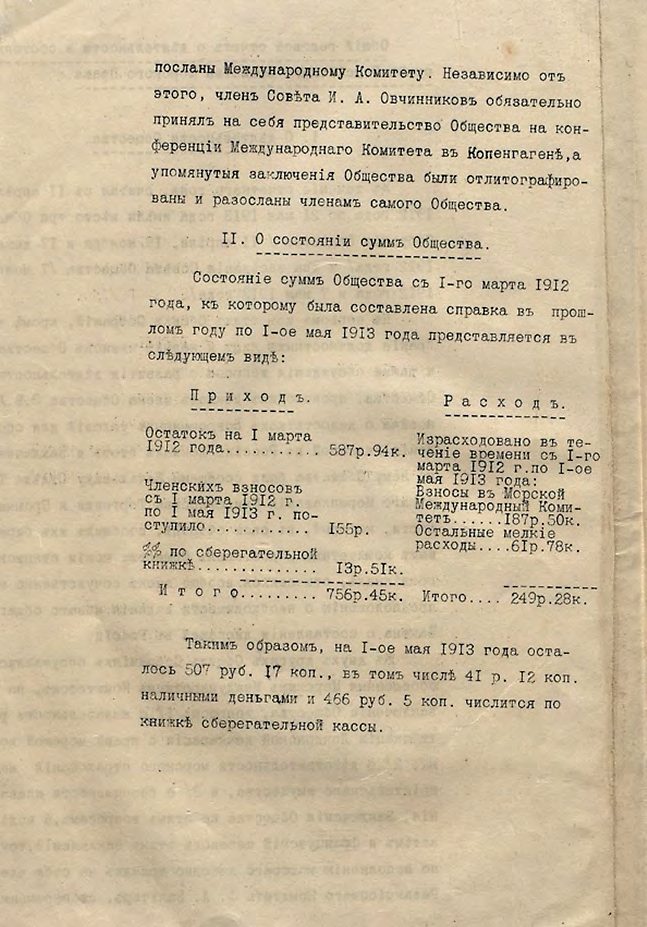
The meeting then proceeded to hear the treasurer’s report on the Society’s financial standing.
Income
Balance as of March 1, 1912 – 587.94 rubles
Membership dues received between March 1, 1912, and May 1, 1913 – 155.00 rubles
Interest earned on savings account – 13.51 rubles
Total income: 756.45 rubles
Expenditure
Expenses incurred from March 1, 1912, to May 2, 1913:
Contribution to the CMI – 187.50 rubles
Miscellaneous minor expenses – 61.78 rubles
Total expenditure: 249.12 rubles
“As of May 1, 1913, the remaining balance amounts to 507.15 rubles, including 41.12 rubles in cash and 466.5 rubles held in the savings account,” the compilers of the report wrote.
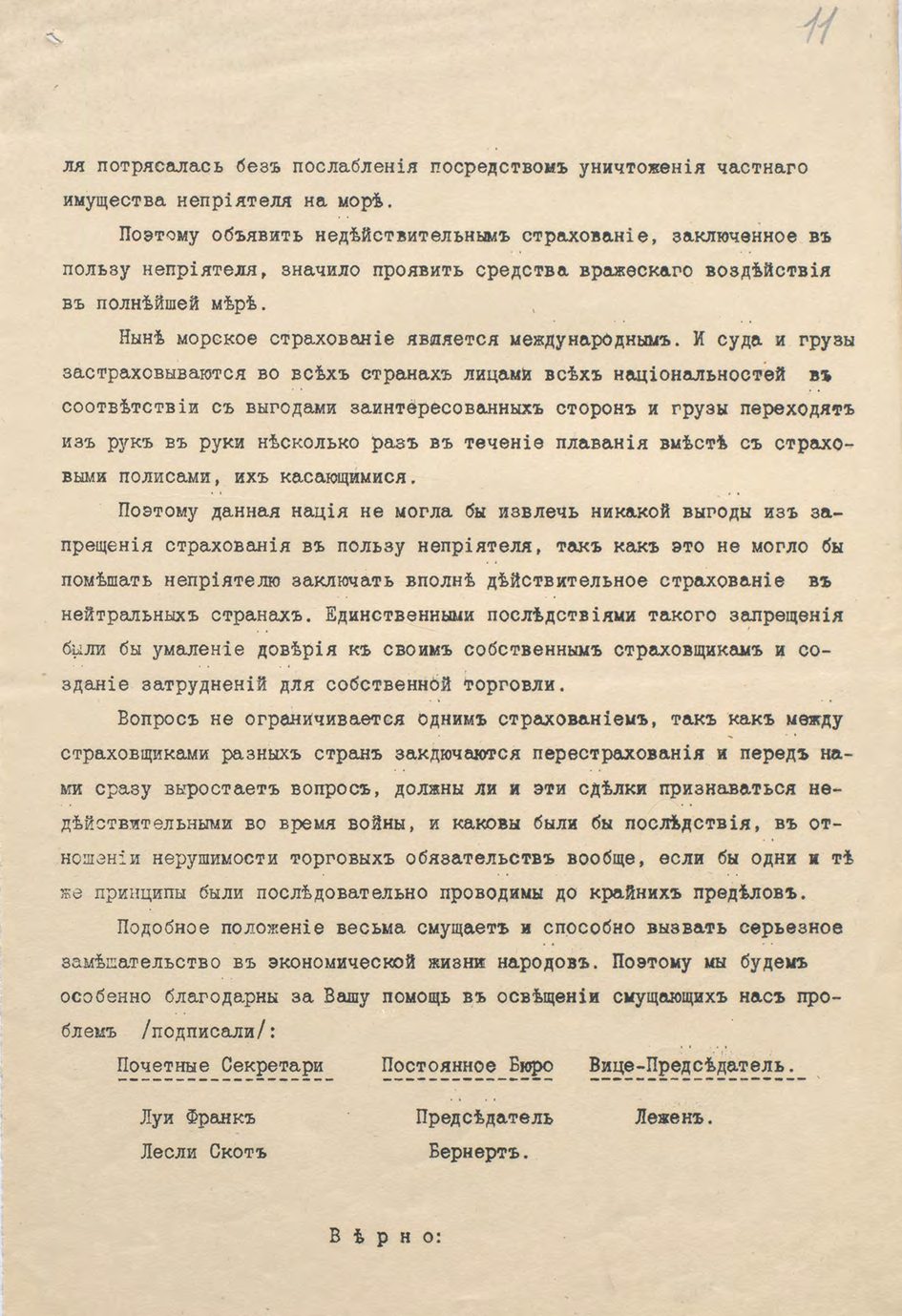
The annual report was accompanied by the previously mentioned memorandum37 responding to the list of questions circulated by the CMI38. In emphasizing the critical importance of maritime safety, the CMI pointed to the recent disaster of the liner Titanic, which had occurred just three months earlier.
“The Titanic tragedy exposed the inadequacy of existing laws designed to safeguard human life at sea and protect property from maritime hazards. The profound shock it caused gave rise to a universal call for government intervention. This is, by its very nature, an international issue,” the CMI stated and added that no other consultative body was better qualified than the CMI to advise on the matter.
“Thanks to our influential national associations, which are by their nature truly representative, every country will be in a position to send a delegation of experts who can take part in the debate with both authority and thoughtfulness,” the CMI asserted.
A list of questions was sent to the national societies, along with an appeal to consider both the safety of seafarers and the practical realities of the merchant marine when preparing their responses.
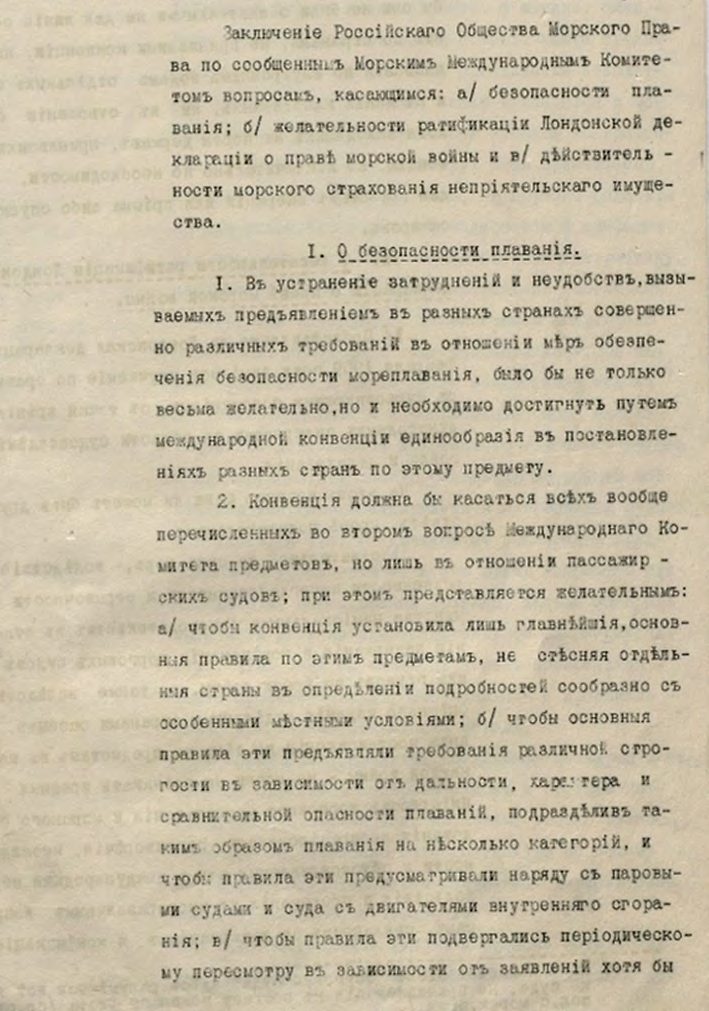
Society’s Conclusions on the Questions Raised by the CMI Circular of July 15, 1912
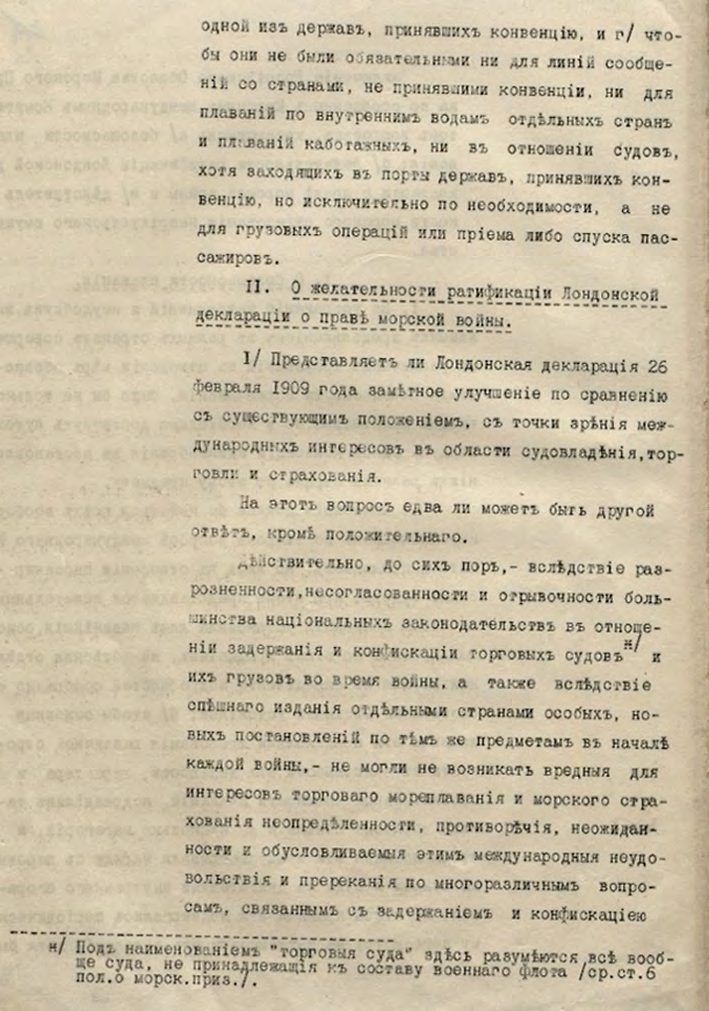
Society’s Conclusions on the Questions Raised by the CMI Circular of July 15, 1912
Another issue raised by the CMI concerned maritime commerce. Drawing on international events from the past two years, the Committee observed that private property at sea remained far less protected than on land. Moreover, widely accepted policies regarding the rights of inspection and seizure, as well as the definitions of absolute and conditional contraband, varied widely from one country to another. The London Naval Conference of 1909 had produced the Declaration on the Laws of Naval War, which aimed to resolve disputes over contraband, blockades, the capture of vessels, and prize law39. However, not a single government had ratified the Declaration, which, in turn, stalled the establishment of the International Prize Court.
Given the circumstances, the CMI stressed that it would be useful for governments to receive the Committee’s consolidated opinion — reflecting the views of national associations — on whether ratification of the Declaration should proceed without further delay.
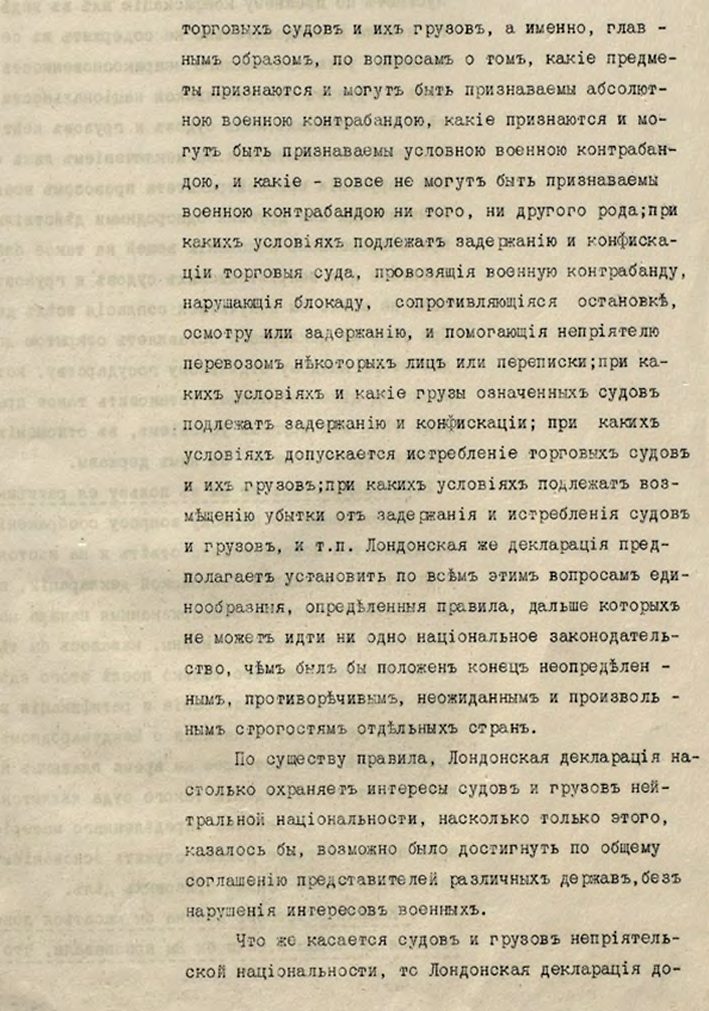
Society’s Conclusions on the Questions Raised by the CMI Circular of July 15, 1912
The CMI also raised a related question, which fell outside the Declaration’s formal scope but was closely tied to commercial maritime interests: whether, in wartime, nationals of a belligerent state may lawfully insure enemy property.
The Russian Maritime Law Society responded to these questions with careful consistency.
In the opinion of its members, the Declaration provided a reasonable degree of protection for vessels and cargo flying neutral flags — so far as such protection could be established through international consensus without undermining legitimate military concerns.
The Society also noted that only once the Declaration had been ratified would the “Great Powers” be able to sign and ratify the Convention on the International Prize Court. At that time, the main obstacle remained the lack of a sufficiently well-defined body of substantive law to serve as a foundation for adjudicating prize cases.
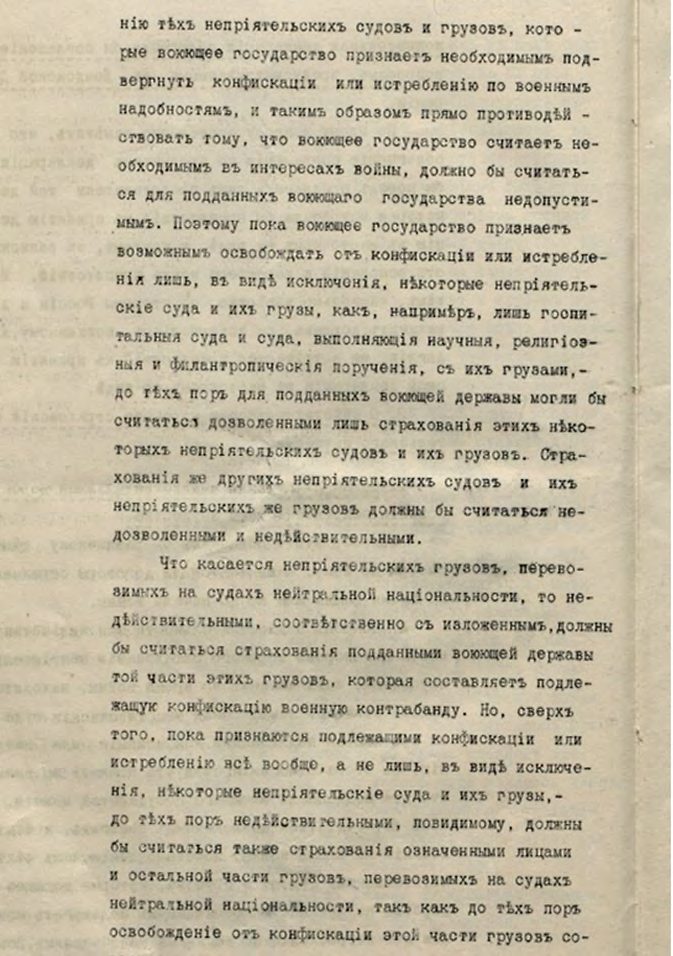
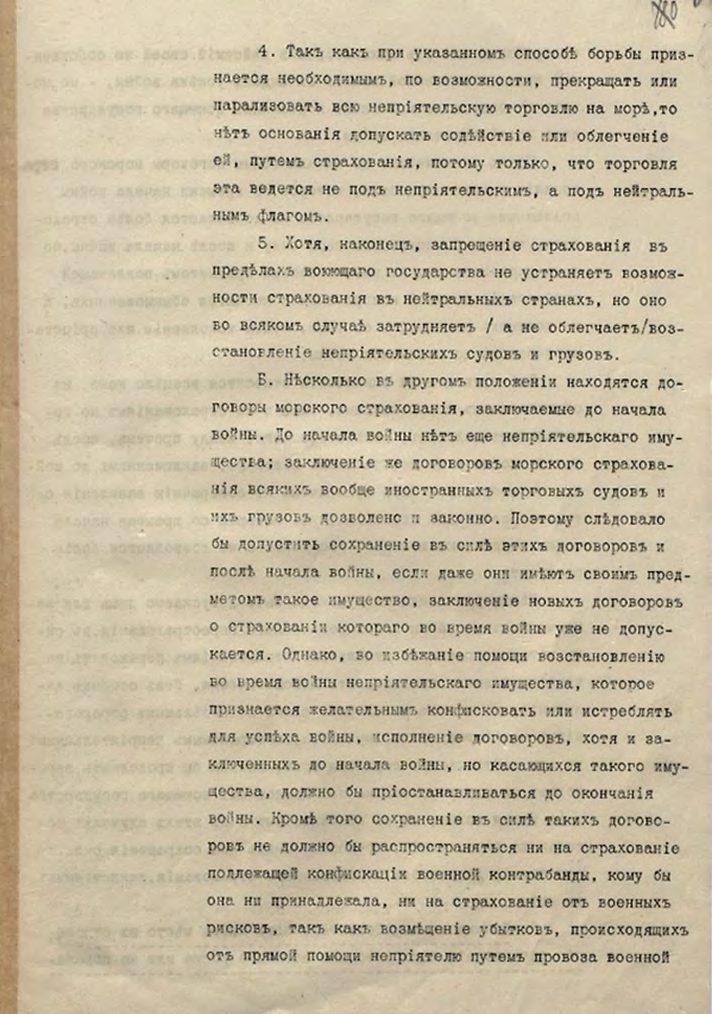
The Society then addressed the question of whether marine insurance covering enemy property could be considered valid. In its view, the answer depended on the date on which the contract was signed — that is, whether it was concluded before or after the outbreak of war.
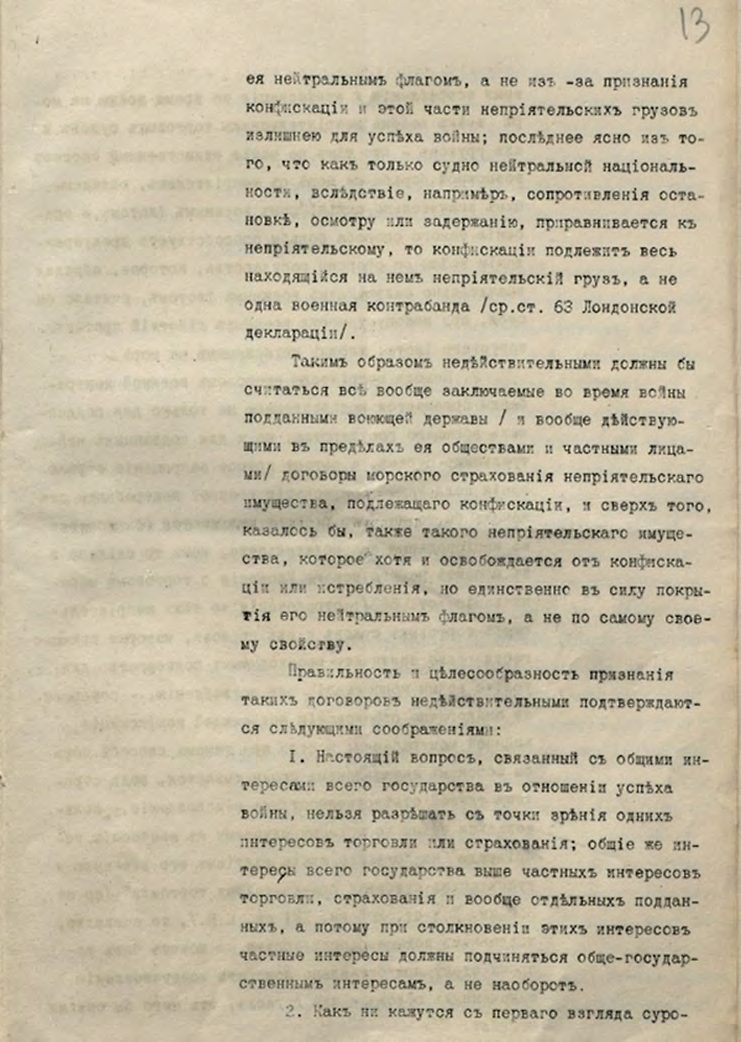
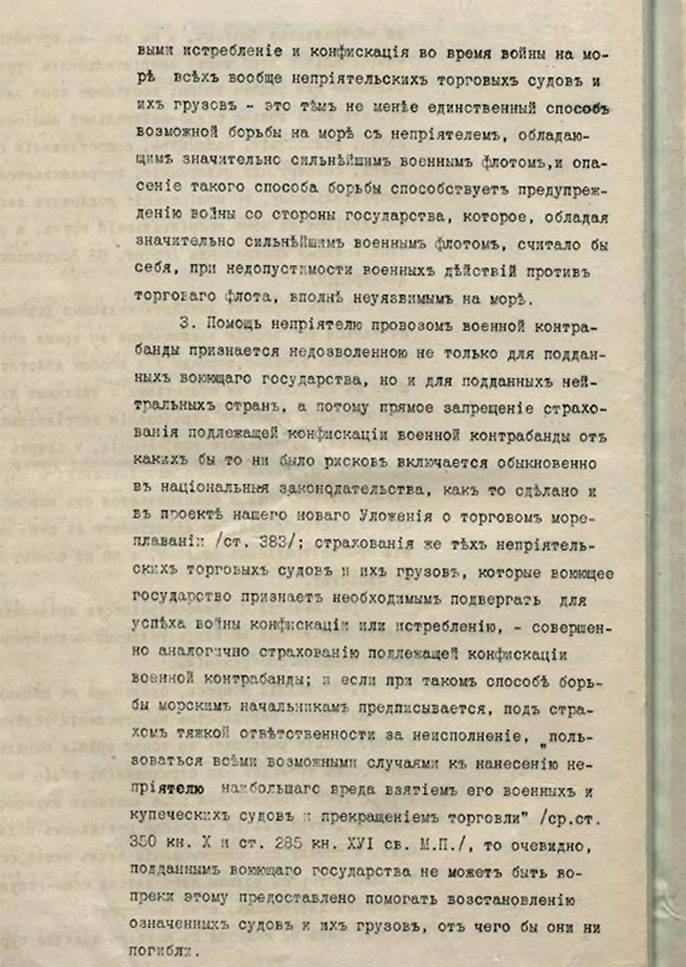
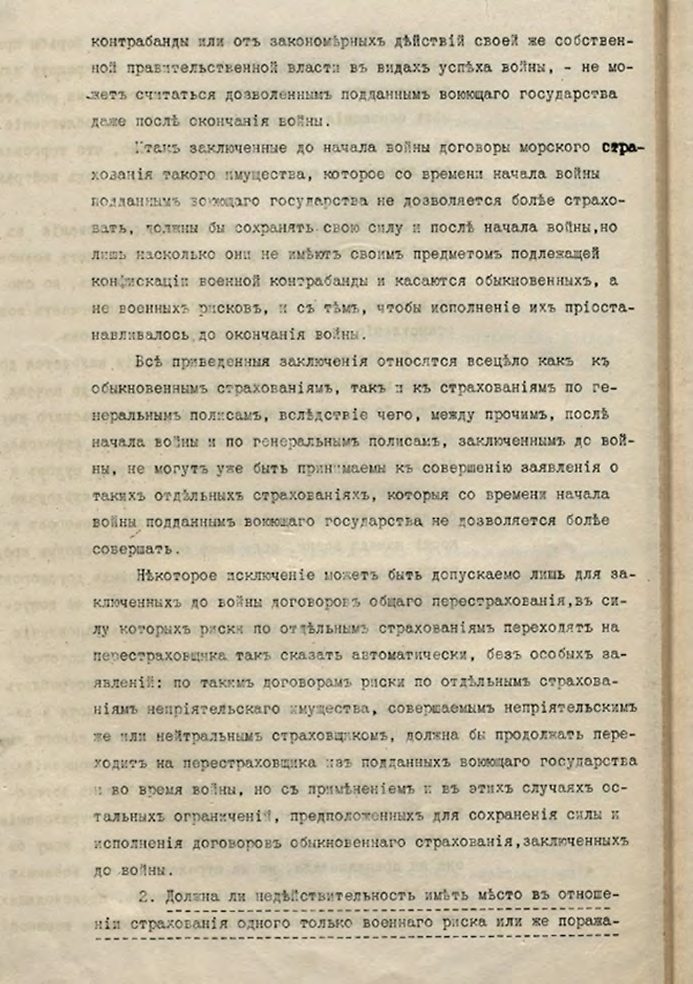
Accordingly, any marine insurance contracts entered into during wartime by subjects of a belligerent state — or by companies and individuals operating within its jurisdiction — covering enemy property subject to confiscation should be regarded as invalid. The same would apply to enemy property that is exempt from confiscation solely ‘because it sails under a neutral flag, rather than by the nature of the cargo itself’40.
As for pre-war insurance contracts, the Society clarified that, prior to the outbreak of hostilities, “enemy property” did not yet exist in legal terms; therefore, it was lawful to conclude marine insurance contracts for any foreign merchant vessels and their cargo. “It would be advisable to keep such contracts in force even after the outbreak of war, even if their subject is property which, in time of war, would no longer be insurable under new agreements,”41 the Society wrote. However, the Society stressed one important caveat: in order to avoid assisting the enemy by restoring property that ought to be confiscated or destroyed for military reasons, the enforcement of these contracts should be suspended until the end of the war. Their continued validity should not extend to war-risk coverage for military contraband intended for confiscation.
With regard to navigational safety, the Society emphasized that, in order to eliminate the inconvenience caused by varying national safety requirements, a unified international convention should be established. This Convention should apply only to passenger ships and set out only the core standards, leaving states free to determine the specific details in accordance with their particular local conditions and to impose additional requirements based on the distance, nature, and risks of the voyages, which were to be divided into several categories.
The Society noted that the provisions of the convention should not be binding in relation to lines of communication with countries that have not adopted the convention, to navigation on inland waterways, or to vessels entering the ports of convention-adopting states out of necessity.
Another suggestion was to allow for regular revision of the Convention, if requested by any of the signatory nations.
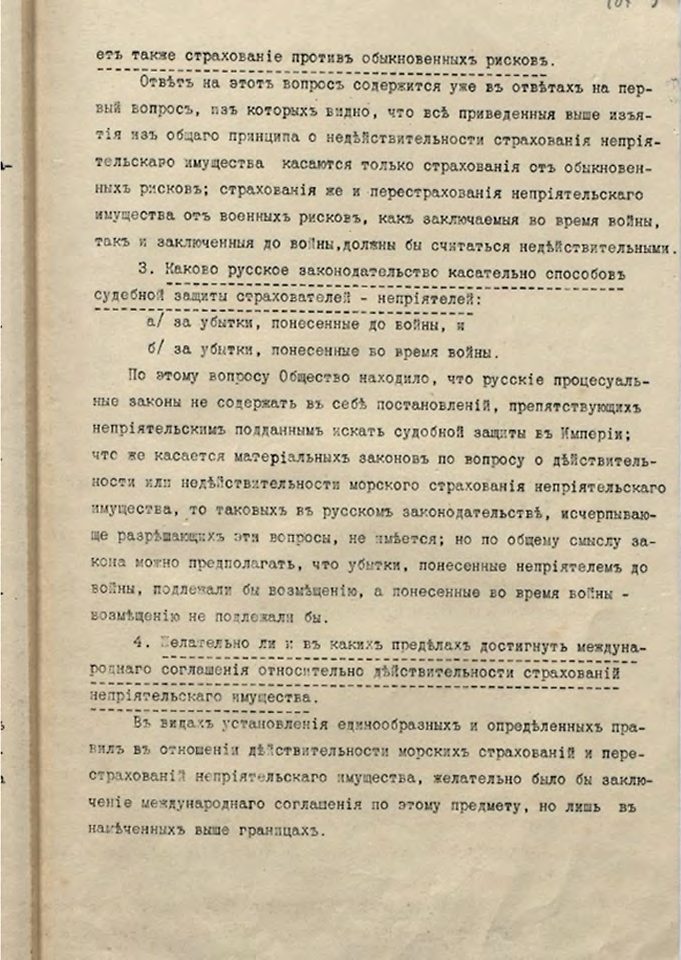
The final remarks included commentary on Russian legislation concerning the legal remedies available to enemy insurers for losses incurred before and during wartime. The Society noted that Russian procedural law does not prohibit enemy nationals from seeking legal protection in the Empire. However, it acknowledged that comprehensive substantive legislation on the validity of marine insurance for enemy property had yet to be enacted. As a general principle of law, the Society added, losses sustained by enemy parties prior to the outbreak of war are eligible for compensation, whereas those incurred during wartime are not.
These positions, as outlined in the Society’s responses to the CMI’s questionnaire, were presented and defended by its delegates at the 1913 Copenhagen Conference — a subject covered in greater detail in the following section.
Information on at least thirty general meetings of the Society’s members has yet to be uncovered. Unfortunately, this is not an easy task: materials — whether entire case files or individual documents — directly or indirectly related to the Maritime Law Society are not stored in a single, unified collection. Instead, they are scattered across disparate archives, varying in both subject matter and geographical location.
Seal of the Russian Maritime Law Society
For example, the materials from one of the Society’s annual general meetings — including its official opinion on questions raised by the CMI — were found in the Arkhangelsk archive of the Northern Steamship Company, while the CMI circular itself was located in the Russian State Naval Archive in Saint Petersburg.
The Society’s Charter, meanwhile — published in 1911 by order of the General Directorate for Merchant Shipping and Ports (six years after that body had ceased to exist) — was discovered in the holdings of the Russian National Library. The Society’s meeting minutes were located in the Central Naval Archive, filed among the records of the Maritime Excursions Committee.
Incidentally, after a long search, the Society’s official seal was discovered quite by chance — at an auction in 2022. The seller, a private collector, had no information about the Society itself.
This suggests that other materials may yet surface – not only the missing records of the Society’s meetings, but also more specific documents, such as those related to its scholarly and educational activities, which were listed among its core objectives in the charter.
5. Participation of the Society in the CMI Activities
The first CMI conference in which the Society participated as a full-fledged member was held in Venice from September 25 to 28, 1907. The Russian delegation consisted of Rukhlov, the Society’s chairman; Karnitsky, deputy chairman; and Grevs, secretary.
Taube, Ovchinnikov, and Martens were designated as CMI members representing Russia.
The conference participants discussed three issues: 1) limitation of shipowners’ liability; 2) maritime mortgages and liens, and 3) conflict of laws in cargo shipping.
Grevs presented a report on behalf of the Maritime Law Society on the draft convention under the second agenda item42.
The speaker noted that, to strengthen the international significance of maritime mortgages, it was necessary to introduce mandatory registration of mortgage rights in ship certificates or any other equivalent document.
Turning to the question of the priority of maritime liens, Grevs noted that while there may be a preference for mortgage loans, it is essential not to exclude from the category of privileged claims those arising from maritime casualties, significant loans contracted by the captain, or other necessary expenses incurred by the captain during a voyage. He explained that, regardless of how advanced modern maritime commerce and international shipping had become, it was impossible to be certain that such borrowings would not still be required in practice.
According to the Society, depriving claims arising from such borrowings of their privileged status would effectively eliminate the possibility of using this form of credit. In other words, by preventing a captain from repairing the vessel and continuing the voyage, it would ultimately harm the very creditors whose interests the Paris Commission sought to protect by removing such claims from the privileged category.
Additionally, the Society did not support changing the method of calculating the limitation period. It had been proposed to supplement the starting point with the moment “when the creditor could act.” Members of the Society found this definition vague, believing it could lead to an excessive extension of the one-year limitation period and thereby undermine the validity of claims. The Society considered it more effective to slightly extend the limitation period — despite its already sufficient length — while calculating it from a clear and indisputable moment when the creditor’s right of action arose.
In discussing the impact of the transfer of vessel ownership on the existence of maritime liens and mortgages, the Society recommended that conference participants — regardless of national laws — find a way to ensure that such transfers do not affect the rights of lien holders and mortgage creditors. According to the Society, the rights of privileged creditors would be protected if the convention included a provision stating that a lien duly certified under national law remains valid upon the transfer of vessel ownership.
The second CMI conference attended by the Society took place two years later in Bremen, from September 22 to 25, 1909. Participants discussed conflict-of-law issues related to freight, compensation in cases of death or injury, and the registration and publication of maritime mortgages and liens.
The Society was represented by delegates Rukhlov and Karnitsky. Meanwhile, the group of Russian CMI members — following the withdrawal of Martens — welcomed a new member: Sigismund Lewis, an attorney from Saint Petersburg.
The CMI bulletin contains no record of any presentations by Russian delegates on the conference agenda. The Society is also absent from both the Review of National Associations’ Reports on Compensation for Personal Injuries and the Review of Associations’ Responses on the Draft Convention on Freight Carriage. From this, it can be concluded that the Society did not submit any opinions on agenda topics prior to the conference and did not participate actively in their discussions.
The third conference attended by the Society was held in Paris from October 9 to 13, 1911. The composition of the Russian delegation had change and now included the Society’s new chairman, E.E. Steblin-Kamensky; his deputy, Benislavsky; and the treasurer, Linden (listed in CMI documents as Head of the Merchant Shipping Department). The list of Committee members from Russia remained unchanged.
Participants of the Paris conference discussed the limitation of shipowners’ liability in cases of loss of life or personal injury, as well as issues related to freight. They emphasized that chartering and freight matters required regulation specifically at the international level43. This applied not only to freight itself but also to practical formalities such as demurragе44 and through bills of lading45.
However, the Russian delegates, as at the previous conference, did not participate actively in discussions on these topics, nor did they deliver any reports related to the conference agenda.
The reasons that prevented the Society from participating in discussions of maritime issues during that period remain unknown.
At the subsequent CMI conference in Copenhagen (May 13–17, 1913), the Committee and national associations actively discussed the 1909 London Declaration concerning the Laws of Naval War, including the necessity and prospects of its ratification. Other topics covered freight, maritime safety, and the insurance of enemy property at sea.
The composition of the Russian delegation remained unchanged at this conference, which was the last CMI conference attended by the Society.
During discussions on the London Declaration, conference participants noted that even at that time — prior to any formal ratification — the Declaration had already exerted significant influence on public opinion. This was attributed to the fact that it had been developed by a distinguished group of lawyers, statesmen, and seafarers. Consequently, the very act of codifying international custom had endowed it with substantial authority.
For instance, during the Italo-Turkish War, Russia relied on the Declaration to lodge a strong protest against any obstruction to its grain trade in the Black Sea. Italian prize courts also based their decisions on the provisions of the Declaration during the same conflict, and France cited the document when protesting the seizure of French vessels46.
The Russian Maritime Law Society likewise recognized the importance of the Declaration — even prior to its ratification — for international interests in business, trade, and insurance.
In addition to the previously stated arguments, the delegates noted that national laws regarding the seizure of merchant ships and cargoes during wartime differ significantly. Moreover, at the outbreak of war, states are often compelled to hastily enact new regulations addressing the same issues. As a result, the lack of precise and uniform rules negatively affects the interests of shipping and marine insurance and creates tensions in international relations.
At the same time, the Declaration addresses contentious issues such as determining which items may be classified as absolute or conditional contraband, under what conditions merchant vessels carrying contraband can be arrested, and when shipowners are entitled to compensation for losses resulting from such seizures.
On these and other issues, the Society maintained that the Declaration was intended to establish uniform and precise rules, the stringency of which should not be exceeded by any nation’s domestic legislation. “Upon ratification, this Declaration should put an end to the harsh, contradictory, unexpected, and arbitrary measures frequently adopted by belligerent countries at present,”47 the Society asserted.
However, the Declaration was not supported by England, and as a result, the document was never ratified.
Addressing the issue of marine insurance for enemy cargo, the Society noted that the validity of such contracts is directly linked to the broader interests of the belligerent state. Therefore, this matter cannot be approached solely from a commercial standpoint. “The interests of the entire country outweigh those of commerce, insurers, and private individuals as a whole, and in cases where these interests conflict, private interests must be subordinated to those of the state,”48 the Society emphasized.
The Society concluded that all marine insurance contracts concluded during wartime by subjects of a belligerent nation, covering enemy cargo subject to confiscation, should be considered null and void49.
In the Society’s view, although the destruction and confiscation of all enemy merchant vessels and their cargoes may at first appear excessively harsh, such measures are the only effective means of countering an adversary with naval superiority. Moreover, the mere possibility of such actions could, at times, deter a country – one that considers itself invulnerable at sea due to its naval dominance – from declaring war50.
Commenting on the issue of maritime safety, the Society considered it desirable to convene an international conference to develop fundamental rules in this area, using the findings of national associations and the provisions of the maritime laws of seafaring nations as the foundation for its work51.
This proposal was supported in a speech by Ovchinnikov, who added that the focus of such a conference could include the development of fundamental regulations on lifesaving equipment, wireless telegraphy, and the establishment of an International Bureau for Maritime Safety.
6. Termination of the Society’s Activities. Soviet and Russian Representation in the CMI
The last mention of the Russian Maritime Law Society as a national delegation to the CMI appears in the bulletin of the Antwerp conference held in July 1921, after the end of the First World War. However, the list of participants provided there reflected the membership as of the Copenhagen conference of 1913. The names of CMI members from Russia — Taube, Ovchinnikov, and Lewis — were last recorded in the bulletin of the Amsterdam conference in 1949, this time in the section listing deceased members52.
Following the Revolution of 1917, the Society ceased its activities. The writings and contributions of Russian maritime lawyers during their brief yet active participation in the CMI were largely lost as a result of the Great October Socialist Revolution, the Civil War, repressions, and the Second World War.
Russian participation in the CMI was suspended until the 1960s. During the early decades of the Soviet period, legal scholars showed little interest in issues of maritime law.
Nevertheless, the USSR had to participate in international trade, which meant ratifying certain international conventions and resuming cooperative efforts with other maritime powers.
In 1968, the Soviet Maritime Law Association was established by representatives of seaports, fishing cooperatives, research institutions, and universities. A year later, the Association was admitted to the CMI. At that time, the Association was chaired by Andrei Konstantinovich Zhudro, who led the Soviet delegation at the Tokyo Conference in 1969.
“The national associations, members of the CMI — now numbering thirty-one and scattered throughout the world — are the worker bees in our hive. I welcome the thirty-first; it is quite significant: the joining of the Soviet Association will add weight and dimension to our movement,” said Albert Lilar, President of the CMI, greeting the new Society53.
Subsequently, after the dissolution of the USSR, the Soviet Maritime Law Association was reorganized into the Association of International Maritime Law. It retained its membership in the CMI until 2017, when it was expelled from the Committee due to prolonged non-payment of membership fees. As a result, Russian maritime lawyers and experts were effectively left without representation in international maritime relations.
Charter of the Russian Maritime Law Society
However, already in 2018, the Russian Maritime Law Association (RUMLA) was established. Its founders–practicing maritime lawyers Konstantin Krasnokutskiy, Konstantin Putrya, and Filipp Vagin — set out to revive Russia’s presence in global maritime law. Over the years, the Association’s membership has grown to include dozens of Russian practicing attorneys and legal scholars specializing in maritime law. On September 30, 2021, RUMLA became Russia’s official representative in the CMI, having paid off the previous Association’s debt — successfully continuing the work initiated 120 years earlier by the Russian Maritime Law Society.
7. Epilogue. How This Article Was Prepared
Our research was supported by documents discovered in Russian archives and libraries, as well as materials obtained from the website of the Comité Maritime International. These sources provide evidence concerning various periods in the existence of the Russian Maritime Law Society and the activities of its members. Particularly valuable materials were found in the Russian State Historical Archive, The National Library of Russia, the Central Naval Archive, and the Northern Steamship Company. Of special research interest are the files of the Main Directorate of Merchant Shipping and Ports.
Research is still ongoing, and there is confidence that in the near future it will be possible to provide a more detailed account of the activities of the Russian Maritime Law Society.
The article includes photocopies of archival documents that were discussed in detail.

Notes